


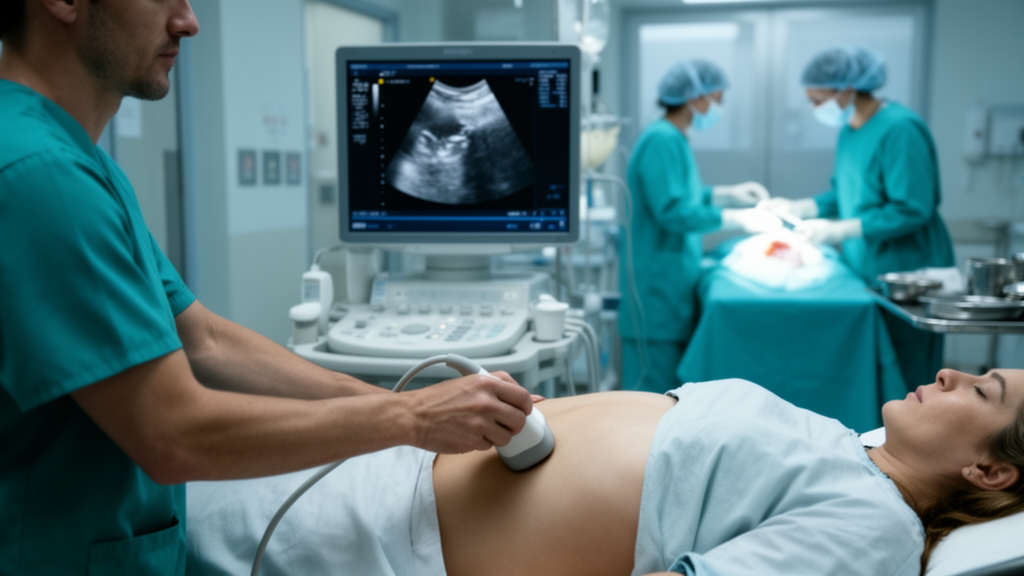
Adults undergoing emergency laparoscopic appendectomy may benefit from a simple preoperative step: a bedside ultrasound scan of the stomach. A retrospective cohort study published in BMC Medical Imaging compared 80 patients whose anaesthetic planning was guided by gastric antral ultrasound with 78 patients assessed using conventional fasting-history and clinical criteria, and found markedly lower documented rates of perioperative nausea and vomiting and reflux or aspiration events in the ultrasound group.
In the ultrasound group, clinicians graded gastric contents using the Perlas system and calculated the antral cross-sectional area from the anteroposterior and craniocaudal diameters. A cross-sectional area threshold of 340 mm² was built into a predefined risk-stratification algorithm that determined which induction strategy the anaesthetic team would use. The study’s authors describe this as an integrated protocol rather than a standalone measurement.
The recorded differences were substantial. Perioperative nausea or vomiting was documented in 1 of 80 patients (1.25%) in the ultrasound group versus 9 of 78 (11.54%) in the control group. Reflux or aspiration events occurred in 1 of 80 patients (1.25%) compared with 8 of 78 (10.26%). Haemodynamic fluctuations were also smaller in the ultrasound group. Because these figures come from a retrospective design, the authors treat them as associations rather than proof of causation.
The workflow indicators pointed in the same direction. Preoperative assessment, surgical waiting time, anaesthetic induction, post-anaesthesia care unit stay, time to first oral intake, and total hospital stay were all shorter in the ultrasound group, and anaesthetic induction-related adverse events were less frequent, a pattern the authors link to more individualised anaesthetic planning. Not every outcome moved in parallel, however: pulmonary complications within 72 hours of surgery did not differ significantly between the two groups.
The study has important limitations that the authors state plainly. It was conducted at a single centre, and the retrospective design means patients were not randomly allocated to the two assessment strategies. Temporal and clinical confounders could have contributed to the observed gaps, and the authors call for prospective multicentre studies with standardised operator training, formal measurement-reliability assessment, and adjustment for such confounders before causal conclusions can be drawn. Within those constraints, the study reports that gastric ultrasound-guided aspiration-risk stratification was associated with more individualised anaesthetic planning and favourable perioperative process and safety outcomes in this population.
Subject of Research: Gastric ultrasound for aspiration-risk assessment in emergency laparoscopic appendectomy
Article Title: Ultrasound-guided gastric antral cross-sectional area assessment for anaesthetic management in emergency laparoscopic appendectomy: a retrospective cohort study
Article References: Wu, T., & Liu, X. (2026). Ultrasound-guided gastric antral cross-sectional area assessment for anaesthetic management in emergency laparoscopic appendectomy: a retrospective cohort study. BMC Medical Imaging. https://doi.org/10.1186/s12880-026-02949-1
Image Credits: AI Generated
DOI: 10.1186/s12880-026-02949-1
Keywords: gastric ultrasound, antral cross-sectional area, aspiration risk, laparoscopic appendectomy, anaesthesia, retrospective cohort, Perlas grading, perioperative outcomes, point-of-care ultrasound, airway safety, Ultrasound-guided, gastric
Cite Scienmag News
Ophelia Keating. (October 23, 2026). Bedside Stomach Ultrasound Linked to Fewer Aspiration Events in Emergency Appendectomy. Scienmag. https://scienmag.com/bedside-stomach-ultrasound-linked-to-fewer-aspiration-events-in-emergency-appendectomy/
Ophelia Keating. "Bedside Stomach Ultrasound Linked to Fewer Aspiration Events in Emergency Appendectomy." Scienmag, 23 October 2026, https://scienmag.com/bedside-stomach-ultrasound-linked-to-fewer-aspiration-events-in-emergency-appendectomy/. Accessed 23 October 2026.
Ophelia Keating. "Bedside Stomach Ultrasound Linked to Fewer Aspiration Events in Emergency Appendectomy." Scienmag. October 23, 2026. https://scienmag.com/bedside-stomach-ultrasound-linked-to-fewer-aspiration-events-in-emergency-appendectomy/


