

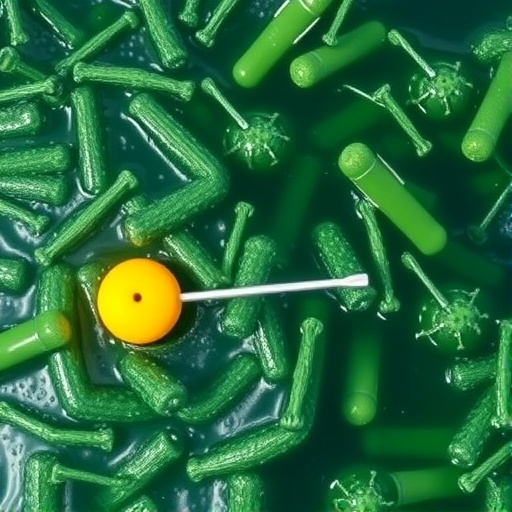
In a groundbreaking advance in the battle against the ecological and health hazards caused by harmful algae blooms, a team of researchers from the University of Toledo have innovated a novel, self-sustaining buoy system that dispenses algaecide with remarkable efficiency. This cutting-edge technology promises to revolutionize the way toxic cyanobacterial outbreaks are managed in aquatic environments, providing a scalable, low-maintenance solution that could mitigate the dangerous consequences of water contamination on both human populations and wildlife.
Algae blooms, characterized by rapid proliferation of photosynthetic microorganisms, often manifest as a shimmering green layer on water surfaces, capturing the eye but masking a darker threat beneath. Particularly, cyanobacteria—a subgroup notorious for releasing potent toxins—pose significant risks when their concentrations spike, jeopardizing drinking water safety and ecosystem health. The magnitude of this issue was vividly illustrated in 2014 when a massive bloom in Lake Erie rendered tap water unsafe for hundreds of thousands. These events underscore an urgent need for interventions that can preemptively control bloom formation and spread.
The new buoy system is ingeniously designed for simplicity and endurance. Constructed from polyvinyl chloride (PVC) piping, the devices are available in multiple sizes suited for various deployment environments. Their distinctive “T” or cross-shaped configuration accommodates a hydrogel disk at the openings, which acts as a controlled release medium allowing slow and steady diffusion of hydrogen peroxide-based algaecide into the surrounding water. This hydrogel-mediated diffusion mechanism is instrumental in sustaining algicidal activity over extended periods, drastically reducing the need for repetitive and labor-intensive applications.
One of the most innovative aspects of this system is the built-in feedback mechanism embedded into the buoy’s physical design. As the algaecide reservoir depletes, the buoy’s buoyancy changes, causing it to tilt or fall to one side. This visual cue provides users with an immediate and straightforward indication that refilling is required, enabling timely maintenance without sophisticated monitoring equipment. Such a feature is a practical boon for remote or resource-limited sites where constant supervision is challenging.
Experimental evaluation of the buoys demonstrated impressive efficacy against cyanobacteria. Small-sized units loaded with the hydrogen peroxide solution were tested in controlled settings using cyanobacteria-spiked water samples from Lake Erie. Over the course of a two-week period marked by daily partial water renewals to mimic natural conditions, researchers observed near-total cyanobacterial eradication within just seven days. Importantly, this treatment did not significantly harm non-target microbial communities, suggesting a selective mode of action that preserves overall aquatic microbial diversity.
The authors estimate that their buoys maintain effective algaecide release through at least four distinct release cycles, each spanning approximately 35 days. This sustained-release profile indicates that deployment can be relatively infrequent while still providing continuous bloom suppression. Such longevity is a critical improvement over current algaecide applications that commonly require recurrent dosing, which increases operational costs and environmental disturbance.
While promising, the research team acknowledges areas for future development. One challenge is preventing biofilm formation and microbial colonization on the buoy surfaces themselves, which could impede diffusion or reduce efficacy over time. Innovative coatings or material modifications may be necessary to address this. Additionally, comprehensive field trials are needed to validate performance in diverse natural settings, accounting for varying hydrodynamics, nutrient loads, and biological communities.
If these hurdles are overcome and the technology scaled appropriately, the impact could be monumental. Early and targeted intervention against harmful algal blooms will help safeguard drinking water supplies, protect aquatic ecosystems, and reduce economic losses linked to fisheries and recreation. The reduction of frequent manual algaecide application also aligns with sustainability goals by cutting chemical usage and labor demands.
Hydrogen peroxide-based algaecides, noted for their rapid breakdown and minimal environmental persistence, are particularly well suited to this application. Their integration within a controlled-release hydrogel matrix inside a buoy represents a clever adaptation of chemical principles to environmental engineering. This interdisciplinary approach exemplifies how chemistry, microbiology, and materials science can converge for practical environmental solutions.
The team behind this innovation—comprising Umberto Kober, Hanieh Barikbin, Youngwoo Seo, Yakov Lapitsky, and colleagues—has secured funding through the U.S. Army Corps of Engineers and collaborated with SePRO Corporation, which supplied the algaecide. Notably, several members have filed patent applications to protect the core intellectual property of this buoy system, indicating their commitment to advancing the concept toward commercial and real-world utility.
The broader scientific community and stakeholders in water resource management will undoubtedly watch closely as this technology progresses. Its potential to transform the approach to managing harmful algae blooms aligns with increasing global concerns about freshwater quality, climate change-induced ecological shifts, and public health protection. Innovations like these illuminate a path forward where smart chemical delivery systems replace indiscriminate treatments, reducing collateral impacts while enhancing control precision.
In conclusion, the development of bacteria-busting buoys that autonomously release algaecide marks a significant milestone in environmental chemistry and water treatment. By uniting sustained chemical diffusion, user-friendly design cues, and proven efficacy against toxic cyanobacteria, this system stands poised to redefine harmful algae bloom management. Continued research and refinement will be essential, but this strategy holds incredible promise for mitigating one of the 21st century’s most pressing water-quality challenges.
Subject of Research: Controlled-release algaecide buoys for targeted cyanobacteria bloom mitigation
Article Title: Stopping algae blooms with bacteria-busting buoys
News Publication Date: 4-Mar-2026
Web References: 10.1021/acsestwater.5c01257
Image Credits: Adapted from ACS ES&T Water 2026, DOI: 10.1021/acsestwater.5c01257
Keywords
Chemistry, Algae, Bacteria, Cyanobacteria, Algaecide, Hydrogel, Environmental Engineering, Water Treatment, Toxic Algal Blooms, Hydrogen Peroxide, Controlled Release, Water Quality


