


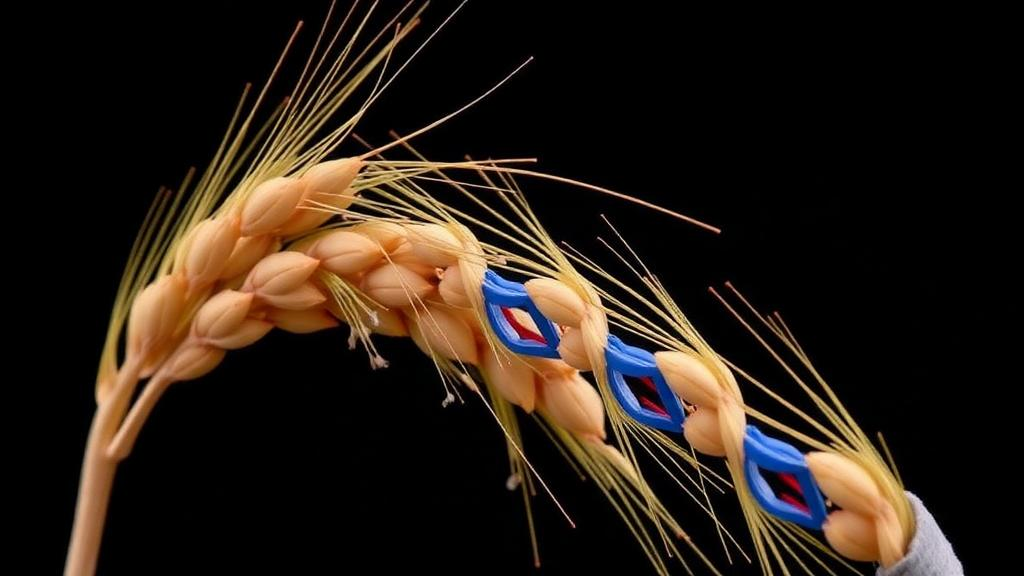
Barley is one of humanity’s oldest crop plants and remains a cornerstone of the global food system, providing grain, animal feed, and the malt that underpins the brewing industry. Yet even this famously hardy cereal suffers when drought, salt, waterlogging, or viral disease strikes its fields. Now, a team of researchers has delivered the first comprehensive genome-wide portrait of a gene family that sits at the heart of how barley copes with such pressures: the carotenoid cleavage oxygenases, or CCOs. Writing in Molecular Biology Reports, the group led by Parshant Kumar Sharma and Muhammad Shafiq Shahid identified eleven CCO genes in barley, classified them into three subfamilies, and traced their expression across tissues and stress conditions, offering plant breeders a shortlist of candidate genes for engineering tougher crops.
The CCO enzymes are non-heme iron-dependent proteins that perform a chemically elegant trick: they slice carotenoids, the isoprenoid pigments that give plants their yellow, orange, and red hues, at precise positions along their carbon backbones. This oxidative cleavage generates apocarotenoids, a diverse class of molecules that act far beyond mere pigmentation. Some apocarotenoids are hormones in their own right; others serve as signaling molecules or volatile compounds that influence aroma, pollinator attraction, and defense against pathogens and herbivores. Because these products touch nearly every aspect of plant life, from seed dormancy to root architecture, the enzymes that make them have long been viewed as promising targets for crop improvement.
The family divides into two major branches based on sequence similarity and catalytic function: the carotenoid cleavage dioxygenases (CCDs) and the 9-cis-epoxycarotenoid dioxygenases (NCEDs). The NCEDs hold particular significance because they catalyze the rate-limiting step in the biosynthesis of abscisic acid, the hormone that orchestrates seed dormancy, stomatal closure, and drought tolerance. The CCDs, meanwhile, feed the production of strigolactones, which regulate shoot branching, shape root systems, and mediate the beneficial partnership between plants and arbuscular mycorrhizal fungi. All members share a highly conserved structural core, the retinal pigment epithelium-specific 65 kilodalton domain, annotated in protein databases as PF03055, which is essential for the carotenoid cleavage reaction itself.
To find barley’s complement of these genes, the researchers used known CCO proteins from Arabidopsis thaliana as query sequences in a BLASTP search against the barley genome hosted on Phytozome v13, then verified each candidate by screening for the telltale RPE65 domain using the NCBI Conserved Domain Database. The search yielded eleven HvCCO genes. The encoded proteins range from 324 to 644 amino acids in length, with molecular weights between roughly 36 and 72 kilodaltons. HvCCD5 turned out to be the shortest protein and HvCCD3 the longest. All eleven proteins carry negative grand average hydropathicity scores, marking them as hydrophilic, and their theoretical isoelectric points span from 5.34 for HvNCED1 to 7.98 for HvCCD7. Subcellular localization predictions placed most of the proteins in the cytoplasm, with a smaller subset destined for the chloroplast, a pattern consistent with findings in cucumber and with the biology of carotenoid metabolism, which begins inside plastids while downstream signaling often proceeds in the cytosol.
Phylogenetic analysis brought in 79 CCO protein sequences from five species: eleven from barley, nine from Arabidopsis, fourteen from rice, twenty-two from wheat, and twenty-three from maize. Using multiple sequence alignment with MUSCLE and a neighbor-joining tree built in MEGA11 with 1,000 bootstrap replications, the team resolved three distinct clades: the CCDs, the CCD-like proteins (CCDLs), and the NCEDs. Strikingly, proteins from different species clustered together within each subfamily regardless of their evolutionary origin, a strong signal that the CCO family has been conserved across both monocot and dicot lineages. The CCD clade was the largest, the NCED clade contained just two barley members, HvNCED1 and HvNCED2, and the CCDL clade included four barley proteins. Comparative synteny analysis reinforced this picture of grass-specific conservation: barley shared five orthologous CCO gene pairs with maize, four with rice, and six with Brachypodium, but none with the dicot Arabidopsis.
The evolutionary history written into these genes proved rich. The eleven HvCCO genes sit unevenly across six of barley’s seven chromosomes, with chromosome 2 entirely empty of them. Five duplicated gene pairs were detected, and the ratio of nonsynonymous to synonymous substitutions, the Ka/Ks ratio, was below one for every pair, ranging from 0.0999 for HvCCD4/HvCCD8 to 0.4859 for HvCCD6/HvCCD7. Values under one indicate purifying selection, meaning natural selection has been actively weeding out harmful mutations and preserving the function of these duplicated genes. Estimating divergence times from synonymous substitution rates suggested that the HvCCD6/HvCCD7 pair split approximately 135.95 million years ago, an ancient event, while the HvNCED1/HvNCED2 pair diverged far more recently, around 34.95 million years ago. The authors note these dates depend on an assumed neutral substitution rate and should be interpreted with caution, but the overall message is clear: segmental duplication at different evolutionary moments drove the expansion and diversification of the barley CCO repertoire.
Gene structure added another layer of insight. Three genes, HvNCED1, HvNCED2, and HvCCD6, are intronless single-exon genes, while HvCCD8 carries the most elaborate architecture with fourteen exons, followed by HvCCD2 and HvCCD3 with thirteen each and HvCCD4 with eleven. The uniformly simple, intron-free organization of the NCED subfamily mirrors what has been reported in tobacco and appears to be a hallmark of NCED evolution across species, hinting at deeply conserved protein function. Conserved motif analysis with the MEME Suite confirmed that all HvCCO proteins contain the characteristic RPE65 superfamily domain. Motifs 1, 3, 5, and 10 appear in every protein except HvCCD7, which retains only three motifs, possibly reflecting evolutionary divergence or motif loss. The NCED subfamily showed higher motif conservation overall, with HvCCD2, HvCCD3, HvCCD8, HvNCED1, and HvNCED2 each containing all fifteen motifs identified in the analysis.
Perhaps most revealing was the regulatory landscape. Scanning 2,000-base-pair promoter regions upstream of each gene with the PlantCARE database, the team cataloged 190 cis-regulatory elements beyond the ubiquitous TATA and CAAT boxes: 84 kinds responsive to light, 68 kinds responsive to hormones, and 38 kinds tied to stress, development, and metabolism. The G-Box dominated the light-responsive category, the ABRE element, which mediates abscisic acid signaling, was the most common hormone-responsive motif, and drought-associated elements such as the MYB-binding site, along with LTR and WUN-motifs, featured prominently among stress-related sequences. This dense regulatory architecture suggests that HvCCO genes are poised to respond to a convergence of environmental and hormonal cues. Adding a post-transcriptional dimension, the psRNATarget tool predicted that twelve barley microRNAs target HvCCO transcripts, including hvu-miR6207 and hvu-miR6182 acting on HvCCD6. Of special interest is miR168, a highly conserved microRNA that regulates the ARGONAUTE1 gene and has been linked to abscisic acid signaling and to drought and salinity responses in plants, although the authors stress that all predicted miRNA interactions await experimental validation.
To see these genes in action, the researchers mined publicly available RNA-seq data rather than running new experiments, drawing normalized transcript abundance values from the BARLEX expression database for eight tissues at different developmental stages, and pulling stress datasets from the NCBI Gene Expression Omnibus and Expression Atlas, covering drought, salt, waterlogging, and yellow mosaic disease. The tissue profiles were highly specific. HvCCD4 was expressed continuously across all tissues, peaking in seedling shoots, while HvCCD6 was largely confined to the internode. HvNCED1 accumulated most strongly in the germinating embryo and in developing inflorescences, HvCCD1 appeared only in seedling roots, and HvCCD8 showed expression in the caryopsis at fifteen days post-anthesis and in seedling shoots. Under stress, a clear pattern emerged: HvCCD4 and HvCCD6 maintained relatively consistent, elevated expression across drought, salt, waterlogging, and yellow mosaic disease conditions, generally with higher transcript abundance in leaves than in roots. Meanwhile, HvNCED1 and HvNCED2, the abscisic acid biosynthesis genes, showed increased expression under drought specifically in the tolerant genotype, a finding that aligns neatly with their known role in drought adaptation and echoes earlier work in wheat, where the TaNCED1 gene enhanced drought tolerance when expressed in tobacco.
The study’s practical payoff lies in its candidate genes. By pinpointing HvCCD4 and HvCCD6 as consistently stress-responsive members of the family, and by furnishing a complete inventory of gene structures, chromosomal positions, regulatory elements, duplication history, and microRNA interactions, the work hands barley breeders and molecular geneticists a detailed map for the next stage: functional validation, whether through mutants, overexpression lines, or genome editing, followed by deployment in breeding programs aimed at stress tolerance. The authors caution that their expression analyses rest on previously processed public datasets and require experimental confirmation, but the framework they have built transforms the barley CCO family from an overlooked corner of the genome into a well-charted resource. As climate volatility intensifies pressure on cereal production worldwide, understanding the genetic circuitry that lets a crop sense and survive drought, salt, flooding, and disease has never mattered more, and this first genome-wide look at barley’s carotenoid-cleaving enzymes marks a significant step in that direction.
Subject of Research: Genome-wide characterization and stress-responsive expression of the carotenoid cleavage oxygenase gene family in barley
Article Title: Unravelling the expression patterns of the CCO gene family in Barley (Hordeum vulgare) under various stress conditions
Article References: Sharma, P. K., Singh, R., Shafiq, M., Khurshid, M., & Shahid, M. S. (2026). Unravelling the expression patterns of the CCO gene family in Barley (Hordeum vulgare) under various stress conditions. Molecular Biology Reports, 53(1), Article 1618. https://doi.org/10.1007/s11033-026-12775-x
Image Credits: AI Generated
DOI: 10.1007/s11033-026-12775-x
Keywords: barley, Hordeum vulgare, carotenoid cleavage oxygenase, CCO gene family, abscisic acid, apocarotenoids, drought stress, genome-wide analysis, RNA-seq, segmental duplication, cis-regulatory elements, microRNA
Cite Scienmag News
Juliet Wilcox. (October 10, 2026). Barley’s Hidden Stress Switches: Scientists Map the CCO Gene Family for the First Time. Scienmag. https://scienmag.com/barleys-hidden-stress-switches-scientists-map-the-cco-gene-family-for-the-first-time/
Juliet Wilcox. "Barley’s Hidden Stress Switches: Scientists Map the CCO Gene Family for the First Time." Scienmag, 10 October 2026, https://scienmag.com/barleys-hidden-stress-switches-scientists-map-the-cco-gene-family-for-the-first-time/. Accessed 10 October 2026.
Juliet Wilcox. "Barley’s Hidden Stress Switches: Scientists Map the CCO Gene Family for the First Time." Scienmag. October 10, 2026. https://scienmag.com/barleys-hidden-stress-switches-scientists-map-the-cco-gene-family-for-the-first-time/


