


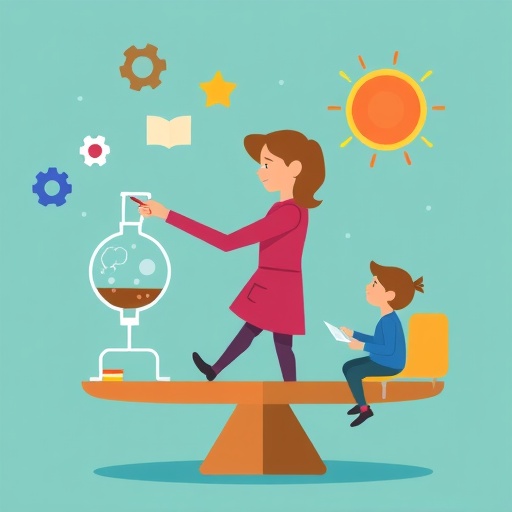
In the realm of contemporary education, striking a harmony between teacher-led and student-led approaches is becoming increasingly critical. A recent study by D. Cairns shines a spotlight on this equilibrium, particularly within the science education framework. As educational paradigms evolve, the quest for a balanced pedagogical strategy has taken center stage, emphasizing the significance of cognitive load management.
Cognitive load theory posits that learning is optimized when the amount of information presented does not overwhelm students. In science education particularly, where concepts can be convoluted and intricate, the teacher’s role in guiding students through the initial challenges of understanding is paramount. A teacher-led approach can provide students with a structured learning environment, where the complexities of scientific principles are simplified and articulated clearly.
While teacher-led learning provides scaffolding, moving towards a student-led model invites a more active participation from learners. This transition can not only enhance engagement but also foster critical thinking and problem-solving skills. The interplay between these two methodologies is essential in creating an inclusive educational experience. In Cairns’ study, the emphasis is on the need for educators to recognize when to lead and when to step back, allowing students to take ownership of their learning journey.
An integral part of Cairns’ argument revolves around the understanding of cognitive load: intrinsic, extraneous, and germane load. Intrinsic load refers to the inherent difficulty of the material, extraneous load pertains to the way information is presented and perceived by students, and germane load relates to the cognitive effort dedicated to processing and internalizing information. The delicacy lies in managing these loads to ensure that students are not only absorbing information but also engaging with it meaningfully.
For instance, in a science classroom, a new topic like chemical reactions can evoke various intrinsic loads due to its complexity. A teacher’s role in elucidating these concepts can mitigate this burden, constructing a foundational understanding that students can later explore independently. Here, the balance tilts towards teacher-led instruction, underscoring the importance of guidance in the initial stages of learning.
However, as students cultivate their understanding, empowering them to engage with the material through student-led discussions or experiments can transition the cognitive load from extraneous to germane. By facilitating activities that require critical thinking and problem-solving, teachers can foster an environment where students feel confident to explore and inquire. This progressive autonomy is essential for cognitive development, nurturing curiosity and intrinsic motivation.
Moreover, technology plays a pivotal role in advancing this equilibrium in modern classrooms. The advent of digital tools allows educators to create tailored learning experiences that cater to individual cognitive loads. For instance, interactive simulations and engaging multimedia resources can break down complex scientific concepts into digestible segments, thereby reducing extraneous cognitive load and enhancing student comprehension.
Cairns emphasizes that the success of this model hinges on teachers’ awareness of their students’ cognitive states and readiness to adapt their teaching styles accordingly. What works for one group of students may not resonate with another, requiring educators to be observant and flexible in their methodologies. The model of balancing instructional approaches brings forth the concept of differentiated instruction, underscoring the critical role of formative assessments in gauging student understanding and adjusting instructional dynamics.
Furthermore, research highlights that a one-size-fits-all approach in education is antiquated. The collaborative nature of science often demands a variety of learning styles, and incorporating both teacher-led and student-led frameworks can address diverse learner needs. Cairns’ study reveals that when students are given the opportunity to lead discussions or to pose their inquiries, their engagement levels rise, leading to deep-seated learning.
Beyond engagement, the balance between these methodologies also touches upon emotional and social dimensions in the classroom. A supportive environment, facilitated by teacher-led instruction, can relieve anxiety associated with complex topics, helping students develop resilience. Subsequently, when students transition into a leadership role, they not only learn the content but also develop crucial social skills, such as teamwork, communication, and accountability.
As educational institutions seek to better prepare students for a rapidly changing world, Cairns’ study serves as a timely reminder of the importance of adaptability in teaching paradigms. Striking a balance between teacher-led and student-led instruction allows for a richer educational experience, one that not only imparts knowledge but also cultivates critical thinkers and adept communicators.
The implications of this research extend beyond individual classrooms, influencing curriculum design and educational policy. School administrators and policymakers must recognize the value of fostering environments that promote this instructional balance. Professional development programs for teachers should incorporate strategies for managing cognitive load and provide frameworks for integrating both approaches effectively.
In conclusion, Cairns’ exploration of cognitive load in the context of teacher-led and student-led learning offers significant insights for educators. The pursuit of balance in instructional methods not only enhances student comprehension but also fosters a culture of engagement and curiosity. As we look towards the future of education, the findings from this research beckon us to rethink traditional teaching strategies, ultimately paving the way for a more dynamic and effective learning landscape.
Cite Scienmag News
Courtney Benton. (November 26, 2025). Balancing Teacher and Student Learning in Science. Scienmag. https://scienmag.com/balancing-teacher-and-student-learning-in-science/
Courtney Benton. "Balancing Teacher and Student Learning in Science." Scienmag, 26 November 2025, https://scienmag.com/balancing-teacher-and-student-learning-in-science/. Accessed 4 September 2026.
Courtney Benton. "Balancing Teacher and Student Learning in Science." Scienmag. November 26, 2025. https://scienmag.com/balancing-teacher-and-student-learning-in-science/


