


Scientists have directly detected thallusin, one of the most potent natural morphogens known, in natural coastal seawater for the first time. The discovery, made in the Kiel Fjord in the southwestern Baltic Sea, confirms that a molecule long studied only in laboratory cultures is genuinely part of the marine chemical landscape, present at concentrations high enough to steer the development of green macroalgae. The study, published in Frontiers in Marine Science, also identifies a previously unrecognized group of bacterial producers, expanding the known diversity of microbes capable of manufacturing this remarkable compound.
Thallusin is a bacterial metabolite that green seaweeds of the genus Ulva cannot synthesize themselves, yet it is essential for their normal development. In the model system Ulva compressa, formerly known as Ulva mutabilis, morphogenesis depends on a tripartite partnership between the alga and two bacterial strains: Roseovarius sp. MS2, which promotes cell division through cytokinin-like activity, and Maribacter sp. MS6, which produces thallusin. The morphogen triggers the formation of rhizoids and normal cell walls, structures the alga cannot build properly without it. With an EC50 value of just 4.9 picomoles per liter, thallusin ranks among the most powerful natural products ever characterized, acting at extraordinarily low concentrations to regulate macroalgal development.
Despite decades of laboratory work on thallusin’s biological activity and biosynthesis, almost nothing was known about its abundance, distribution, or ecological relevance in real marine environments. Earlier studies had shown that coastal seawater could induce normal morphogenesis in bacteria-free Ulva gametes, hinting that waterborne morphogenetic compounds and their bacterial producers existed in nature. But the spatial and seasonal variation of this activity, and the identity of the microorganisms contributing to the environmental thallusin pool, remained unresolved. The new study set out to close that gap by combining field sampling, bioassays, microbiome profiling, high-resolution mass spectrometry, and bacterial culture experiments in a single stepwise workflow.
The research team, led by Thomas Wichard of Friedrich Schiller University Jena together with colleagues at GEOMAR Helmholtz Centre for Ocean Research Kiel and other institutions, chose the Kiel Fjord as their natural laboratory. This shallow, brackish-water coastal system experiences salinity ranging from 7 to 21 practical salinity units, strong seasonal stratification, temperature swings from about 2 degrees Celsius in winter to above 20 degrees in summer, and heavy nutrient loads that drive eutrophication and algal blooms. At least nine identified Ulva species inhabit the fjord, blooming in early summer while several taxa persist year-round with reduced winter growth. These pronounced environmental gradients made the fjord an ideal setting for tracking a highly potent bioactive molecule through space and time.
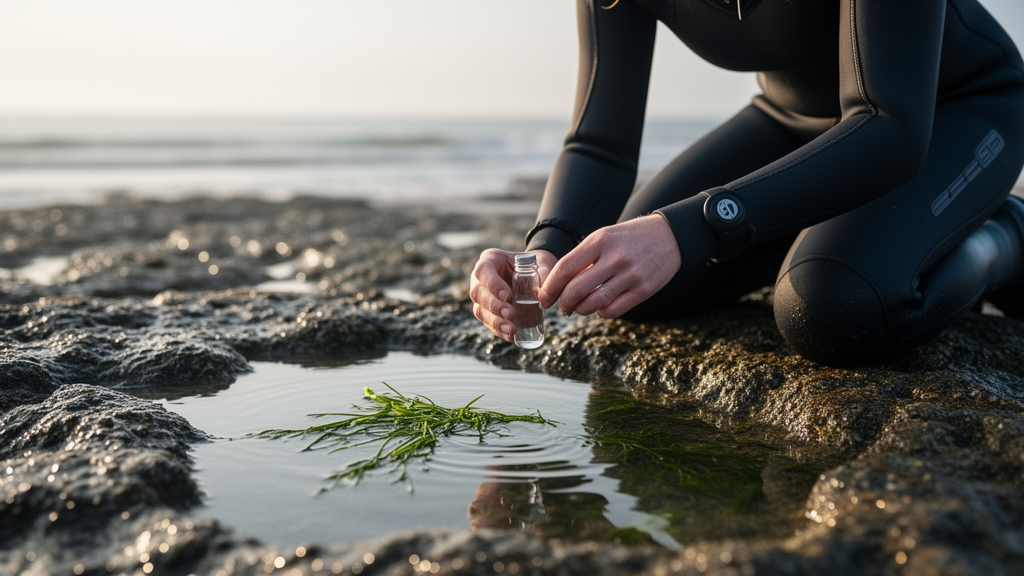
Between May and November 2018, the researchers collected sterile-filtered seawater from 32 stations each month, using sterile syringes at a depth of roughly 30 centimeters and immediately passing each 50-milliliter sample through 0.22-micrometer filters. They then exposed axenic Ulva compressa germlings, grown from bacteria-free gametes, to the filtered seawater in 96-well plates and monitored cell-wall development microscopically over 12 to 18 days. In total, 24,320 individual germlings were evaluated across the spring, summer, and autumn experiments. From these observations the team calculated a morphogenetic index, or MI, that integrates both the magnitude and persistence of morphogenetic activity into a single sample-specific value, with an MI above 0.5 considered indicative of thallusin presence.
The results revealed striking spatial and seasonal patterns. Morphogenetic activity was highest in summer, with MI values ranging from 0.05 to 1.00 and a mean of 0.37, and was significantly higher than in autumn, where values ranged from 0 to 0.57 with a mean of 0.22. Spring samples showed intermediate levels. Station 20 consistently maintained high morphogenetic activity throughout spring and summer, and stations 19 and 20 were subsequently selected for targeted chemical analysis. Statistically, MI correlated positively with temperature and negatively with both salinity and nitrite concentration after correction for multiple testing, while parameters such as pH, oxygen, phosphate, nitrate, and ammonium showed no significant associations. The authors caution that these field data cannot distinguish whether temperature and salinity act directly on thallusin production, stability, or turnover, or indirectly through shifts in the bacterial community.
To confirm that thallusin itself, rather than some other morphogenetic factor, was responsible for the bioactivity, the team collected 66-liter water samples from stations 19 and 20 in spring 2019, coinciding with the seasonal appearance of Ulva in the fjord. After solid-phase extraction on resin columns, the concentrates were analyzed by ultra-high-performance liquid chromatography coupled to high-resolution mass spectrometry. Extracted ion chromatograms revealed a signal whose protonated molecular ion at mass-to-charge ratio 458.2176 matched thallusin, and comparison with a synthetic reference standard supported the identification. Quantitative analysis of a one-liter sample from station 20, processed in duplicate and measured in five technical replicates, yielded a thallusin concentration of 0.66 plus or minus 0.21 nanomoles per liter.
That figure carries real ecological weight. The measured concentration exceeds the EC50 value reported for Ulva compressa by approximately two orders of magnitude, meaning thallusin occurs in natural coastal waters at biologically relevant levels. It even approaches concentrations previously reported for laboratory cultures, despite the open, dynamic nature of the coastal environment. The authors emphasize, however, that the quantitative determination rested on a single environmental sample from one station in one season, so the value should be read as a site- and time-specific observation rather than a representative concentration for the whole fjord. They also note that the bioassay and microbiome surveys were conducted in 2018 while the chemical detection took place in 2019, making the datasets sequential and complementary rather than simultaneous measurements.
The hunt for the producers began with an exploratory microbiome screen. Sequencing of the V3-V4 region of the bacterial 16S rRNA gene from summer and autumn filters revealed 52 bacterial phyla, dominated by Pseudomonadota, Bacteroidota, and Cyanobacteriota, which together accounted for 83.6 percent of relative abundance. Within Bacteroidota, Flavobacteriaceae was the dominant family. Comparing genus-level abundances between seasons, the team found 23 genera significantly enriched in summer, and restricting the analysis to stations 19 and 20 narrowed the candidates to ten. Because thallusin production had previously been linked to Bacteroidota, the genera Algoriphagus and Algibacter emerged as the most promising leads, and Algoriphagus was selected for experimental validation.
Four Algoriphagus species from diverse marine habitats, including associations with green and brown macroalgae, microbial mats, and marine sediments, were cultured and tested alongside the reference strains. All four induced a Maribacter-like morphogenetic phenotype in axenic Ulva compressa germlings, producing rhizoids and normal cell walls when paired with Roseovarius sp. MS2. Chemical analysis of culture supernatants confirmed thallusin production in every strain, with striking quantitative differences: Algoriphagus chordae produced 19.03 nanomoles per liter, exceeding even the positive control Maribacter sp. MS6 at 8.79, while A. winogradskyi, A. machipongonensis, and A. antarcticus produced 6.08, 5.42, and 4.85 nanomoles per liter respectively. These findings suggest that thallusin biosynthesis may be more broadly distributed within Bacteroidota than previously assumed, consistent with the recent identification of the ebo biosynthetic gene cluster, though the small number of strains tested limits broader taxonomic conclusions.
The study stops short of claiming that Algoriphagus alone accounts for the thallusin measured in the fjord; other, still-unidentified bacterial taxa likely contribute as well. But the work opens a compelling ecological picture. Thallusin also complexes iron and facilitates iron uptake in Ulva through a siderophore-like system, so environmental availability may reflect a balance among production, turnover, complexation, and algal uptake. The authors propose that thallusin may represent a new class of phycohormone-like compounds governing seaweed development, part of a natural chemical cocktail that macroalgae experience in their shared habitat. Understanding how such bacterial morphogens fluctuate with season, microbiome composition, and environmental change could inform everything from ecosystem restoration to sustainable seaweed aquaculture, and future studies with higher temporal resolution are planned to untangle the drivers of thallusin abundance in coastal waters.
Subject of Research: First environmental detection and quantification of the algal morphogen thallusin in Baltic Sea coastal seawater and identification of Algoriphagus bacteria as producers
Article Title: Environmental occurrence of the algal morphogen thallusin and identification of Algoriphagus species as producers in the Baltic Sea (Kiel Fjord, Germany)
Article References: Redlich, S., Ulrich, J. F., Reilly-Schott, V., Hethke, A., Steinhagen, S., Weinberger, F., & Wichard, T. (2026). Environmental occurrence of the algal morphogen thallusin and identification of Algoriphagus species as producers in the Baltic Sea (Kiel Fjord, Germany). Frontiers in Marine Science, 13, 1972976. https://doi.org/10.3389/fmars.2026.1972976
Image Credits: AI Generated
DOI: 10.3389/fmars.2026.1972976
Keywords: thallusin, Ulva, Algoriphagus, Baltic Sea, Kiel Fjord, marine microbiology, macroalgae, morphogenesis, seaweed holobiont, UHPLC-HRMS, bacterial morphogens, chemical ecology
Cite Scienmag News
Morgan Morrow. (October 27, 2026). Bacterial Morphogen Thallusin Detected for the First Time in Coastal Seawater. Scienmag. https://scienmag.com/bacterial-morphogen-thallusin-detected-for-the-first-time-in-coastal-seawater/
Morgan Morrow. "Bacterial Morphogen Thallusin Detected for the First Time in Coastal Seawater." Scienmag, 27 October 2026, https://scienmag.com/bacterial-morphogen-thallusin-detected-for-the-first-time-in-coastal-seawater/. Accessed 27 October 2026.
Morgan Morrow. "Bacterial Morphogen Thallusin Detected for the First Time in Coastal Seawater." Scienmag. October 27, 2026. https://scienmag.com/bacterial-morphogen-thallusin-detected-for-the-first-time-in-coastal-seawater/


