

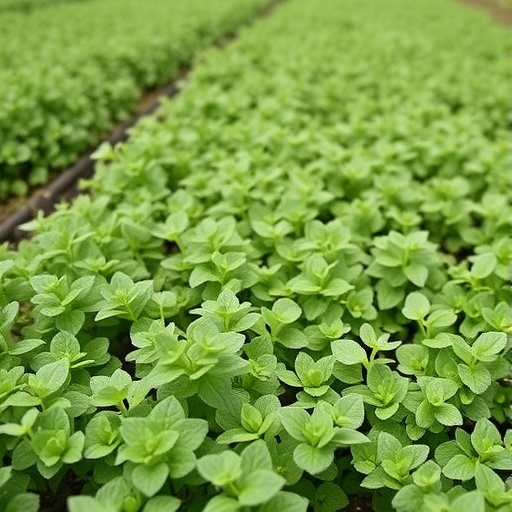
Recent research in the domain of agricultural biotechnology has shed light on an intriguing aspect of crop health—how the ratios of bacterial consortia can significantly impact the growth and resilience of alfalfa, particularly in the face of salinity stress. Alfalfa (Medicago sativa), known for its high nutritional value and ability to improve soil fertility, has been increasingly utilized in sustainable farming practices. The new study, led by researcher N. Baha, provides vital insights into the symbiotic relationships between plants and microorganisms, offering a roadmap for enhancing crop performance under adverse environmental conditions.
The rising salinity in agricultural soils, often due to improper irrigation practices and climate change, poses a serious threat to crop yield and food security. Salinity stress negatively affects the physiological and biochemical processes in plants, leading to diminished growth and productivity. Addressing this growing problem is crucial, as it will not only impact farmers’ livelihoods but also global food supplies. The innovative exploration of bacterial consortia complements traditional plant breeding and agronomic practices, heralding a new era of stress-tolerant crops.
Bacterial consortia—combinations of different bacterial species—play a fundamental role in plant health by enhancing nutrient acquisition, promoting root development, and providing resistance to pathogens. These beneficial microorganisms establish a symbiotic relationship with the root systems of plants, improving their overall performance in nutrient-poor or stressed environments. Baha’s research highlights how various ratios of these consortia affect the efficacy of their benefits, presenting an opportunity to fine-tune these ratios for optimal performance in alfalfa.
Through meticulous experimentation, Baha assessed different combinations of bacterial species introduced to alfalfa plants grown under saline conditions. This study utilized a series of controlled environmental and laboratory conditions to ensure accuracy and reliability. The findings revealed significant variations in plant growth metrics, including root biomass, chlorophyll content, and overall plant height, based on the specific ratios of bacterial input.
Significantly, the results prove that certain ratios of bacterial consortia yield a marked increase in alfalfa resilience to salt stress. For example, a balanced mixture of specific nitrogen-fixing and phosphate-solubilizing bacteria was found to enhance the growth of alfalfa in saline soils more effectively than single-species treatments or unamended controls. This empirical evidence points to the complexity of microbial interactions while emphasizing the necessity of a holistic approach to agricultural health.
The implications of this research extend beyond alfalfa alone; they offer groundbreaking strategies that can be applied to a wide range of crops facing similar environmental challenges. These microbial interventions could revolutionize farm management practices, allowing farmers to cultivate crops effectively in soil previously deemed unfit for agriculture due to high salinity levels. The potential for reducing dependency on chemical fertilizers and increasing sustainable practices aligns well with global efforts to mitigate the environmental impacts of intensive farming.
Moreover, Baha’s findings open up new avenues for future research. The exploration of different bacterial ratios as an agricultural tool draws attention to microbial ecology and its applications in crop management. Understanding the mechanisms driving plant-microbe interactions can lead to the development of specialized inoculants tailored to specific stress conditions, enhancing food security in a changing climate.
In the context of climate resilience, the utilization of bacterial consortia to bolster crop growth not only helps alleviate immediate agricultural challenges but also plays a vital role in long-term sustainability. As the planet grapples with unpredictable weather patterns and diminishing resources, innovative agricultural solutions such as these can contribute to a more secure food supply chain, ultimately benefiting global populations.
Furthermore, the practical applications of this research are both timely and relevant. As policymakers and agricultural bodies look to bolster food production amidst increasing demands, strategies rooted in scientific research hold the key to sustainable practices. The ability to adapt crops to withstand adverse conditions will be a game-changer, enabling farmers worldwide to maximize output while preserving ecological integrity.
The excitement surrounding this study by Baha is palpable within the agricultural and scientific communities. As researchers delve deeper into understanding the complexities of plant-microbe interactions, it paves the way for innovation and progressive farming solutions. With each advancement, the prospect of resilient crops equipped to face the mounting pressures of climate change becomes more achievable.
In conclusion, the research led by N. Baha provides compelling evidence that the proper application of bacterial consortia can significantly enhance alfalfa’s growth response and salt stress tolerance. As technology in agricultural sciences continues to evolve, the potential of microbial applications promises to reshape how we approach crop production and farming sustainability. With the dual challenges of climate change and food security to tackle, this field of study may indeed hold the answers to advancing agriculture well into the future.
Subject of Research: Impact of bacterial consortium ratios on alfalfa growth and salt stress tolerance.
Article Title: Impact of bacterial consortium ratios on alfalfa growth and salt stress tolerance.
Article References:
Baha, N. Impact of bacterial consortium ratios on alfalfa growth and salt stress tolerance.
3 Biotech 16, 37 (2026). https://doi.org/10.1007/s13205-025-04654-2
Image Credits: AI Generated
DOI: https://doi.org/10.1007/s13205-025-04654-2
Keywords: bacterial consortia, alfalfa, salinity stress, sustainable agriculture, plant-microbe interactions, agriculture biotechnology, crop resilience, nitrogen-fixing bacteria, phosphate-solubilizing bacteria, food security.


