


A woman’s egg reserve is finite. Gonad-damaging therapies, such as certain chemotherapies, can therefore lead to infertility. One of the options for preserving fertility is the cryopreservation of ovarian tissue. This involves removing and freezing part of the ovary before a so-called gonadotoxic therapy. This can later be thawed and reimplanted so that undamaged eggs can be returned to the body. Since 2004, numerous international groups have achieved successful pregnancies following cryopreservation, thawing and retransplantation of ovarian tissue. “This illustrates the high potential of this method, which is mainly based on the cryopreservation procedure of slow freezing,” says Dr. Andreas Schallmoser, Head of the Reproductive Medicine Laboratory at the UKB.

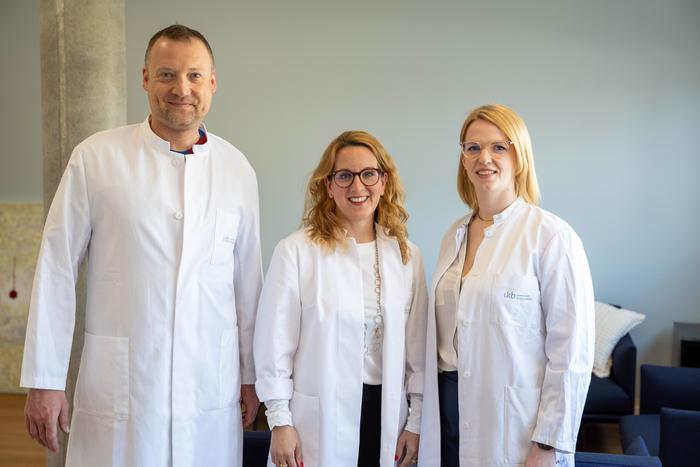
Credit: University Hospital Bonn (UKB) / Alessandro Winkler
A woman’s egg reserve is finite. Gonad-damaging therapies, such as certain chemotherapies, can therefore lead to infertility. One of the options for preserving fertility is the cryopreservation of ovarian tissue. This involves removing and freezing part of the ovary before a so-called gonadotoxic therapy. This can later be thawed and reimplanted so that undamaged eggs can be returned to the body. Since 2004, numerous international groups have achieved successful pregnancies following cryopreservation, thawing and retransplantation of ovarian tissue. “This illustrates the high potential of this method, which is mainly based on the cryopreservation procedure of slow freezing,” says Dr. Andreas Schallmoser, Head of the Reproductive Medicine Laboratory at the UKB.
No damaging ice crystals during flash freezing
However, if the temperature is gradually lowered to -196°C, the formation of ice crystals cannot be completely avoided technically. This can have a negative impact on the integrity of the tissue. If, on the other hand, tissue samples are frozen within fractions of a second, damage to cells can be avoided. “This is because the formation of ice crystals is not possible – the sample vitrifies, so to speak,” explains Dr. Rebekka Einenkel, Head of the Gynecological Endocrinology and Reproductive Medicine Research Laboratory at the UKB. “This procedure, known as vitrification, has long been established for human embryos and egg cells.”
In earlier work by Prof. Sänger’s team, Dr. Schallmoser and Dr. Einenkel were able to demonstrate the positive influence of vitrification compared to slow freezing on the vitality of the oocytes and their environment as well as the release of vasculogenic substances, which are essential for successful retransplantation.
“The first birth in Europe after vitrification, thawing and retransplantation of ovarian tissue is a milestone for our patients and our center. Thanks to our research focus on vitrification and thawing of human tissue and cells, we can offer fertility treatments at the highest level,” says Prof. Sänger from the Department of Reproductive Medicine at the UKB. Previously, one group each from Japan and the USA had been able to report a birth after reimplantation of vitrified ovarian tissue.
Journal
Reproductive BioMedicine Online
Method of Research
Case study
Subject of Research
People
Cite Scienmag News
Nathaniel Bowman. (May 14, 2024). Baby thanks to “glazing” of ovarian tissue. Scienmag. https://scienmag.com/baby-thanks-to-glazing-of-ovarian-tissue/
Nathaniel Bowman. "Baby thanks to “glazing” of ovarian tissue." Scienmag, 14 May 2024, https://scienmag.com/baby-thanks-to-glazing-of-ovarian-tissue/. Accessed 3 September 2026.
Nathaniel Bowman. "Baby thanks to “glazing” of ovarian tissue." Scienmag. May 14, 2024. https://scienmag.com/baby-thanks-to-glazing-of-ovarian-tissue/

