


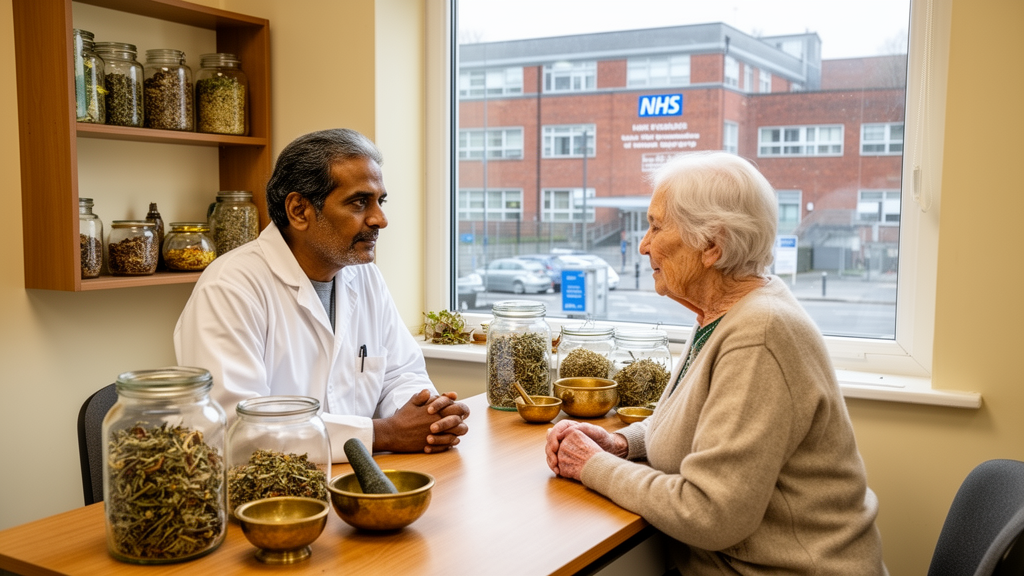
Non-communicable diseases such as type 2 diabetes, cardiovascular disease, and chronic respiratory conditions now account for the overwhelming majority of deaths in the United Kingdom, and they place a relentless strain on the National Health Service. Conventional biomedicine dominates the official response to this burden, but a quieter parallel system has been growing alongside it. Complementary and alternative medicine is increasingly used by patients across Britain, and among the traditions they turn to is Ayurveda, the ancient Indian system of medicine built around diet, herbal treatment, lifestyle regulation, and a highly individualised view of the body. A new qualitative study published in PLOS One offers one of the most detailed portraits yet of how Ayurvedic practitioners actually operate inside the British healthcare landscape, what they believe they can contribute to chronic disease management, and the structural and financial walls they run into every day.
The research team, led by Patricia Egwumba of the University of Nottingham together with Manpreet Bains, Laura Nellums, and Kaushik Chattopadhyay, interviewed seventeen UK-based Ayurvedic practitioners using semi-structured qualitative interviews. Each conversation was audio-recorded and transcribed verbatim, and the transcripts were then analysed thematically, a method that allows researchers to identify recurring patterns of meaning across independent accounts rather than testing predetermined hypotheses. The participants ranged across the small but established community of Ayurvedic professionals working in Britain, a group that occupies an unusual position: trained in a coherent medical tradition with its own diagnostic framework, yet practising outside the statutory regulation and funding structures that govern conventional clinicians.
The first major theme to emerge was how these practitioners see themselves. Far from positioning Ayurveda as a rival to Western medicine, they consistently described their role as complementary, offering holistic, individualised, and patient-centred care that supports people living with long-term conditions. In practice, this meant detailed attention to diet, daily routine, sleep, stress, and digestion alongside herbal preparations, with treatment plans tailored to the specific constitution and circumstances of each patient rather than to a disease label. Several practitioners described patients who arrived feeling that their chronic condition had been reduced to a prescription and a set of numbers, and who were looking for a framework that treated them as whole people. The practitioners argued that this personalised approach could improve adherence, support self-management, and address aspects of chronic disease care that time-pressed conventional consultations often struggle to reach.
That self-understanding, however, sits inside a healthcare system that was built around a very different epistemology. The second theme documented the considerable barriers practitioners face, and the researchers divided these into structural challenges and financial constraints. Structurally, Ayurveda enjoys almost no formal integration with the NHS, little institutional support, and restricted patient access, since there are no referral pathways that would allow a general practitioner to route a patient to an Ayurvedic consultation as part of a coordinated care plan. Practitioners described working in isolation from mainstream services, with no mechanism for sharing information safely with a patient’s GP or specialist, a gap that carries real risks when patients take both herbal and conventional medicines. The absence of statutory regulation for Ayurvedic practice in the UK leaves the profession in a grey zone, dependent on voluntary self-regulation and vulnerable to public confusion about who is and is not properly qualified.
The financial picture was equally stark. Practitioners reported that high treatment costs put Ayurvedic care out of reach for many of the patients who might benefit from it, precisely because the NHS does not cover it and private insurance rarely does. Every pound of treatment must come directly from the patient’s pocket, which skews the client base toward those with disposable income and limits the profession’s ability to serve the communities where the burden of non-communicable disease is often heaviest. Import regulations added a further layer of difficulty: herbal medicines and formulations central to Ayurvedic practice face regulatory hurdles at the UK border, creating supply problems and uncertainty that practitioners in India or other countries where the tradition is institutionally embedded simply do not encounter. The cumulative effect is a profession that must constantly justify its existence economically before it can even begin to demonstrate its clinical value.
Against this backdrop, the third theme highlighted an unexpected source of resilience: professional associations. Practitioners credited these bodies with providing legal and regulatory guidance in a landscape where the rules are opaque and shifting, helping them understand what they can lawfully claim, sell, and practise. The associations also promoted continuing professional development, offering training that keeps practitioners current in both Ayurvedic knowledge and the safety standards expected in a Western clinical environment. Most strategically, they supported research designed to strengthen the evidence base for Ayurvedic interventions, recognising that legitimacy in the British system ultimately depends on the ability to demonstrate safety and efficacy in terms that regulators, physicians, and patients accept. In effect, these associations are doing the institutional work that a statutory regulator would normally perform, and the study suggests they are central to the profession’s survival.
The findings speak to a broader tension in modern healthcare. Non-communicable diseases are precisely the conditions where lifestyle, diet, stress, and long-term behavioural change matter most, and where purely pharmacological approaches have repeatedly shown their limits. Ayurveda, whatever the unresolved questions about the strength of its clinical evidence, is a tradition organised almost entirely around those behavioural and dietary levers. The practitioners in this study argued that culturally congruent care, care that matches the beliefs and backgrounds of the patient, can reach communities that mainstream services struggle to engage, particularly among the South Asian diaspora for whom Ayurveda carries deep cultural resonance. From their perspective, the NHS’s difficulty is not that patients seek out complementary medicine but that the system has no framework for incorporating that reality safely and constructively.
The researchers are careful about what their study can and cannot claim. This was a qualitative study of seventeen practitioners’ experiences and perspectives, not a clinical trial of Ayurvedic treatment, and it cannot speak to the effectiveness of any intervention. What it documents instead is a sociological reality: a group of healthcare providers navigating a structurally Western-centric system, negotiating legitimacy and professional recognition without institutional backing, and maintaining a persistent presence despite considerable odds. The authors suggest that their findings offer insights into integrative approaches to chronic disease care, pointing toward models in which conventional and traditional systems coordinate rather than compete, with clear referral pathways, shared records, and agreed safety standards. Similar debates are playing out across Europe and North America as patient demand for complementary medicine grows faster than the regulatory frameworks designed to govern it.
For the NHS, the study lands at a delicate moment. With chronic disease driving record waiting lists and unsustainable costs, policymakers are actively searching for prevention-focused, patient-empowering models of care. The practitioners interviewed here effectively argue that they are already delivering such care, but in a policy vacuum that prevents the NHS from harnessing it, monitoring it, or protecting patients within it. Whether British health authorities choose to engage with that argument, through research funding, regulatory clarity, or pilot integration schemes, will determine whether Ayurveda remains a marginal, self-funded parallel practice or becomes a documented part of a more pluralistic chronic disease strategy. What the study makes unmistakable is that the practitioners are not waiting for permission; they are already treating patients, one personalised consultation at a time, and asking only to be seen by the system their patients also rely on.
Subject of Research: Ayurvedic practitioners' experiences and perspectives on non-communicable disease management in the United Kingdom
Article Title: Experiences and perspectives of Ayurvedic practitioners on non-communicable disease management in the UK: A qualitative study
Article References: Egwumba, P., Bains, M., Nellums, L., & Chattopadhyay, K. (2026). Experiences and perspectives of Ayurvedic practitioners on non-communicable disease management in the UK: A qualitative study. PLOS One, 21(10), e0360754. https://doi.org/10.1371/journal.pone.0360754
Image Credits: AI Generated
DOI: 10.1371/journal.pone.0360754
Keywords: Ayurveda, non-communicable diseases, complementary and alternative medicine, NHS, qualitative research, integrative medicine, UK healthcare, chronic disease management, professional regulation, patient-centred care, herbal medicine, PLOS One
Cite Scienmag News
Ophelia Keating. (October 15, 2026). Ayurvedic Practitioners in the UK Struggle to Treat Chronic Disease Within a Western-Dominated NHS. Scienmag. https://scienmag.com/ayurvedic-practitioners-in-the-uk-struggle-to-treat-chronic-disease-within-a-western-dominated-nhs/
Ophelia Keating. "Ayurvedic Practitioners in the UK Struggle to Treat Chronic Disease Within a Western-Dominated NHS." Scienmag, 15 October 2026, https://scienmag.com/ayurvedic-practitioners-in-the-uk-struggle-to-treat-chronic-disease-within-a-western-dominated-nhs/. Accessed 15 October 2026.
Ophelia Keating. "Ayurvedic Practitioners in the UK Struggle to Treat Chronic Disease Within a Western-Dominated NHS." Scienmag. October 15, 2026. https://scienmag.com/ayurvedic-practitioners-in-the-uk-struggle-to-treat-chronic-disease-within-a-western-dominated-nhs/


