


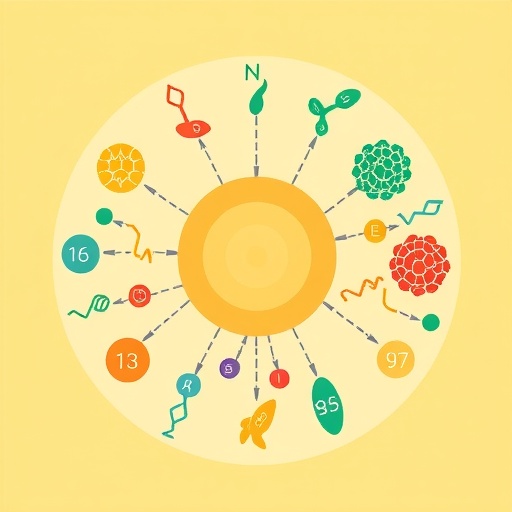
In the field of material science, the ability to develop and utilize stimulus-responsive materials is transforming the landscape of advanced applications including biosensing, tissue engineering, and therapeutic delivery. These materials exhibit dynamic behavior, reacting to specific stimuli in their environment. This responsive nature is particularly powerful for applications that require precise control over timing and localization of drug release, which can significantly enhance the efficacy of therapeutic interventions.
A critical hurdle in the development of sophisticated stimulus-responsive materials has been the intricate and often inefficient synthetic methods traditionally employed. Recent advancements have highlighted that the intricacies of molecular topology can be leveraged to enhance the functionality and responsiveness of biomaterials. However, the reliance on complicated multi-step organic syntheses has hindered scalability and reduced the practicality of these innovations in real-world applications. As such, researchers have sought novel strategies that can simplify the synthesis while maintaining or enhancing the complexity needed for effective response to multiple inputs.
Recent breakthroughs have demonstrated the potential of integrating recombinant expression techniques with emerging chemical biology tools. This integration allows for the creation of topologically specified protein cargos that can be tethered to biomaterials in a site-specific manner. Furthermore, these cargos can be conditionally released from the material in response to user-programmable Boolean logic inputs. Such a system offers a revolutionary approach to protein delivery, akin to building a complex digital circuit where specific activations from multiple inputs yield precise outputs.
At the core of this innovation is the concept of autonomously compiled molecular topology during protein expression. By utilizing spontaneous intramolecular ligations, researchers can achieve direct and scalable synthesis of advanced protein constructs. This method drastically reduces the number of synthetic steps required, enabling the production of multifunctional materials that can address complex biological challenges. The modularity of the approach also provides researchers with a flexible platform to fine-tune the properties of the materials for targeted applications.
One significant aspect of this technology is its ability to achieve conditional protein release from biomaterials based on distinct Boolean logic combinations. The team has successfully demonstrated the execution of all 17 possible outputs derived from combinations of three orthogonal protease actuators, effectively laying the groundwork for intricate programming of biological functions. This flexibility in combining inputs allows researchers to construct sophisticated therapeutic modalities that respond to specific environmental signals, which is particularly beneficial for applications in drug delivery and personalized medicine.
In addition to programming protein release, the framework enables the multiplexed delivery of various biomacromolecules from hydrogels. By utilizing five different input signals, researchers can achieve a conditional liberation of cargo that can be finely tuned according to the desired therapeutic profile. The ability to deliver multiple distinct biomolecules simultaneously from a single platform enhances the therapeutic potential and offers a strategic advantage for co-delivery purposes, such as combinational therapies that target various pathways in disease management.
Another pivotal achievement presented in this research is the capability of achieving logically defined protein localization within living mammalian cells. The technology not only allows for the release of proteins in a controlled manner but also directs proteins to specific cellular compartments. This precision is essential for studying cellular processes, understanding disease mechanisms, and devising novel therapeutic strategies that require spatial control of protein activity.
The implications of harnessing such advanced protein delivery systems are vast, ranging from fundamental research in molecular and cellular biology to innovative therapeutic applications. The ability to control when and where proteins are released allows for more efficient healing processes and can drastically improve outcomes in regenerative medicine. Moreover, this refined control could transform the landscape of vaccine delivery and personalized therapy, wherein treatments are tailored to the unique biological context of the patient.
As this technology continues to advance, it will open up new avenues for research and application in synthetic biology, tissue engineering, and therapeutic interventions. The merge of computational design with synthetic biology initiates a new paradigm where biological responses can be carefully orchestrated, leading to enhanced control over physical and biochemical processes. This advancement will not only accelerate the pace of discovery in various scientific domains but could also lead to the development of next-generation therapeutics that are responsive to the dynamic nature of biological systems.
Harnessing the power of Boolean logic in biological applications offers an exciting glimpse into the future of material sciences and biotechnology. The potential to create intelligent materials that can adapt to their environments opens pathways to innovations that we have yet to fully realize. From autonomous drug delivery systems that react to disease progression to smart biomaterials that facilitate cell regeneration, the possibilities are limitless.
As researchers build upon this foundation, the fields of biosensing and tissue engineering stand to benefit immensely. The prospect of embedding these advanced materials within clinical settings promises transformative impacts on patient care and therapeutic outcomes. Stakeholders in these quantum leaps in scientific innovation must ensure that these technologies are developed with ethical considerations and governed by guidelines that prioritize patient safety and efficacy.
In essence, this research marks a watershed moment in the intersection of chemical biology and material science. By simplifying the complexity traditionally associated with synthetic routes and empowering biotechnological applications through ingenious coding systems, we are embarking on a new era of intuitive biomaterials that respond intelligently to their surroundings, enabling innovations never before considered.
As we look towards the future, the infusion of computational and biological methodologies in material science could redefine our approach to the development of responsive systems. We can anticipate the convergence of various scientific disciplines resulting in novel solutions that cohesively address complex biological challenges. The journey ahead is not just a promise of advanced scientific discoveries but also a testament to the synergies that drive innovation when diverse fields collaborate.
The insights gleaned from the integration of molecular topology and Boolean logic will undoubtedly set the stage for the next generation of therapeutic innovations that fundamentally alter how we approach treatment and healing strategies in healthcare.
Gharios, R., Ross, M.L., Li, A. et al. Boolean logic-gated protein presentation through autonomously compiled molecular topology.
Nat Chem Biol (2025). https://doi.org/10.1038/s41589-025-02037-5
Cite Scienmag News
Ophelia Keating. (November 15, 2025). Autonomous Protein Presentation via Boolean Logic Gating. Scienmag. https://scienmag.com/autonomous-protein-presentation-via-boolean-logic-gating/
Ophelia Keating. "Autonomous Protein Presentation via Boolean Logic Gating." Scienmag, 15 November 2025, https://scienmag.com/autonomous-protein-presentation-via-boolean-logic-gating/. Accessed 3 September 2026.
Ophelia Keating. "Autonomous Protein Presentation via Boolean Logic Gating." Scienmag. November 15, 2025. https://scienmag.com/autonomous-protein-presentation-via-boolean-logic-gating/


