

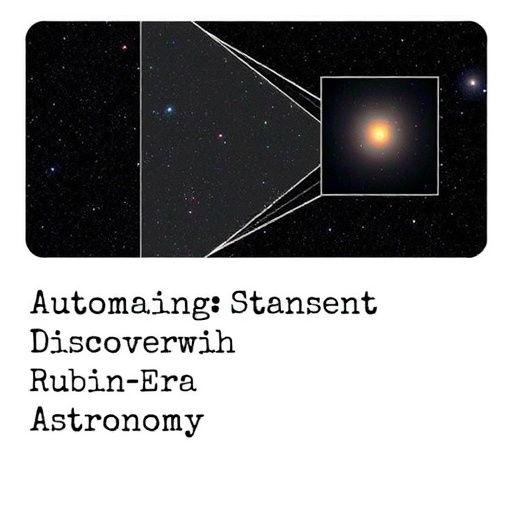
In the vast expanse of the night sky, fleeting celestial phenomena—known as optical transients—flash into existence, captivating astronomers with their unpredictable brilliance. Over recent decades, the quest to detect and understand these transient events has evolved into a sophisticated science, relying increasingly on robotic wide-field surveys and cutting-edge automation technologies. With the dawn of the Rubin Observatory era, the scale and complexity of transient discovery are reaching unprecedented proportions, demanding a transformative approach to data handling, detection, and classification.
Today, robotic surveys such as the Zwicky Transient Facility (ZTF) and the Asteroid Terrestrial-impact Last Alert System (ATLAS) serve as vanguards in transient astronomy. These observatories scan broad swaths of the sky nightly, identifying dozens of new transient sources ranging from supernovae to variable stars. These discoveries are no longer the product of manual probing but of highly automated pipelines that integrate real-time data processing and machine learning techniques. This transformation has accelerated not only the rate of discovery but also enabled rapid classification critical for timely follow-up observations.
The integration of artificial intelligence (AI) and machine learning (ML) into these workflows marks a pivotal milestone. Complex data streams from survey telescopes now undergo automatic vetting where candidate transients are identified, filtered, and categorized without human intervention. This approach culminated recently in the fully automated end-to-end discovery and classification of optical transients—a breakthrough demonstrating that AI can manage discovery pipelines from data ingestion to reporting. Such advancements significantly reduce human biases and reaction times, allowing astronomers to prioritize the most scientifically valuable transients swiftly.
Perhaps the most transformative development on the horizon is the operational commencement of the Vera C. Rubin Observatory and its flagship initiative, the Legacy Survey of Space and Time (LSST). The Rubin Observatory’s powerful wide-field camera and rapid cadence imaging will generate petabytes of data annually. This deluge dwarfs current datasets by an order of magnitude, signaling both incredible opportunities and daunting challenges. The expected surge in transient detections necessitates an acceleration in automation workflows to handle this data avalanche efficiently and meaningfully.
The scaling of transient discovery with Rubin-era data demands innovation not only in detection but also classification accuracy. Machine learning classifiers must evolve to accommodate a richer and more diverse dataset, incorporating subtle spectral and photometric features to differentiate between myriad astrophysical phenomena. These classifiers will need to function with low latency while incorporating adaptive learning models to refine accuracy continuously. The interplay of AI with human expertise will remain critical but is likely to shift towards oversight and validation rather than primary analysis.
In parallel, end-to-end workflow automation extends into follow-up coordination. Once a transient is discovered and classified, the urgency to schedule additional observations via space-based or ground-based telescopes intensifies. Automated decision-making protocols, guided by AI, are necessary to optimize the allocation of limited telescope time across myriad targets. This integration enhances the efficiency and scientific return of transient studies by facilitating rapid response campaigns that capture transient evolution in real time.
Furthermore, the growing complexity of transient data necessitates advanced anomaly detection techniques. Novel events that do not conform to known transient classes may harbor groundbreaking physics or undiscovered phenomena. AI systems equipped with unsupervised learning algorithms can flag unusual signals that escape traditional template-based classification. Such anomaly detection will be crucial in ensuring that the richest scientific opportunities are not overlooked amid the flood of data.
The challenges inherent in real-time transient workflows extend beyond computation. Data storage, transmission, and management infrastructures must scale commensurately. Cloud-based computing and distributed data centers are becoming integral components of the transient discovery ecosystem. These infrastructures support collaborative networks of astronomers, enabling global data sharing and analysis, thereby accelerating discoveries beyond the capabilities of isolated facilities.
The human element continues to play a vital role in the era of automation. Expert astronomers provide essential domain knowledge to train and validate machine learning models. They refine algorithms based on astrophysical insights ensuring that automation enhances rather than replaces scientific understanding. As these automated systems become more prevalent, transparency and interpretability of AI decisions rise in importance to build trust within the astronomical community.
Importantly, the sustained development of automation in transient astronomy necessitates interdisciplinary collaboration between astronomers, data scientists, and software engineers. By combining expertise from these fields, the community can design robust, scalable, and adaptive systems that remain flexible in the face of unknown and evolving research questions. The success of such collaborative efforts will dictate the pace and success of transient science discoveries during the Rubin era and beyond.
Looking ahead, the potential for AI-driven autonomous observatories looms on the horizon. Future facilities may operate with minimal human intervention, autonomously managing observation schedules, data reduction, transient discovery, classification, and follow-up. Such autonomy could herald a new age of time-domain astronomy, where discoveries unfold in real-time with little latency between detection and investigation, revolutionizing our understanding of dynamic astrophysical processes.
As the Rubin Observatory revolutionizes optical transient science, the imperative to refine automation workflows becomes ever more pressing. Investments in faster algorithms, enhanced machine learning frameworks, and scalable infrastructures will be essential to harness the observatory’s vast scientific potential. The community’s collective efforts to accelerate automation will pave the way for discoveries that deepen our grasp of the violently changing cosmos.
In conclusion, the path forward in optical time-domain astronomy is intertwined fundamentally with technological innovation and automation. The foundation laid by current robotic surveys and machine learning tools has set the stage for the Rubin era’s transformative science. By embracing automation—not as a replacement of human curiosity but as its force multiplier—astronomy stands poised to unlock the universe’s most ephemeral and captivating phenomena with unprecedented speed and scale.
Subject of Research: Real-time automation of discovery and classification workflows for optical transients in time-domain astronomy, focusing on the impacts of the Vera C. Rubin Observatory and machine learning technologies.
Article Title: The automation of optical transient discovery and classification in Rubin-era time-domain astronomy.
Article References:
Rehemtulla, N., Coughlin, M.W., Miller, A.A. et al. The automation of optical transient discovery and classification in Rubin-era time-domain astronomy. Nat Astron (2025). https://doi.org/10.1038/s41550-025-02720-6
DOI: https://doi.org/10.1038/s41550-025-02720-6
Image Credits: AI Generated


