


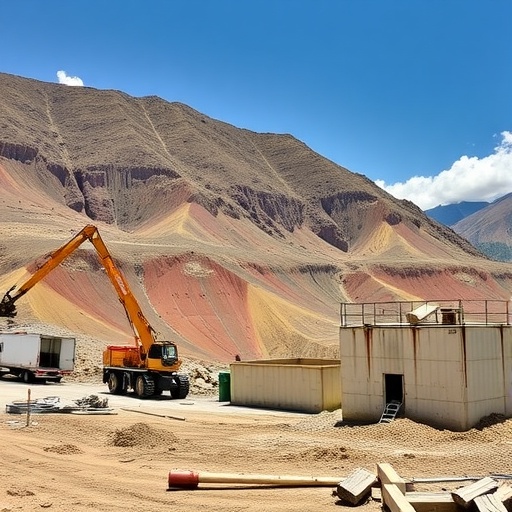
In an era where the intersection of environmental sustainability and mining operations is increasingly scrutinized, a groundbreaking study from Wang, Zhan, and Zhou at Hongqinghe Mine offers unprecedented insights into ground subsidence phenomena. Leveraging a multifaceted approach using various data sources, this research unravels the complex subsidence mechanisms that pose significant challenges to both the mining industry and environmental management spheres.
Ground subsidence, the gradual sinking or sudden collapse of the earth’s surface, often follows extensive underground mining operations. Its impact can be profound, as it threatens the structural integrity of infrastructure, alters natural landscapes, and disrupts ecosystems. The Hongqinghe Mine, a site characterized by extensive underground excavations, presents a unique laboratory to study these effects with enhanced precision.
One of the standout features of this study is its integrative methodology, combining satellite radar interferometry (InSAR), ground-based monitoring, and geotechnical data. This combination allows for a more comprehensive analysis of the surface deformation patterns over time. Unlike traditional single-source investigations, this approach provides increased accuracy and temporal resolution, unlocking the dynamic evolution of subsidence phenomena post-mining.
The application of multi-temporal InSAR data was crucial in capturing subtle shifts in the land surface at Hongqinghe Mine. Advanced processing algorithms interpreted phase differences in radar signals, revealing millimeter-scale deformation over extended periods. This continuous remote sensing capability ensures real-time monitoring possibilities for mining operations, potentially preventing catastrophic failures associated with unexpected subsidence.
Ground-based monitoring complements remote observations by providing detailed geotechnical parameters such as soil moisture content, stress distribution, and micro-seismic activities. These data sets enhance the understanding of sub-surface processes triggering subsidence, elucidating how excavation depth, geological composition, and water table fluctuations interplay. The integration fosters a more holistic model of subsidence mechanisms relevant for predictive analytics.
Crucially, Wang and collaborators identified distinct spatial patterns of surface settlement tied to the mine’s layout and extraction sequence. Areas directly above heavily mined sections exhibited pronounced sinking, while regions at the periphery experienced differential deformation. This spatial heterogeneity underscores the necessity for localized risk assessments rather than broad, generalized models often employed in environmental risk management.
The temporal dimension further revealed that subsidence at Hongqinghe Mine follows a non-linear progression. Initial phases post-excavation showed accelerated land surface lowering, which plateaued or slowed with time, influenced by geological consolidation and stress redistribution underground. Understanding this temporal variability allows for optimized scheduling of mining activities to minimize environmental and infrastructural damage.
Mechanistically, the research highlights that mine-induced subsidence results from a combination of mechanical failure within rock strata and fluid migration disturbances. Excavation relieves confining stresses, triggering fractures and collapses, while water movement modulates pore pressures affecting ground stability. This nuanced view challenges oversimplified explanations focusing solely on rock deformation, advancing engineering practices.
From an environmental management perspective, the study emphasizes that subsidence effects extend beyond immediate ground settlement. Altered hydrological pathways can modify surface water flow and groundwater recharge zones, impacting ecosystems and agricultural land in surrounding communities. The comprehensive data-driven approach adopted provides a blueprint for sustainable planning and risk mitigation.
The implications for mining engineering are equally significant. Incorporating multi-source data enables the development of predictive subsidence models that can be integrated into real-time mining operation controls. This foresight ensures that adaptive strategies can be deployed swiftly, preserving mine safety while reducing environmental footprints. Such data-driven decision frameworks represent a leap towards green mining technologies.
Furthermore, the research establishes a replicable methodology that other mining regions worldwide can adopt to deepen their understanding of subsidence dynamics. By harnessing satellite remote sensing combined with ground instruments, resource extraction industries can transition into a new paradigm of transparency and environmental responsibility, responding conscientiously to societal demands.
Wang, Zhan, and Zhou’s work also opens avenues for interdisciplinary collaborations involving geologists, civil engineers, environmental scientists, and policymakers. Their integrative approach offers insights that can inform guidelines and regulations governing mining activities, ensuring comprehensive oversight rooted in empirical evidence rather than conjecture.
The long-term monitoring techniques employed promise to serve not only mining but also urban planning and disaster risk reduction sectors. Many urban areas worldwide lie above former or active mining sites; hence, understanding subsidence patterns is critical in retrofitting infrastructures and safeguarding human populations from geological hazards.
Finally, their study underscores the critical importance of transparent data sharing and technological advancements in mining hazard assessment. The synergy between satellite platforms, advanced sensors, and computational modeling epitomizes the future of earth sciences—dynamic, precise, and socially responsible. As major mining enterprises adopt such sophisticated monitoring regimes, communities adjacent to mining areas stand to benefit from enhanced safety and environmental stewardship.
In conclusion, the research conducted at Hongqinghe Mine sets a new standard in subsidence analysis, transforming how we perceive and manage the environmental consequences of underground mining. By merging multiscale, multisource data with rigorous scientific inquiry, Wang and colleagues not only elucidate the physical processes at play but also pave the way for safer and more sustainable mining practices worldwide. The integration of modern technology with traditional geological understanding represents a cornerstone for the future of environmental earth sciences amidst growing resource extraction demands.
Cite Scienmag News
Violet Maxwell. (December 11, 2025). Studying Hongqinghe Mine Subsidence via Multi-Source Data. Scienmag. https://scienmag.com/studying-hongqinghe-mine-subsidence-via-multi-source-data/
Violet Maxwell. "Studying Hongqinghe Mine Subsidence via Multi-Source Data." Scienmag, 11 December 2025, https://scienmag.com/studying-hongqinghe-mine-subsidence-via-multi-source-data/. Accessed 6 September 2026.
Violet Maxwell. "Studying Hongqinghe Mine Subsidence via Multi-Source Data." Scienmag. December 11, 2025. https://scienmag.com/studying-hongqinghe-mine-subsidence-via-multi-source-data/


