


A new study led by autistic people and researchers from the University of Technology Sydney (UTS) sheds light on the challenges faced by autistic girls, women and gender diverse people within healthcare, the education system and society.

Credit: Image courtesy University of Technology Sydney.
A new study led by autistic people and researchers from the University of Technology Sydney (UTS) sheds light on the challenges faced by autistic girls, women and gender diverse people within healthcare, the education system and society.
The research paper titled ‘Nothing About Us, Without Us’: Research Priorities for Autistic Girls, Women and Gender Diverse People in Australia, highlights the urgent need for inclusive supports to maximise the wellbeing of autistic people and provides key considerations for the National Autism Strategy that is currently under community consultation.
Study co-lead Dr Rachel Grove from the UTS School of Public Health, said the research aims to address the longstanding gaps in understanding the experiences of autistic women, girls and gender diverse people.
“Historically, autism has been viewed through a gendered lens with incorrect assumptions that only boys can be autistic, resulting in oversight and inadequate support.
“It was critical to ensure that autistic people undertook the research,” said Dr Grove.
Sarah Gurrin, an autistic co-lead on the project said autistic people have often been studied by academics with no lived experience and a narrow view of what autism is.
“This is vital research to help ensure there is not another lost generation of autistic girls, women and gender diverse people.”
The researchers heard from over 100 autistic girls and gender diverse people aged from 7 to 17. Parents and health professionals were deliberately excluded to prioritise the perspectives of autistic youth.
As Hayley Clapham, an autistic co-lead in the research explains, “for too long autism research focused on children and young people has predominantly reflected the perspectives of clinicians, educators and parents.
“To ensure that research accurately responds to the needs and experiences of autistic young people, it is crucial that researchers prioritise their inclusion in the shaping and informing of research and outcomes that directly impact their lives.”
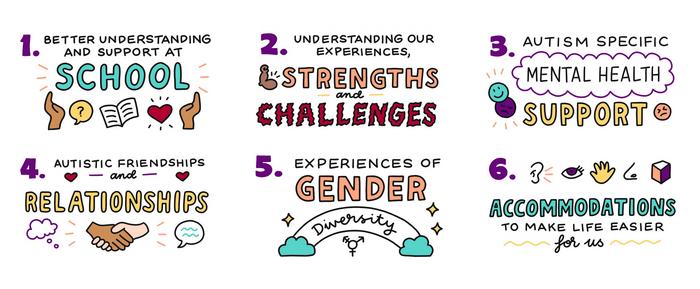
The findings, distilled into six key research priority areas for autistic young people, provide a roadmap for meaningful change.
The foremost concern expressed by autistic girls and gender diverse young people was the need for greater understanding and support at school, including tailored inclusive support across all educational environments.
One autistic young person told the researchers:
“The fact is that I can be in a school system where I don’t receive the support I need because I’m not visibly struggling. I think there needs to be more awareness spread of how autism looks and that it’s not a little mould that someone can fit into.”
Autistic girls and gender diverse young people also want a better understanding of their experiences, strengths and challenges related to puberty, sensory differences, self-regulation needs, and to see themselves represented in society and the media.
As one autistic young person put it:
“I didn’t really see representation of an autistic person that looked or acted like me, a girl, a teenager, all of these things.”
The third priority outlines the pressing need for specialised mental health services tailored to the autistic experience. This is critical given autistic women are 83% more likely to lose their life by suicide than the general population.
One young person said:
“I spent years struggling in school until I mentally broke … Why does it take so long to help autistic females? Why do we have to be mentally exhausted?”
Other research priorities included friendships and relationships, and inclusive policies and resources that affirm and respect diverse gender identities and focus on support first. The researchers say this is critical given the greater gender diversity among autistic people.
The final research priority focuses on accommodations to make life easier, such as practical adjustments that alleviate stress, build capacity and promote autonomy.
The researchers also spoke to over 300 autistic women and gender diverse adults, with a further eight key priorities identified, including understanding experiences of trauma, abuse and sexual violence, and addressing barriers in healthcare, education and the workplace.
One autistic adult spoke of the importance of recognising the strengths of autistic young people and supporting them to flourish:
“I think these girls, these strengths and these brains need to be embraced and utilised. These brilliant, brilliant human beings… I wished that I had those tools, and that I was allowed to thrive and to be who I am when I was that young.”
Tess Moodie, an autistic co-lead in the research said, “for years we have been saying there should be nothing about us without us.
“I am hopeful this will set the standard for commitments from future researchers, both for the priorities, but also in authentically collaborating with autistic people in co-development of research.
“This work sets the agenda for future research to help autistic young people live better lives in our neurotypical-centred world.”
Journal
Journal of Autism and Developmental Disorders
Method of Research
Survey
Subject of Research
People
Article Title
Autistic-led study reveals urgent priorities for supporting autistic girls and gender diverse youth
Article Publication Date
6-May-2024
COI Statement
The authors have no competing interests to declare that are relevant to the content of this article.
Cite Scienmag News
Courtney Benton. (May 22, 2024). Autistic-led study reveals urgent priorities for supporting autistic girls and gender diverse youth. Scienmag. https://scienmag.com/autistic-led-study-reveals-urgent-priorities-for-supporting-autistic-girls-and-gender-diverse-youth/
Courtney Benton. "Autistic-led study reveals urgent priorities for supporting autistic girls and gender diverse youth." Scienmag, 22 May 2024, https://scienmag.com/autistic-led-study-reveals-urgent-priorities-for-supporting-autistic-girls-and-gender-diverse-youth/. Accessed 3 September 2026.
Courtney Benton. "Autistic-led study reveals urgent priorities for supporting autistic girls and gender diverse youth." Scienmag. May 22, 2024. https://scienmag.com/autistic-led-study-reveals-urgent-priorities-for-supporting-autistic-girls-and-gender-diverse-youth/

