


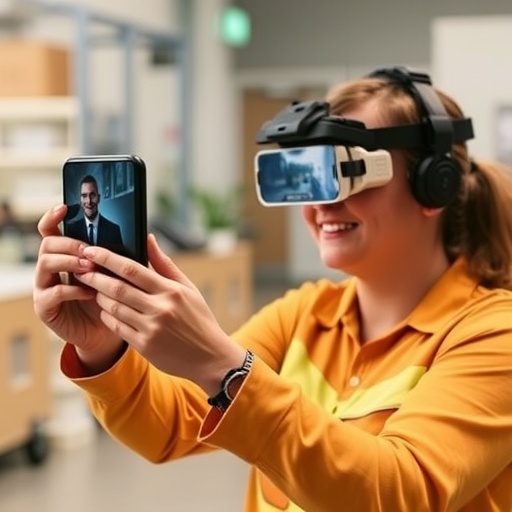
In a groundbreaking advancement that promises to redefine workforce integration for individuals with intellectual and developmental disabilities (IDD), researchers at Florida Atlantic University have unveiled a revolutionary augmented reality (AR) job coaching system. This innovative technology seamlessly combines real-time, context-sensitive guidance with user-friendly interfaces to empower individuals facing cognitive and social challenges to execute complex job tasks independently. Such a breakthrough comes amidst a pressing need to close the employment gap that currently sees only a fraction—approximately 15 percent—of people with IDD engaged in competitive work environments.
Employment offers much more than financial stability; it fosters self-worth, community belonging, and social health. Yet, many with developmental disabilities encounter systemic barriers that hinder their ability to obtain and maintain meaningful employment. Traditional programs have attempted to mitigate these challenges through supported employment services, which rely heavily on one-on-one job coaching, and customized employment approaches. However, these solutions confront substantial issues including high turnover rates among coaches, erratic support consistency, and difficulties navigating workplace social norms. Recognizing these persistent obstacles, Florida Atlantic University embarked on developing an AR-based job coach designed to enhance task accuracy and accelerate training paradigms.
The AR application developed by the FAU team operates by overlaying digital instructions and prompts directly onto the physical workspace of the user. Tailored to break down intricate tasks into manageable steps, the system provides immediate feedback and guidance aligned with the user’s current context. This means that the technology not only instructs what to do but adapts dynamically, offering real-time assistance as users engage with their tasks. This is particularly transformative for roles requiring continual attention, problem-solving, and cognitive flexibility—areas where individuals with IDD often need additional support.
To rigorously evaluate the technology’s impact, the study enlisted participants to simulate the role of library assistants responsible for shelving books—an occupation chosen for its demand on sequential task performance, reading, listening, and situational judgment. These skill sets typically present significant hurdles for individuals with intellectual impairments when supported only by conventional training. The research investigated whether the AR intervention could foster increased task independence and accuracy, compared to baseline performance without technological aid.
The results were nothing short of extraordinary. Initially, participants succeeded in completing a mere 14% of the task steps accurately, underscoring the complexity of the role without additional support. As soon as the AR-based coaching was introduced, accuracy soared to an astonishing 93%, with some individuals achieving flawless 100% performance. Every participant met the mastery criterion by consistently executing at least 90% of the task steps independently over consecutive sessions. This leap in effectiveness demonstrates the power of context-aware AR applications to break down cognitive and environmental challenges, providing personalized scaffolding precisely when and where it is needed.
One of the most compelling implications of the research is the dramatic reduction in training time. Whereas traditional job coaching methods for similar work duties conventionally require months of ongoing engagement, the AR approach enabled participants to reach high levels of proficiency within a single 15-minute session of AR-supported training. This accelerated learning curve not only benefits the learners but also presents a more efficient and scalable pathway for employment programs operating under constrained resources.
From a technical perspective, the development of this AR job coach required sophisticated integration of wearable devices, computer vision algorithms, and user-centered design principles. The system’s ability to interpret task environments and generate adaptive instructional cues relies on real-time data processing embedded within accessible hardware. This convergence of cutting-edge technologies aligns with emerging trends in human-computer interaction, where augmenting human capabilities through seamless digital assistance is becoming increasingly viable.
Moreover, the implementation of AR in supporting workers with IDD could herald a paradigm shift in how workplace accommodations and training are delivered. By decentralizing coaching from heavy reliance on human supervisors to digitally augmented assistance, the approach has the potential to alleviate workforce shortages, reduce costs, and provide uniform quality of support. Such scalability offers a promising solution to longstanding systemic inefficiencies in supported employment programs across industries.
Senior author Dr. Ayse Torres emphasized the transformative potential of AR, highlighting how breaking down complex duties into manageable prompts enables individuals to navigate job requirements with unprecedented independence. This shift not only propels workforce inclusion but also resonates with broader societal imperatives to harness technology for social good, ensuring no demographic is marginalized in the evolving labor landscape.
The study’s publication in Focus on Autism and Other Developmental Disabilities marks a pivotal entry in the intersection of technology, rehabilitation, and vocational training research. It also underscores Florida Atlantic University’s commitment to pushing boundaries in assistive tech innovation, with collaborative efforts spanning biomedical engineering, special education, software development, and library sciences. Such multidisciplinary collaboration has been central to developing an application that is both technically robust and pedagogically sound.
Financial sustainability further bolsters the case for widespread adoption of this AR coaching technology. Although initial investments are required for device deployment and software development, the reduced need for continuous one-on-one human coaching translates into long-term cost savings for service providers and employers alike. The system’s capacity to serve numerous users simultaneously, without proportional increases in overhead, aligns with visions for scalable, inclusive workforce policies.
Looking ahead, this pioneering research sets the stage for expanding AR-assisted employment tools to a wider array of vocational roles and disability profiles. Continued refinement of the technology could integrate machine learning capabilities to personalize coaching further, track user progress, and dynamically optimize instructional strategies. Such innovations hold promise not only for individuals with IDD but for diverse populations seeking enhanced training and support in complex occupational landscapes.
As technology continues to reshape the nature of work through automation, artificial intelligence, and immersive experiences, ensuring equitable access remains critical. Florida Atlantic University’s AR job coaching system exemplifies how technological innovation can serve as a powerful equalizer, bridging gaps between potential and opportunity. By empowering individuals with intellectual and developmental disabilities to thrive in the workforce, this initiative advances a future where employment truly offers a gateway to dignity, autonomy, and societal inclusion for all.
News Publication Date: 18-Jan-2026
Web References:
References:
Published in Focus on Autism and Other Developmental Disabilities, DOI: 10.1177/10883576251407604
Cite Scienmag News
Courtney Benton. (March 11, 2026). Augmented Reality Job Coaching Enhances Performance by 79% for Individuals with Disabilities, Study Finds. Scienmag. https://scienmag.com/augmented-reality-job-coaching-enhances-performance-by-79-for-individuals-with-disabilities-study-finds/
Courtney Benton. "Augmented Reality Job Coaching Enhances Performance by 79% for Individuals with Disabilities, Study Finds." Scienmag, 11 March 2026, https://scienmag.com/augmented-reality-job-coaching-enhances-performance-by-79-for-individuals-with-disabilities-study-finds/. Accessed 4 September 2026.
Courtney Benton. "Augmented Reality Job Coaching Enhances Performance by 79% for Individuals with Disabilities, Study Finds." Scienmag. March 11, 2026. https://scienmag.com/augmented-reality-job-coaching-enhances-performance-by-79-for-individuals-with-disabilities-study-finds/


