


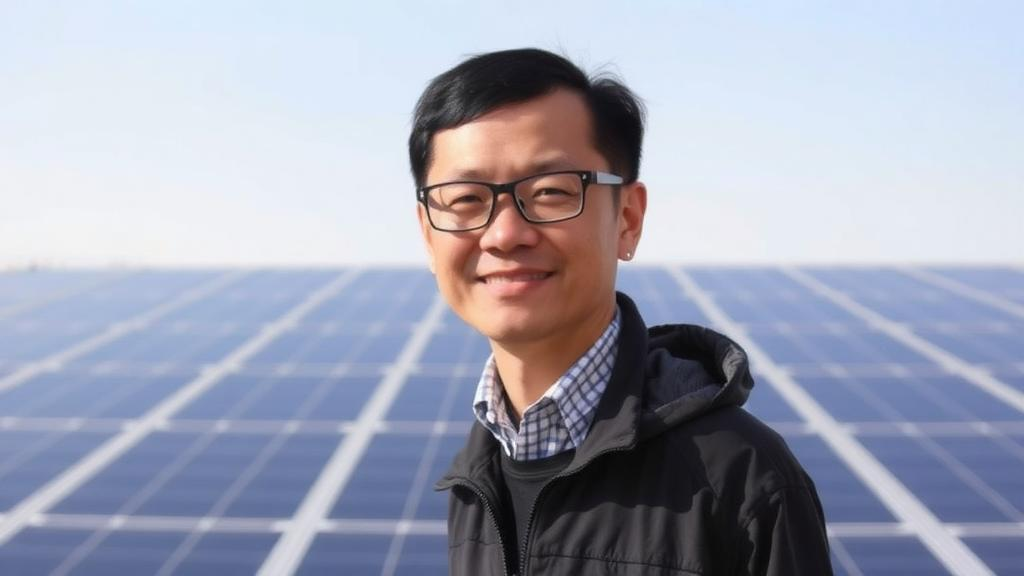
Chen Shi, an assistant professor in Auburn University’s Department of Physics, has received a 2026 Kamide Lecture Award from the Asia Oceania Geosciences Society, one of the largest international bodies dedicated to Earth and space sciences. The award, presented annually to outstanding early-career researchers selected by the society’s scientific sections, recognized Shi’s contributions to understanding plasma turbulence, the origin of the solar wind, and the physical processes that shape the space environment surrounding Earth. Shi was nominated and chosen by the society’s Solar and Terrestrial Sciences Section, a community of researchers who study the Sun, the interplanetary medium, and the complex interactions between solar activity and planetary systems.
The honor carries particular weight within the field because the Kamide Lecture Awards are named in memory of Wallace Kunio Kamide, a highly influential figure in geomagnetism and space physics whose work shaped decades of research on magnetospheric dynamics. Receiving a lecture award in this tradition means the recipient is invited to deliver a plenary-style talk summarizing both the historical development of a research area and their own contributions to it. Shi delivered his award lecture, titled “Generation of Supersonic Solar Wind: The Role of Plasma Turbulence,” at the 2026 AOGS Annual Meeting in Fukuoka, Japan, before an audience of solar and terrestrial scientists from across the Asia-Pacific region and beyond.
“This recognition is especially meaningful because it comes from colleagues in the solar and terrestrial sciences community,” Shi said. “The solar wind connects the Sun to Earth and to the rest of the solar system. Understanding how it is heated and accelerated is not only a fundamental question in physics—it is also essential to understanding the space weather that can affect satellites, communications and other technologies.” His remarks underscore the dual character of solar wind research: it addresses deep questions about how magnetized plasmas behave, while simultaneously informing practical forecasts of the conditions that spacecraft, power grids, navigation systems, and radio communications must endure.
The solar wind itself is a continuous, nearly isotropic outflow of electrically charged particles—electrons, protons, and heavier ions—that streams outward from the Sun’s outer atmosphere, the corona, and fills the entire heliosphere. Although the Sun’s immense gravity pulls matter inward at the solar surface, the corona is extraordinarily hot, with temperatures reaching more than a million kelvin, and the gas heated to such extremes can overcome gravity and escape. As the plasma expands, it accelerates to supersonic speeds, sweeping past the planets and carving out the bubble of charged particles and magnetic fields known as the heliosphere. The existence of this outflow was first proposed theoretically by physicist Eugene Parker in 1958, and his foundational model remains the starting point for nearly all modern treatments of the problem.
Parker’s model demonstrated that a hot corona must naturally produce a supersonic wind, and the prediction was spectacularly confirmed by early spacecraft observations. Yet as measurements accumulated over the following decades, a persistent puzzle emerged: the corona and the young solar wind close to the Sun are hotter and faster than thermal conduction and simple adiabatic expansion alone can explain. Something must be continuously adding energy to the plasma, both heating it and accelerating it, and that additional energy source must operate throughout the solar atmosphere and the inner heliosphere. Identifying and quantifying that missing energy has become one of the central challenges of space physics, and it is precisely the problem at the heart of Shi’s research program.
A leading candidate for the missing energy source is turbulence. The plasma surrounding the Sun is not smooth or laminar; it is filled with fluctuations, waves, and interacting eddies spanning an enormous range of spatial and temporal scales, from structures comparable to the size of the Sun’s magnetic features down to scales at which individual particle orbits matter. Much like swirling air in Earth’s atmosphere, these turbulent motions can transfer energy from large-scale flows into progressively smaller structures through a cascade process. At sufficiently small scales, the cascade connects to the physics of individual charged particles, where turbulent energy may ultimately be converted into heat. If the cascade is efficient enough, and if the dissipation preferentially heats certain particle species, turbulence could supply both the thermal pressure that drives the wind and the acceleration that pushes it to supersonic speeds.
Testing this idea requires observations from inside the region where the solar wind is actually born, and this is where modern spacecraft have transformed the field. NASA’s Parker Solar Probe, launched in 2018, has traveled closer to the Sun than any previous spacecraft, repeatedly dipping through the corona and sampling the young solar wind directly. Its instruments measure magnetic fields, electric fields, plasma waves, and particle distributions with a resolution that earlier missions could not achieve, revealing an inner heliosphere far more turbulent and structured than previously imagined. Shi’s research combines theoretical physics, advanced numerical simulations, and measurements from Parker Solar Probe and other spacecraft to investigate how turbulent energy is transported, cascaded, and dissipated in this environment, connecting the raw data from the probe to the fundamental equations of magnetized plasma dynamics.
In his award lecture in Fukuoka, Shi traced the intellectual arc of the field from Parker’s original model to the present day. He explained why additional energy sources beyond simple thermal expansion are required to reproduce the solar wind observed by spacecraft, and he presented the case for plasma turbulence as the mechanism that supplies the missing energy. By weaving together the historical development of the problem and the newest observational results, the lecture exemplified the spirit of the Kamide Lecture format, which asks recipients to situate their own work within the broader trajectory of their discipline.
“Dr. Shi’s selection for the Kamide Lecture Award is a tremendous distinction and an exciting recognition of the impact of his research,” said Allen Landers, professor and chair of Auburn’s Department of Physics. “Chen is addressing some of the most important unanswered questions in space physics. We are delighted to have him as part of Auburn’s vibrant research program in plasma and space science.” Shi joined Auburn University in 2025, bringing with him a research portfolio that bridges theory, computation, and spacecraft data analysis. He earned a bachelor’s degree in space science and technology from Peking University in 2015 and a doctorate in geophysics and space physics from the University of California, Los Angeles, in 2020, and he subsequently continued at UCLA as a postdoctoral researcher and assistant researcher before moving to Auburn.
Beyond his work on solar wind turbulence, Shi investigates magnetic reconnection, the explosive process by which magnetic field lines rapidly reorganize and release stored magnetic energy into particle motion and heat. Reconnection drives solar flares and coronal mass ejections, powers auroras and geomagnetic storms at Earth, and operates in laboratory and astrophysical plasmas throughout the universe. He also develops high-performance computational codes for large-scale plasma simulations, tools that allow researchers to model processes occurring across scales far too vast for any single observation to capture. Together, these research threads address the solar corona, solar eruptions, and the space-weather events that interact with Earth’s magnetic environment. The Asia Oceania Geosciences Society, which promotes research and international collaboration across atmospheric, oceanic, planetary, solar, terrestrial, and solid-earth sciences, recognized in Shi’s early career a combination of technical depth and scientific breadth that the coming decades of heliophysics research will demand.
Subject of Research: Early-career recognition of research on solar wind generation and plasma turbulence in space physics
Article Title: Auburn physicist Chen Shi receives international early-career research award
Article References: Auburn physicist Chen Shi receives international early-career research award. (n.d.). Original publication
Image Credits: AI Generated
DOI: Not provided
Keywords: Chen Shi, Auburn University, Kamide Lecture Award, Asia Oceania Geosciences Society, solar wind, plasma turbulence, space weather, Parker Solar Probe, magnetic reconnection, heliophysics, Eugene Parker, solar corona
Cite Scienmag News
Katie Riggs. (October 7, 2026). Auburn Physicist Chen Shi Wins International Award for Solar Wind Turbulence Research. Scienmag. https://scienmag.com/auburn-physicist-chen-shi-wins-international-award-for-solar-wind-turbulence-research/
Katie Riggs. "Auburn Physicist Chen Shi Wins International Award for Solar Wind Turbulence Research." Scienmag, 7 October 2026, https://scienmag.com/auburn-physicist-chen-shi-wins-international-award-for-solar-wind-turbulence-research/. Accessed 7 October 2026.
Katie Riggs. "Auburn Physicist Chen Shi Wins International Award for Solar Wind Turbulence Research." Scienmag. October 7, 2026. https://scienmag.com/auburn-physicist-chen-shi-wins-international-award-for-solar-wind-turbulence-research/


