

Tuesday, November 10, 2026
Science
No Result
View All Result
  • Login
  • HOME
  • SCIENCE NEWS
  • CONTACT US
  • HOME
  • SCIENCE NEWS
  • CONTACT US
No Result
View All Result
Scienmag
No Result
View All Result
Home Science News Science Education

Attention-Guided Spatio-Temporal Masking Improves Self-Supervised Skeleton Action Recognition

November 7, 2026
in Science Education
Blake Davidson
By Blake Davidson Scienmag Editorial Profile - Data Science
Reading Time: 2 mins read
0
Attention-Guided Spatio-Temporal Masking Improves Self-Supervised Skeleton Action Recognition

Attention-Guided Spatio-Temporal Masking Improves Self-Supervised Skeleton Action Recognition

65
SHARES
587
VIEWS
Share on FacebookShare on Twitter
ADVERTISEMENT

A self-supervised computational framework named AMST consistently outperforms state-of-the-art methodologies in skeleton-based action recognition across benchmark evaluations, yielding substantial performance gains across diverse evaluation metrics. In extensive experiments conducted on the NTU RGB+D60, NTU RGB+D120, and PKU-MMD benchmark datasets, the framework demonstrated superior performance compared to existing self-supervised methods on downstream action recognition tasks, confirming the transferability of its learned representations.

While skeleton-based action recognition is inherently robust to variations in background and viewpoint, existing self-supervised learning approaches often suffer from temporal redundancy and noisy spatial structures.

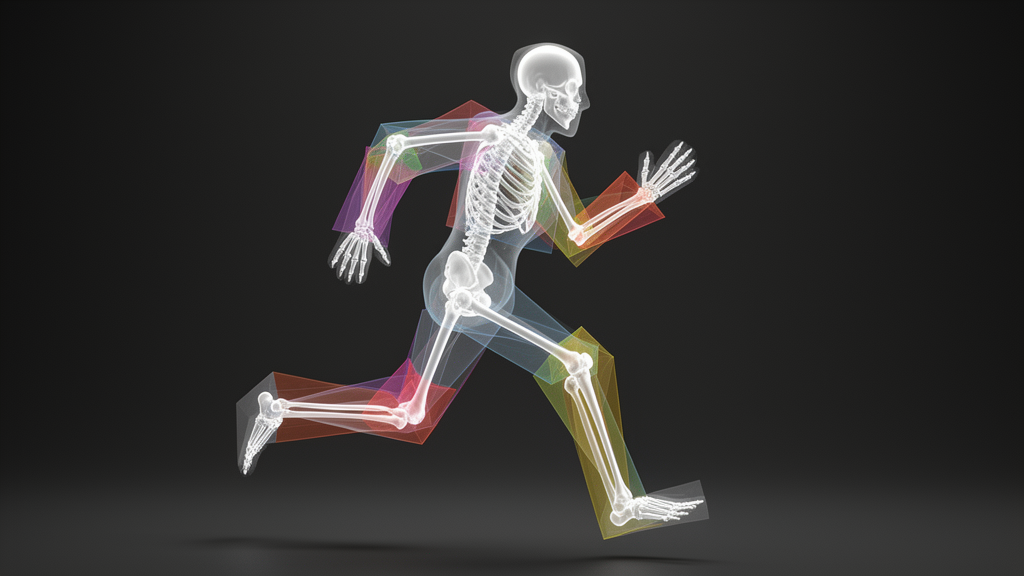
To resolve these vulnerabilities, the researchers designed AMST as an Attention Mask Spatio-Temporal framework utilizing a triple-stream architecture with a shared common encoder. The architecture incorporates an anchor stream that preserves full semantics alongside two specialized masking streams. A temporal masking stream employs Adaptive Temporal Modeling to select motion-salient frames, while a spatial masking stream uses Adaptive Spatial Modeling to capture key joint dependencies across the skeleton.

All three streams sharing the common encoder are optimized via an objective based on Barlow Twins, enforcing representation consistency across views while reducing feature redundancy. By combining adaptive spatio-temporal masking with redundancy reduction, the framework learns robust, transferable skeleton representations that consistently exceed prior self-supervised benchmarks across diverse evaluation metrics.

The empirical verification of the framework relies on downstream action recognition evaluations across three established benchmark collections: NTU RGB+D60, NTU RGB+D120, and PKU-MMD. Across these testing suites, the learned representations demonstrated robust transferability and achieved consistent improvements over existing self-supervised baselines across diverse evaluation metrics, confirming the effectiveness of combining adaptive spatio-temporal masking with redundancy-reducing self-supervised objectives.

Subject of Research: Self-supervised skeleton-based action recognition

Article Title: Self-supervised skeleton action recognition with attention-guided spatio-temporal masking

Article References: Kou, S., Chen, H., Cui, X., & Li, X. (2026). Self-supervised skeleton action recognition with attention-guided spatio-temporal masking. International Journal of Machine Learning and Cybernetics, 17(11), Article 521. https://doi.org/10.1007/s13042-026-03369-x

Image Credits: AI Generated

DOI: 10.1007/s13042-026-03369-x

Keywords: skeleton action recognition, self-supervised learning, spatio-temporal masking, Barlow Twins, attention mechanisms, action recognition, computer vision, machine learning, Self-supervised, skeleton, action, recognition

Cite Scienmag News

Blake Davidson. (November 7, 2026). Attention-Guided Spatio-Temporal Masking Improves Self-Supervised Skeleton Action Recognition. Scienmag. https://scienmag.com/attention-guided-spatio-temporal-masking-improves-self-supervised-skeleton-action-recognition/

Blake Davidson. "Attention-Guided Spatio-Temporal Masking Improves Self-Supervised Skeleton Action Recognition." Scienmag, 7 November 2026, https://scienmag.com/attention-guided-spatio-temporal-masking-improves-self-supervised-skeleton-action-recognition/. Accessed 10 November 2026.

Blake Davidson. "Attention-Guided Spatio-Temporal Masking Improves Self-Supervised Skeleton Action Recognition." Scienmag. November 7, 2026. https://scienmag.com/attention-guided-spatio-temporal-masking-improves-self-supervised-skeleton-action-recognition/

Tags: actionaction recognitionattention mechanismsBarlow Twinscomputer visionMachine learningrecognitionSelf-supervisedself-supervised learningskeletonskeleton action recognitionspatio-temporal masking
Share26Tweet16
Previous Post

Framework Translates Sociohydrology From Systems Thinking Into Real-World Water Management Action

Next Post

Chemically Recycled ABS Proves Viable for 3D-Printed Medical Devices

Related Posts

Research report: A program evaluation for teaching AI prompt engineering for evidence-based medicine to fourth year medical students
Science Education

A program evaluation for teaching AI prompt engineering for evidence-based medicine to fourth year medical students

November 10, 2026
American College of Cardiology Launches Young Scholars Program Across Five Cities
Science Education

American College of Cardiology Launches Young Scholars Program Across Five Cities

November 10, 2026
Machine Learning Reveals Demographic Factors Weakly Predict Antiretroviral Therapy Adherence Barriers
Science Education

Machine Learning Reveals Demographic Factors Weakly Predict Antiretroviral Therapy Adherence Barriers

November 10, 2026
Indonesian Study Shows Values Education Sequentially Builds Children’s Digital Citizenship Literacy
Science Education

Indonesian Study Shows Values Education Sequentially Builds Children’s Digital Citizenship Literacy

November 10, 2026
Prompts Boost Immediate Uptake But Not Long-Term Grammar Gains
Science Education

Prompts Boost Immediate Uptake But Not Long-Term Grammar Gains

November 10, 2026
Generative AI Grammar Support Improves Ethiopian University Students’ Writing Performance
Science Education

Generative AI Grammar Support Improves Ethiopian University Students’ Writing Performance

November 10, 2026
Next Post
Urinary Tract Endometriosis Linked to Lower Physical Health in Clinical Study

Urinary Tract Endometriosis Linked to Lower Physical Health in Clinical Study

  • Mothers who receive childcare support from maternal grandparents show more optimized

    Mothers who receive childcare support from maternal grandparents show more parental warmth, finds NTU Singapore study

    27656 shares
    Share 11059 Tweet 6912
  • University of Seville Breaks 120-Year-Old Mystery, Revises a Key Einstein Concept

    1061 shares
    Share 424 Tweet 265
  • Bee body mass, pathogens and local climate influence heat tolerance

    682 shares
    Share 273 Tweet 171
  • Researchers record first-ever images and data of a shark experiencing a boat strike

    546 shares
    Share 218 Tweet 137
  • Groundbreaking Clinical Trial Reveals Lubiprostone Enhances Kidney Function

    531 shares
    Share 212 Tweet 133
Science

Embark on a thrilling journey of discovery with Scienmag.com—your ultimate source for cutting-edge breakthroughs. Immerse yourself in a world where curiosity knows no limits and tomorrow’s possibilities become today’s reality!

RECENT NEWS

  • Particle Swarm Optimized XGBoost Accurately Predicts Concrete Deep Beam Shear Strength
  • Combined Bone and Muscle Deficits Linked to Falls and Depressive Symptoms
  • Hybrid CNN-Transformer Framework Improves Breast Mass Boundary Segmentation in Mammograms
  • Review Examines Microplastic Exposure Pathways, Toxicological Evidence, and Health Risks

Categories

  • Agriculture
  • Anthropology
  • Archaeology
  • Athmospheric
  • Biology
  • Biotechnology
  • Blog
  • Bussines
  • Cancer
  • Chemistry
  • Climate
  • Earth Science
  • Editorial Policy
  • Marine
  • Mathematics
  • Medicine
  • Pediatry
  • Policy
  • Psychology & Psychiatry
  • Science Education
  • Science News
  • Social Science
  • Space
  • Technology and Engineering

Subscribe to Blog via Email

Enter your email address to subscribe to this blog and receive notifications of new posts by email.

Join 5,150 other subscribers

© 2026 Scienmag - Science Magazine

Welcome Back!

Login to your account below

Forgotten Password?

Retrieve your password

Please enter your username or email address to reset your password.

Log In
No Result
View All Result
  • HOME
  • SCIENCE NEWS
  • CONTACT US

© 2026 Scienmag - Science Magazine

Discover more from Science

Subscribe now to keep reading and get access to the full archive.

Continue reading

