


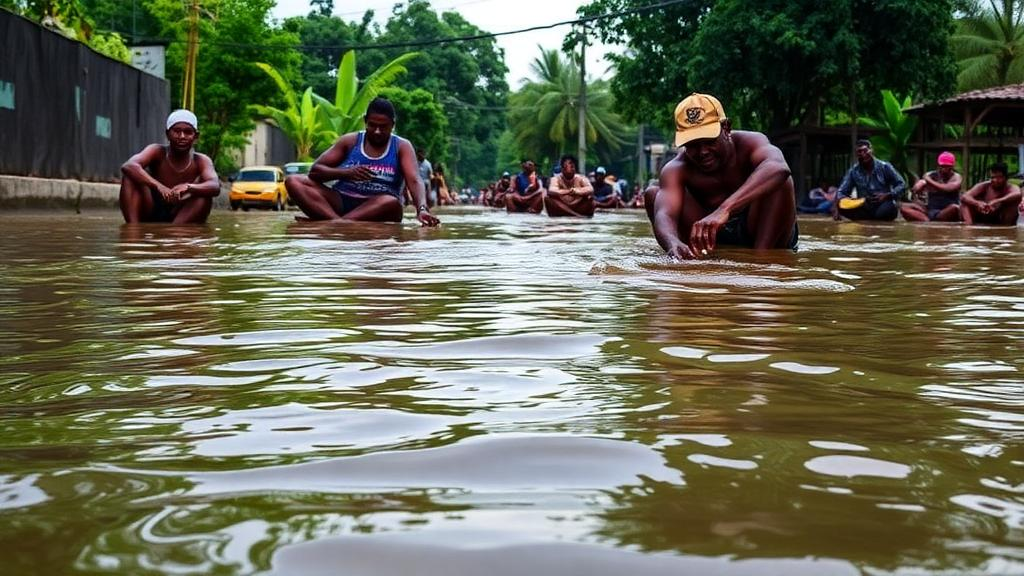
When world leaders, scientists, and activists descended on Belém, Brazil, for the 30th United Nations Climate Change Conference, the host city became a global stage for climate diplomacy. It also became an uncomfortable showcase for its own sanitation deficits. A new study published in Frontiers in Sustainable Cities examines how the Brazilian media framed water and sanitation during COP30, and its findings reveal a striking pattern: although these essential services were highly visible in the news, they were rarely discussed as the fundamental human rights that the United Nations formally recognized in 2010. Instead, coverage overwhelmingly treated water and sanitation as problems of pipes, drainage canals, and engineering—a technical story rather than a story about equity, dignity, and justice.
The research, conducted by Davi Madureira Victral of the Oswaldo Cruz Foundation’s René Rachou Institute and Bruna Silveira de Oliveira of the Federal University of Minas Gerais, applied a mixed-methods content analysis to 143 news articles retrieved from the Google News RSS feed. Data collection took place on 10 March 2026, roughly four months after the conference concluded, a timing choice that allowed the researchers to capture the complete news cycle surrounding the summit, including both immediate event reporting and later retrospective analyses. The team used Boolean search combinations of the terms COP30, water, and sanitation, configured for Brazilian Portuguese and geographically restricted to Brazil, and employed a Python-based extraction pipeline to compile, deduplicate, and organize the corpus.
What distinguishes the study is its analytical framework. Rather than simply tallying how often water appeared in headlines, the researchers coded each article against the normative dimensions of the Human Rights to Water and Sanitation, a framework that defines state obligations across principles including availability, quality and safety, accessibility, affordability, acceptability and dignity, equity and non-discrimination, participation, access to information, accountability, and sustainability. Both authors coded the articles independently, following a predefined protocol, and reached consensus on every article without requiring third-party adjudication. Importantly, coding decisions relied on substantive content rather than explicit rights terminology, meaning that articles discussing service disruptions or unequal access were classified appropriately even when the phrase human rights never appeared.
The thematic results paint a vivid picture of what Brazilian audiences actually read about water during COP30. The single most frequent theme, covering 37 articles or 26 percent of the corpus, was infrastructure works, macrodrainage, and urban legacy in Belém—stories about the rehabilitation of urban canals such as the Tucunduba, Cipriano Santos, and Una, and the promise of post-event improvements. Public policy, water governance, and climate resilience followed with 25 articles, while the historical sanitation deficit of Belém and Brazil’s Northern region, and water and sanitation as climate adaptation strategies, each accounted for 16 articles. Lower-frequency but revealing categories included environmental racism and socioeconomic impacts, bottled water inflation and organizational expenditures, privatization debates, and operational failures such as water interruptions in the conference’s own media centers and public restrooms.
That last detail—the irony of water scarcity at a climate summit held in the Amazon—proved irresistible to major commercial outlets, and it highlights the study’s most significant finding about media fragmentation. When the researchers classified outlets by institutional profile, they found four distinct narrative regimes. Institutional and governmental media, including Portal Gov.br and Agência Brasil, framed water issues through a pro-event, legacy-focused lens emphasizing multi-billion-real investments and Brazil’s leadership in global water governance. Sponsored and private-sector content, often tied to the sanitation company Aegea, used COP30 as a milestone to validate privatization and market-based concessions as the solution to historical deficits. Major commercial outlets adopted a consumer-oriented, fact-driven posture that pivoted toward logistical failures and cost-of-living complaints.
Investigative and independent media told a fundamentally different story. Outlets such as Agência Pública, Outras Palavras, O Joio e o Trigo, Brasil de Fato, and O Eco denounced what they characterized as environmental racism, forced displacement risks, and the marginalization of peripheral, predominantly Black neighborhoods by infrastructure works that prioritized affluent areas. A fifth category of political and fiscal analytical outlets, including Folha de S.Paulo and Congresso em Foco, interrogated expenditure transparency and the incoherence of spending billions on a mega-event while basic needs went unmet. The same underlying facts, in other words, became narratives of progress, market opportunity, consumer grievance, structural injustice, or fiscal irresponsibility depending on who was telling the story.
The rights-based coding quantified these silences with precision. Availability dominated the corpus with 57 coded occurrences, or 20.5 percent of the total, reflecting relentless attention to sewage network gaps, service interruptions, and infrastructure expansion. Sustainability followed with 49 occurrences, encompassing climate resilience, nature-based solutions, and even the hydrological footprint of artificial intelligence data centers promoted as climate tools. Equity and non-discrimination, and quality and safety, each registered 32 occurrences. But the procedural, governance-oriented dimensions of the rights framework fared poorly: accountability appeared only 18 times, participation 17, accessibility 16, and access to information a mere 11. These are the very principles designed to ensure that communities can shape decisions, monitor power, and demand remedies—dimensions that the researchers argue were systematically marginalized.
The cross-analysis of media categories and rights dimensions makes the pattern sharper still. Major commercial media concentrated the highest number of availability references at 22, and dominated affordability coverage with 14 occurrences, largely through stories about inflated bottled-water prices. Investigative and independent outlets led on equity and non-discrimination with 11 occurrences and were the strongest voice for participation with 8. Institutional and governmental media emphasized sustainability with 17 occurrences while contributing almost nothing on affordability. Political and fiscal analytical outlets led on accountability with 7 occurrences. The visibility of any given dimension of the human right to water, the study concludes, depended less on the issue itself than on the editorial identity of the outlet reporting it—a fragmented public sphere in which no single narrative integrated the full rights framework.
Why does this framing gap matter? The authors argue that when water and sanitation are portrayed exclusively as technical and infrastructural challenges, public debate loses sight of the governance failures, distributive inequities, and accountability mechanisms that determine who actually benefits from new pipes and treatment plants. In a city like Belém, marked by persistent territorial inequalities and a large riverside population facing geographical barriers to access, the difference between infrastructure as modernization spectacle and infrastructure as rights fulfillment is not academic. The researchers note that mega-events historically privilege narratives of urban transformation while rendering structural inequalities less visible, and their data suggest COP30 followed this familiar script.
Methodologically, the study also offers a replicable template. By fusing a rights-based coding framework with systematic media content analysis, it demonstrates how communication research can serve as a diagnostic instrument for climate governance itself, revealing which dimensions of justice circulate in the public sphere and which are filtered out. The authors are careful to note that their corpus represents Google News-indexed coverage rather than the entirety of Brazilian media production, and that platform limitations such as algorithmic ranking constrain what such samples can capture. Still, the consistency of the patterns across outlet categories lends confidence to the central conclusion: water and sanitation were not absent from COP30 coverage, but they were only partially incorporated as human rights. How the media frame essential services, the study suggests, ultimately shapes whether urban inequalities become visible in climate politics—or quietly disappear beneath the concrete of the legacy narrative.
Subject of Research: Media framing of the human rights to water and sanitation in coverage of the COP30 climate conference in Belém, Brazil
Article Title: Human rights to water and sanitation at COP30: a comparative media analysis from a climate-vulnerable host city
Article References: Victral, D. M., & Oliveira, B. S. D. (2026). Human rights to water and sanitation at COP30: a comparative media analysis from a climate-vulnerable host city. Frontiers in Sustainable Cities, 8, Article 1895638. https://doi.org/10.3389/frsc.2026.1895638
Image Credits: AI Generated
DOI: 10.3389/frsc.2026.1895638
Keywords: COP30, Belém, human rights to water and sanitation, climate communication, media framing, environmental justice, urban sanitation, climate adaptation, Brazil, content analysis, water governance, climate justice
Cite Scienmag News
Gavin Prescott. (October 15, 2026). At COP30’s Amazon Host City, Water Was Everywhere in the News—but Rarely as a Human Right. Scienmag. https://scienmag.com/at-cop30s-amazon-host-city-water-was-everywhere-in-the-news-but-rarely-as-a-human-right/
Gavin Prescott. "At COP30’s Amazon Host City, Water Was Everywhere in the News—but Rarely as a Human Right." Scienmag, 15 October 2026, https://scienmag.com/at-cop30s-amazon-host-city-water-was-everywhere-in-the-news-but-rarely-as-a-human-right/. Accessed 15 October 2026.
Gavin Prescott. "At COP30’s Amazon Host City, Water Was Everywhere in the News—but Rarely as a Human Right." Scienmag. October 15, 2026. https://scienmag.com/at-cop30s-amazon-host-city-water-was-everywhere-in-the-news-but-rarely-as-a-human-right/


