


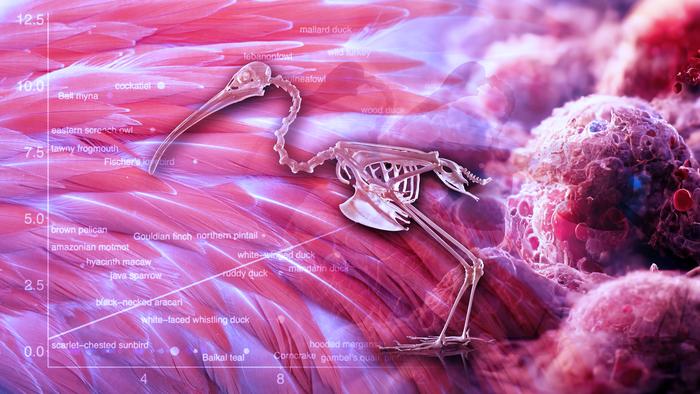
In one of the largest studies of cancer susceptibility across bird species, researchers at Arizona State University describe an intriguing relationship between reproductive rates and cancer susceptibility.

Credit: Graphic by Jason Drees
In one of the largest studies of cancer susceptibility across bird species, researchers at Arizona State University describe an intriguing relationship between reproductive rates and cancer susceptibility.
The research, conducted by an international team of scientists, analyzed data from more than 5,700 bird necropsies across 108 species. They discovered birds that lay more eggs per clutch tend to have higher rates of cancer. The findings shed new light on evolutionary trade-offs between reproduction and survival in birds and have implications for health and disease across the tree of life.
By examining how different energy allocation strategies affect cancer development in birds, researchers gain insights into relevant mechanisms for studying human cancers. This understanding could lead to new strategies for preventing and treating cancer, highlighting the interconnectedness of biological research across species.
“Birds are exceptional for many reasons but one of them is the fact that birds get less cancer than mammals, and we don’t know why,” says Carlo Maley, corresponding author of the new study. “We’d like to understand how birds avoid getting cancer and see if we can use that to help prevent cancer in humans.”
Maley directs the Arizona Cancer and Evolution Center, is a researcher with the Biodesign Center for Biocomputing, Security and Society, and is a professor with the School of Life Sciences at ASU.
The group’s findings appear in the Oxford Academic journal Evolution, Medicine, and Public Health.
The study was conducted by an interdisciplinary team of researchers from Arizona State University, the University of California Santa Barbara, North Carolina State University and several European universities. The team brought together expertise in evolutionary biology, veterinary medicine and cancer research.
Cooperation and cancer
While cancer is an ever-present hazard for nearly all multicellular organisms, the susceptibility and risk factors for cancer in birds have not been as extensively studied as it has in mammals. Birds, and all other organisms, have limited energy resources that they can allocate to various functions. When more energy is devoted to reproduction, less is available for maintaining the health of the body, potentially leading to a higher risk of diseases, including cancer.
Life history theory is a part of evolutionary ecology that examines how evolutionary pressures shape the trade-offs between different life functions. In birds, species that have high reproductive rates and invest heavily in raising offspring have less energy available for DNA repair, making them more susceptible to cancer. The same may be true in mammals, as the authors have previously shown.
Such studies also help to explain why some long-lived species, which tend to have fewer offspring and invest more in maintenance and longevity, might have lower cancer rates. In contrast, species with high reproductive rates and shorter lifespans may prioritize reproduction over longevity and maintenance, increasing their vulnerability to cancer.
“It is interesting that depending on the reproductive trait that we focus on, the trade-off between reproduction and bodily maintenance is not always clear,” says co-first author Stefania Kapsetaki. “For example, investing in a trait linked to increased reproduction does not always mean less investment in a trait linked with bodily maintenance. It is important to bear in mind that patterns of avian cancer prevalence are affected by multiple interacting components, some known and others yet to be discovered.”
The study found no significant correlation between body size or lifespan and cancer risk in birds, contrary to what might be expected. These results highlight a phenomenon in biology called “Peto’s paradox,” in which larger, longer-lived animals sometimes display lower cancer rates despite having more cells that could potentially become cancerous.
In earlier research, Maley and his colleagues explored how large mammals, including whales and elephants, have developed sophisticated strategies of cancer suppression, which may hold clues in the battle against human cancers.
The current study finds that birds with larger clutch sizes (more eggs per brood) had significantly higher rates of malignant cancers. This suggests a potential trade-off between reproduction and cancer defense mechanisms. Other factors like incubation length, physical differences between males and females, and the bird’s sex were not significantly associated with cancer prevalence.
Costs of reproduction
The findings add to a growing body of evidence linking reproductive investment to the risk of disease in animals. The researchers used advanced statistical techniques to account for the evolutionary relationships between different bird species, allowing them to identify patterns that likely arose from natural selection rather than chance. This suggests there may be optimal levels of cancer defense for different ecological niches, which can occasionally shift due to environmental changes.
Data on cancer susceptibility came from necropsies performed at 25 different zoological institutions over 25 years, and the life history information was compiled from existing scientific databases on bird biology. The researchers emphasized their findings are based on birds living under human care, which may differ from wild populations in some respects.
Avenues for future research
The study opens new questions for future investigation: What are the molecular mechanisms underlying the relationship between clutch size and cancer risk? How do ecological factors influence cancer susceptibility in wild bird populations? And for the bird species that have extremely low cancer rates, how are they preventing cancer?
The findings could have implications for the care and conservation of bird species.
Zoos and wildlife centers may need to consider cancer screening more carefully for species with larger clutch sizes. Further, conservation efforts for endangered bird species may benefit from considering cancer risk as part of overall population health management.
The research demonstrates the value of applying evolutionary thinking to cancer biology. By studying how different species manage the risk of cancer, researchers may uncover new strategies for prevention and treatment that could benefit both human and veterinary medicine.
Method of Research
Literature review
Subject of Research
Animals
Article Title
Life history traits and cancer prevalence in birds
Article Publication Date
27-Jun-2024
Cite Scienmag News
Nathaniel Bowman. (July 31, 2024). ASU researchers explore cancer susceptibility in birds. Scienmag. https://scienmag.com/asu-researchers-explore-cancer-susceptibility-in-birds/
Nathaniel Bowman. "ASU researchers explore cancer susceptibility in birds." Scienmag, 31 July 2024, https://scienmag.com/asu-researchers-explore-cancer-susceptibility-in-birds/. Accessed 3 September 2026.
Nathaniel Bowman. "ASU researchers explore cancer susceptibility in birds." Scienmag. July 31, 2024. https://scienmag.com/asu-researchers-explore-cancer-susceptibility-in-birds/

