


“[…] this study is an initial examination of the associations between epigenetic and transcriptomic aging biomarkers and novel NMR lipoprotein biomarkers.”

Credit: 2024 Raab et al.
“[…] this study is an initial examination of the associations between epigenetic and transcriptomic aging biomarkers and novel NMR lipoprotein biomarkers.”
BUFFALO, NY- May 7, 2024 – A new research paper was published in Aging (listed by MEDLINE/PubMed as “Aging (Albany NY)” and “Aging-US” by Web of Science) Volume 16, Issue 8, entitled, “Associations among NMR-measured inflammatory and metabolic biomarkers and accelerated aging in cardiac catheterization patients.”
Research into aging has grown substantially with the creation of molecular biomarkers of biological age that can be used to determine age acceleration. Concurrently, nuclear magnetic resonance (NMR) assessment of biomarkers of inflammation and metabolism provides researchers with new ways to examine intermediate risk factors for chronic disease.
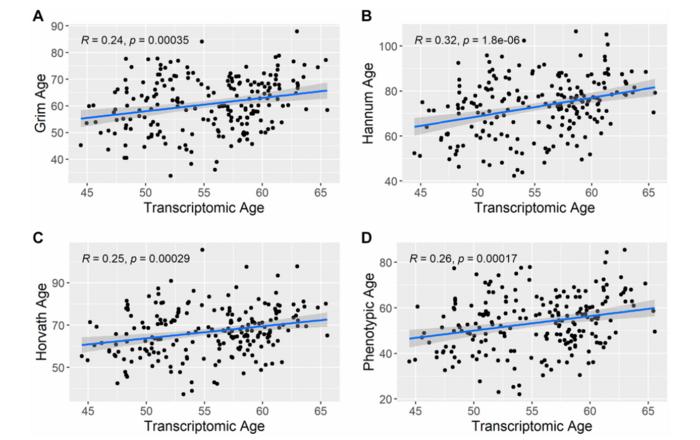
In this new study, researchers Henry Raab, Elizabeth R. Hauser, Lydia Coulter Kwee, Svati H. Shah, William E. Kraus, and Cavin K. Ward-Caviness from the U.S. Environmental Protection Agency and Duke University used data from a cardiac catheterization cohort to examine associations between biomarkers of cardiometabolic health and accelerated aging assessed using both gene expression (Transcriptomic Age) and DNA methylation (Hannum Age, GrimAge, Horvath Age, and Phenotypic Age).
“This study utilizes the CATHGEN cohort from the Jiang et al. study to investigate associations between multiple epigenetic and transcriptomic aging biomarkers and a broad array of NMR-based measures of inflammation, lipid homeostasis, and diabetes risk.”
Linear regression models were used to associate accelerated aging with each outcome (cardiometabolic health biomarkers) while adjusting for chronological age, sex, race, and neighborhood socioeconomic status. Their study shows a robust association between GlycA and GrimAge (5.71, 95% CI = 4.36, 7.05, P = 7.94 × 10⁻¹⁶), Hannum Age (1.81, 95% CI = 0.65, 2.98, P = 2.30 × 10⁻³), and Phenotypic Age (2.88, 95% CI = 1.91, 3.87, P = 1.21 × 10⁻⁸). The researchers also saw inverse associations between apolipoprotein A-1 and aging biomarkers.
“These associations provide insight into the relationship between aging and cardiometabolic health that may be informative for vulnerable populations.”
Read the full paper: DOI: https://doi.org/10.18632/aging.205758
Corresponding Author: Cavin K. Ward-Caviness
Corresponding Email: ward-caviness.cavin@epa.gov
Click here to sign up for free Altmetric alerts about this article.
About Aging:
Aging publishes research papers in all fields of aging research including but not limited, aging from yeast to mammals, cellular senescence, age-related diseases such as cancer and Alzheimer’s diseases and their prevention and treatment, anti-aging strategies and drug development and especially the role of signal transduction pathways such as mTOR in aging and potential approaches to modulate these signaling pathways to extend lifespan. The journal aims to promote treatment of age-related diseases by slowing down aging, validation of anti-aging drugs by treating age-related diseases, prevention of cancer by inhibiting aging. Cancer and COVID-19 are age-related diseases.
Aging is indexed by PubMed/Medline (abbreviated as “Aging (Albany NY)”), PubMed Central, Web of Science: Science Citation Index Expanded (abbreviated as “Aging‐US” and listed in the Cell Biology and Geriatrics & Gerontology categories), Scopus (abbreviated as “Aging” and listed in the Cell Biology and Aging categories), Biological Abstracts, BIOSIS Previews, EMBASE, META (Chan Zuckerberg Initiative) (2018-2022), and Dimensions (Digital Science).
Please visit our website at www.Aging-US.com and connect with us:
- X, formerly Twitter
- YouTube
- Spotify, and available wherever you listen to podcasts
Click here to subscribe to Aging publication updates.
For media inquiries, please contact media@impactjournals.com.
Aging (Aging-US) Journal Office
6666 E. Quaker Str., Suite 1B
Orchard Park, NY 14127
Phone: 1-800-922-0957, option 1
###
Journal
Aging-US
Method of Research
Observational study
Subject of Research
People
Article Title
Associations among NMR-measured inflammatory and metabolic biomarkers and accelerated aging in cardiac catheterization patients
Article Publication Date
23-Apr-2024
Cite Scienmag News
Beatrice Stafford. (May 7, 2024). Association of inflammatory and metabolic biomarkers and accelerated aging in cardiac catheterization patients. Scienmag. https://scienmag.com/association-of-inflammatory-and-metabolic-biomarkers-and-accelerated-aging-in-cardiac-catheterization-patients/
Beatrice Stafford. "Association of inflammatory and metabolic biomarkers and accelerated aging in cardiac catheterization patients." Scienmag, 7 May 2024, https://scienmag.com/association-of-inflammatory-and-metabolic-biomarkers-and-accelerated-aging-in-cardiac-catheterization-patients/. Accessed 3 September 2026.
Beatrice Stafford. "Association of inflammatory and metabolic biomarkers and accelerated aging in cardiac catheterization patients." Scienmag. May 7, 2024. https://scienmag.com/association-of-inflammatory-and-metabolic-biomarkers-and-accelerated-aging-in-cardiac-catheterization-patients/

