


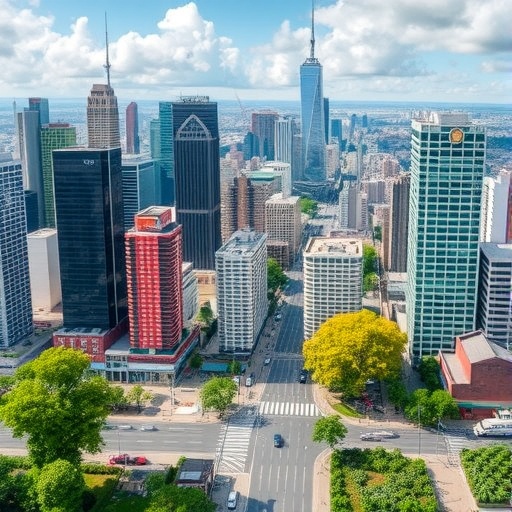
In recent years, the pursuit of urban sustainability has become a paramount objective for cities across the globe. The challenges posed by rapid urbanization, environmental degradation, and social inequality have necessitated innovative approaches to city planning and management. A groundbreaking study set to be published in npj Urban Sustainability in 2026, authored by Yuan, Zhang, Song, and colleagues, takes a significant leap forward in this domain. Their research focuses on assessing progress toward Sustainable Development Goal 11.2 (SDG11.2) through an intricate analysis of functional zones in five major Chinese cities. This pioneering methodology not only provides a fresh lens to gauge urban sustainability but also offers actionable insights for policy makers and urban planners worldwide.
Sustainable Development Goal 11.2 targets the enhancement of public transport and the promotion of safe, affordable, accessible, and sustainable urban mobility. Achieving this goal is critical against the backdrop of escalating commuter populations, growing greenhouse gas emissions from vehicular traffic, and the widening divide between urban cores and their peripheries. The authors employ functional zone analysis, a sophisticated spatial methodology that delineates urban areas based on their primary land uses and human activities. By parsing these functional zones, the study isolates distinct urban fabrics — residential, commercial, industrial, recreational, and mixed-use zones — to examine how they influence sustainable mobility patterns.
The five cities scrutinized in this research span a spectrum of urban profiles and developmental trajectories: Beijing, Shanghai, Guangzhou, Chengdu, and Wuhan. Together, these cities encapsulate the multifaceted challenges of Chinese urbanization, from megacities grappling with congestion to rapidly developing inland hubs. The functional zone approach reveals not only how land-use composition varies within and across these cities but also the complex interplays between urban form, transport infrastructure, and social equity. For example, it highlights how certain zones promote walkability and public transit use, whereas others remain heavily dependent on private vehicles.
At the core of the methodology lies the integration of high-resolution geospatial data, transport network analysis, and demographic information. The researchers harness machine learning algorithms to classify satellite imagery and land-use datasets, effectively mapping out the spatial extent and functional characteristics of each zone. Coupled with transit accessibility indices and population density metrics, this enables a granular evaluation of each city’s alignment with SDG11.2 criteria. Crucially, this data-driven approach moves beyond traditional metrics that often focus narrowly on infrastructure expansion or emissions reduction, offering a holistic perspective.
One of the salient findings of the study is the identification of stark disparities in sustainable mobility access within each city. While central business districts and mixed-use zones generally exhibit robust transit connectivity and active transport options, peripheral residential zones often lag behind, constrained by underdeveloped transport links and sprawling urban designs. This dichotomy underscores systemic inequalities that urban policies must address to fulfill SDG11.2’s equitable mobility mandate. The study’s multi-scalar analysis provides evidence that investment in transit infrastructure needs to be coupled with strategic land-use planning to optimize accessibility.
The research further illuminates the temporal dynamics of urban mobility, acknowledging that functional zones are not static entities but evolve with socio-economic changes, policy interventions, and demographic shifts. By incorporating longitudinal data, the authors track changes in mobility patterns and functional zone configurations over time, offering predictive insights into how sustainable transport systems might fare under various urban development scenarios. This dynamic modeling proves vital for cities undergoing rapid transformation, guiding adaptive policy-making that anticipates future mobility demands.
Importantly, the study also engages with environmental implications tied to sustainable urban mobility. Through detailed emissions modeling associated with transportation modes prevalent in different functional zones, it quantifies the potential ecological benefits of shifting commuter behaviors toward public transit and non-motorized modes. This environmental lens reinforces the interdependence between spatial planning and climate action, emphasizing that well-designed functional zones can significantly mitigate urban carbon footprints and air pollution levels.
Another innovative aspect of the study is its attention to social inclusion. The researchers analyze how accessibility disparities manifest across different socioeconomic groups within the functional zones, highlighting vulnerable communities that risk exclusion from urban opportunities due to mobility constraints. This social equity dimension is critical in ensuring that sustainable urban transport systems serve all residents fairly, promoting inclusive growth and social cohesion. The study advocates for tailored interventions that address these inequities directly within the urban spatial fabric.
The authors extend their investigation by simulating policy interventions at the functional zone level. By modeling the effects of introducing new transit corridors, increasing mixed-use developments, or enhancing pedestrian infrastructure, they demonstrate potential pathways for cities to accelerate progress toward SDG11.2 targets. These scenario simulations are not merely theoretical exercises but are grounded in localized data, making their recommendations highly relevant for city planners. Such actionable insights pave the way for evidence-based urban sustainability practices.
In addition, the study’s multidisciplinary approach showcases the synergy between urban geography, transport engineering, environmental science, and social policy. By harnessing diverse data streams and analytical techniques, the authors set a new benchmark for research on urban sustainability indicators. This integrative framework can be adapted and scaled across different global contexts, providing a replicable model for assessing functional urban zones and their role in sustainable mobility worldwide.
The implications of this research reach far beyond the specific Chinese cities studied. As urban populations continue to swell globally, especially in developing nations, the need for sustainable, accessible transportation systems becomes increasingly urgent. This study’s functional zone lens equips policy makers with a nuanced understanding of how urban form shapes mobility outcomes, informing smarter investments and regulatory strategies tailored to local conditions. Consequently, it contributes substantially to the global discourse on sustainable urban development and the operationalization of SDG11.2.
Moreover, the findings resonate with recent advances in smart city initiatives and digital urbanism. The utilization of AI-driven land-use classification and real-time mobility data integration aligns with the broader trend of leveraging big data analytics for urban management. This convergence opens new horizons where cities can dynamically monitor and adjust transport services and land use planning in response to evolving sustainability goals, thereby enhancing resilience and efficiency.
The study’s comprehensive dataset and transparent methodological framework set a precedent for urban sustainability research transparency. The authors make their datasets and analytical tools available to the academic community, facilitating further scholarly inquiry and collaboration. Such openness accelerates collective efforts to refine sustainability assessments and develop innovative solutions attuned to the spatial complexities of modern cities.
While the study underscores significant progress in some areas, it also candidly acknowledges persistent gaps and challenges. Issues such as urban sprawl, the climate vulnerability of transport infrastructure, and disparities in digital access remain formidable obstacles. Addressing these requires sustained political commitment, cross-sector coordination, and community engagement. The research offers a roadmap but also highlights that achieving SDG11.2 is an ongoing, multifaceted endeavor that demands holistic, integrated policies.
In conclusion, the work of Yuan, Zhang, Song, and their team represents a seminal contribution to the field of urban sustainability. By marrying functional zone analysis with rigorous data analytics and policy-relevant insights, their study provides an indispensable tool for cities striving to create equitable, environmentally sound, and efficient urban mobility systems. As cities worldwide confront the challenges and opportunities of the 21st century, such visionary research will be critical in steering urban futures toward sustainability.
Cite Scienmag News
Sloane Callahan. (March 5, 2026). Assessing Urban Sustainability: SDG11.2 in Five Cities. Scienmag. https://scienmag.com/assessing-urban-sustainability-sdg11-2-in-five-cities/
Sloane Callahan. "Assessing Urban Sustainability: SDG11.2 in Five Cities." Scienmag, 5 March 2026, https://scienmag.com/assessing-urban-sustainability-sdg11-2-in-five-cities/. Accessed 3 September 2026.
Sloane Callahan. "Assessing Urban Sustainability: SDG11.2 in Five Cities." Scienmag. March 5, 2026. https://scienmag.com/assessing-urban-sustainability-sdg11-2-in-five-cities/


