

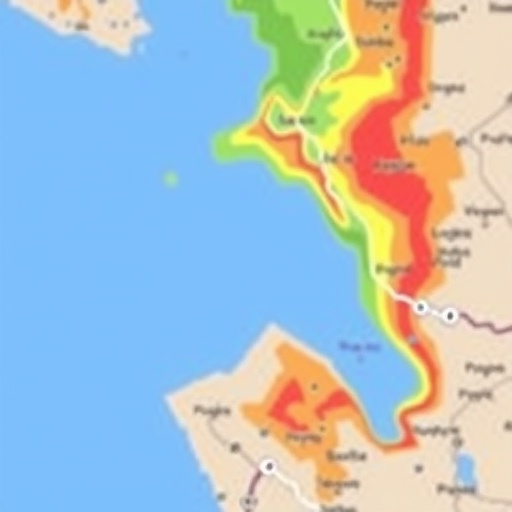
In the Pacific Northwest, seismic hazards have long been associated with major geologic structures such as the Cascadia subduction zone, a colossal fault line situated offshore where the Juan de Fuca Plate slips beneath the North American Plate. This formidable fault garners significant scientific and public concern due to its potential to unleash megathrust earthquakes with catastrophic consequences. However, recent investigations reveal that it is not solely these grand faults that warrant attention; smaller, intricate fault systems located beneath urban centers may play a crucial role in shaping seismic risk. Among these, the Seattle Fault Zone (SFZ), an east-west trending network slicing through Bainbridge Island and the city of Seattle itself, represents a complex and somewhat enigmatic seismic feature deserving closer scrutiny.
Traditionally, assessments in seismic hazard modeling prioritize lengthier, more prominent fault lines, given their well-established capability to generate high-magnitude earthquakes. Shorter faults often fall beneath the radar, omitted from national hazard models due to their perceived limited capacity to produce destructive events. Dr. Stephen Angster, a paleoseismologist with the U.S. Geological Survey’s Earthquake Science Center, challenges this conventional framework through his recent study published in the GSA Bulletin. Angster emphasizes the vital importance of elucidating the temporal and spatial dynamics of these secondary faults within the SFZ to better quantify their rupture frequency and potential impact on densely populated areas, particularly the four million residents of the Seattle metropolitan region.
One of the fundamental difficulties in studying these faults is their sub-surface location, making direct observation challenging. Unlike surface-rupturing faults that leave visible scarps and displacements, many secondary faults of the SFZ are obscured under dense forest canopies and urban infrastructure. To overcome these impediments, Angster and his team employ a multidisciplinary approach, integrating high-resolution lidar imagery to penetrate vegetation cover and detect subtle geomorphic features indicative of previous fault activity. Additionally, magnetic surveys attentive to minute variations in the earth’s bedrock composition provide indirect evidence of fault structures at depth. These geophysical tools collectively enable identification and delineation of previously unmapped faults, facilitating a comprehensive overview of the SFZ’s complexity.
In an innovative methodological step, the researchers excavate trenches across fault scarps revealed by their remote sensing analysis. These trenches expose stratigraphic layers disturbed by seismic events, allowing for the collection of datable organic materials like charcoal and tree remains. Radiocarbon and dendrochronological dating of these samples deliver refined temporal constraints for past rupture events. Through this rigorous paleo-seismological toolkit, Angster’s study reveals that the smaller secondary faults within the SFZ undergo surface-rupturing earthquakes approximately every 350 years. This periodicity signifies an order of magnitude higher frequency compared to the main fault segment, which has rupture intervals spanning over 5,000 years.
Such findings pivotally alter the seismic hazard paradigm for Seattle, indicating a more persistent and localized tectonic activity than previously recognized. These secondary fault ruptures have dominated earth surface deformation in the region over the last two and a half millennia. Notably, the most recent seismic event dated to the nineteenth century correlates with tree mortality evidenced in the trench samples. This revelation intensifies concern given the high population density and critical infrastructure embedded across the fault zone. While the anticipated Cascadia megaquake will undoubtedly produce profound shaking, the Seattle Fault’s smaller yet more frequent ruptures could inflict disproportionate damage precisely where exposure is greatest.
The SFZ accommodates approximately 15% of the regional crustal strain accumulated due to convergent tectonics spanning from Portland, Oregon, northwards into Vancouver, British Columbia. Strain accumulation represents the gradual build-up of mechanical stress within the earth’s lithosphere as tectonic plates and crustal blocks interact. Earthquakes occur when this accumulated energy surpasses frictional resistance along faults, causing abrupt displacement. The SFZ’s role in strain release is thus critical to the broader geodynamic behavior of the Pacific Northwest, influencing seismic hazard assessments for a broad swath of urban and rural communities.
Dr. Angster underscores the essential distinction between main fault and secondary fault behavior within the SFZ. Current seismic hazard models, including the National Seismic Hazard Model employed by U.S. agencies, typically exclude secondary faults due to their short length, which predicts low maximum earthquake magnitudes. However, observational evidence delineated in this study challenges such categorical exclusion. The rupture complexity, including interactions between multiple fault strands at depth and rupture propagation patterns, remains poorly constrained yet is vital for accurate hazard prediction. This study essentially calls for integrating more nuanced fault representations within seismic hazard frameworks to encapsulate local ground-shaking scenarios accurately.
The implications for urban planning and emergency preparedness in Seattle are sizeable. Understanding the recurrence interval of secondary fault ruptures and their potential magnitude can inform building codes, land use policies, and public safety campaigns. Given that these faults experience ruptures more frequently and with significant shaking potential, preparedness efforts must anticipate scenarios not only dominated by rare megaquakes but also by these moderate yet recurrent seismic events. Recognizing this spectrum of hazards enriches resilience strategies for critical infrastructure such as bridges, hospitals, and transportation networks vital to Seattle’s functionality.
Moreover, the relationship between the SFZ’s main fault and secondary faults may influence future rupture progression and earthquake triggering. It remains an open question whether rupture along the main fault could cascade into secondary fault activation and vice versa. Deciphering these interactions demands further geophysical investigations, high-resolution subsurface imaging, and extensive paleoseismic records. Advances in seismic monitoring instrumentation and computational modeling will play an instrumental role in unraveling these complexities and refining probabilistic seismic hazard assessments.
Looking forward, Angster’s team aims to deepen their investigation by employing even more sensitive geophysical methods coupled with broader trenching campaigns to establish a more detailed chronology of seismic events across the SFZ. The goal is to develop a fault interaction model that transcends traditional length-based categorization and incorporates strain partitioning, rupture history, and seismic slip rates across both primary and secondary faults. Such holistic insight promises to revolutionize our comprehension of seismic hazards in metropolitan Seattle, reshaping risk mitigation frameworks accordingly.
While the Cascadia subduction zone remains a dominant feature in Pacific Northwest seismic hazard consciousness, the emerging recognition of the Seattle Fault Zone’s multi-fault complexity and behavior underlines the necessity of broadening our geological scope. Urban centers worldwide are built atop similarly complex fault networks, often concealed beneath surface cover, posing unanticipated risks. This study exemplifies how modern interdisciplinary geoscience approaches, leveraging technological advancements such as lidar and paleo-seismic trenching, enhance hazard detection and allow for more informed societal preparedness.
In summary, the Seattle Fault Zone, with its network of secondary faults rupturing at high frequency, presents a substantial seismic hazard for the region. This contradicts prior assumptions that fault length alone dictates seismic risk. The newly documented rupture periodicity of approximately 350 years for secondary faults contrasts markedly with the millennial-scale cycles of the main fault. Such findings emphasize the urgent need to integrate these complexities into seismic hazard models and public safety planning, thereby safeguarding millions of residents and the vital activities centered around this dynamic and growing urban landscape.
Subject of Research: Earthquake dynamics and rupture history of the Seattle Fault Zone secondary faults
Article Title: Latest Pleistocene to nineteenth-century rupture frequency of secondary faults within the Seattle Fault Zone
News Publication Date: 27-Jan-2026
Web References: http://dx.doi.org/10.1130/B38333.1
Keywords: Geology, Geophysics, Seismology, Earthquakes


