


In a groundbreaking study published in the Journal of Cancer Research and Clinical Oncology, researchers led by Wurschi et al. delve deep into the implications of total neoadjuvant therapy (TNT) for patients suffering from rectal cancer. The primary focus lies not just on survival rates or tumor shrinkage but rather on a holistic aspect that often gets overshadowed in clinical research: the quality of life (QoL) following this intensive treatment. As cancer therapies evolve, the significance of patient well-being and life satisfaction post-treatment remains paramount.
Rectal cancer, prevalent among various demographics worldwide, often necessitates complex and extensive treatment plans, including surgery, chemotherapy, and radiation therapy. Traditional approaches sometimes lead to debilitating side effects that can diminish a patient’s quality of life, making it essential to evaluate new treatment strategies. Total neoadjuvant therapy, aimed at delivering all treatments before surgical intervention, presents a promising alternative, potentially mitigating some of these adverse effects.
The study meticulously analyzed data from a considerable cohort of rectal cancer patients undergoing TNT. Through a combination of questionnaires and clinical assessments, researchers assessed various dimensions of quality of life, including physical health, emotional well-being, social participation, and functional capabilities. This multi-faceted evaluation stands as a critical component of the study, reflecting the need for a comprehensive understanding of patient experiences beyond mere clinical outcomes.
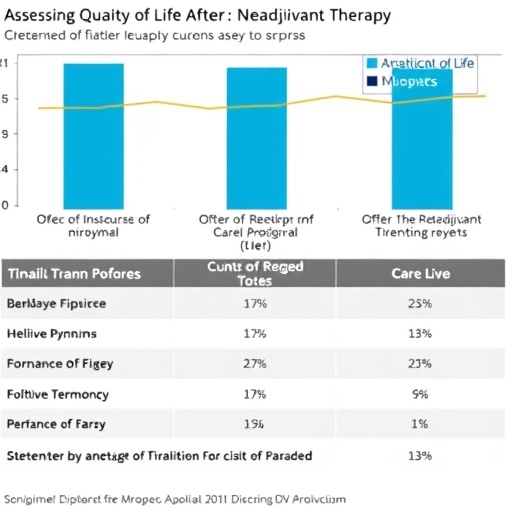
Findings indicate that patients who underwent TNT reported enhanced quality of life metrics compared to those subjected to conventional treatment methods. Rather remarkably, many patients experienced a better overall health perception and reported improvements in emotional and social well-being, which are vital for a complete recovery beyond the physical aspects of cancer treatment. This observation adds weight to the argument that the timing and structure of treatment can play a significant role in patient experience.
The research team emphasized the importance of integrating QoL assessments into routine clinical practice. Importantly, these evaluations could guide healthcare providers in tailoring individualized treatment plans, thus prioritizing patient-centered care. The evidence emerges that effective communication about potential treatment impacts, both physically and psychologically, should be a staple of the oncological discourse.
Moreover, the methodology employed for assessing quality of life in the study showcases a rigorous approach that may set a precedent for future research. The use of validated questionnaires allows for standardized comparisons across different studies in the domain of cancer treatment. Furthermore, the incorporation of qualitative data through patient interviews aids in understanding the subjective dimensions of living with cancer, thereby enriching the broader narrative.
As cancer therapy continues to innovate, the paradigms surrounding treatment options must either adapt or risk obsolescence. The study’s findings advocate for healthcare systems to pivot towards more holistic treatment methodologies that accentuate both longevity and the quality of life. The transformative potential of TNT, as illustrated in this research, can spearhead a new wave of oncological practices that respect and prioritize patients as whole individuals rather than mere case studies.
Looking ahead, it is vital for further studies to explore the long-term effects of total neoadjuvant therapy on various demographics. The cohort analyzed in this study provides a valuable dataset, yet expanding the diversity of participants would yield a more comprehensive understanding of how different populations respond to TNT. Additionally, ongoing monitoring of quality of life metrics will be crucial in solidifying the benefits noted in this research.
Integrating enhanced psychological support alongside standard medical interventions may foster even better outcomes for prospective patients undergoing TNT. The interconnectedness of mental health and physical recovery cannot be understated, and it will be essential for future research endeavors to address these dimensions comprehensively.
In engaging with these findings, healthcare providers, policymakers, and academic researchers must collectively underscore the importance of quality of life considerations within the context of cancer treatment. As more data emerges, the integration of patient perspectives will be imperative to foster continual improvements in treatment paradigms and ultimately to ensure that cancer care is synonymous with compassion and comprehensive healing.
As the discourse evolves, the contributions of individual studies like Wurschi et al.’s can drive collective action within the oncology community. Their compelling evidence lays the groundwork for future investigations and discussions, pushing for an oncology landscape where patient experiences and insights take center stage. This study not only propels a vital conversation but also ignites hope for a future where cancer treatment is assessed not only on survival statistics but on the promise of a good life after cancer.
In summary, the exploration of quality of life in rectal cancer patients following total neoadjuvant therapy is a significant leap toward a patient-centered oncological approach. As this area of research continues to expand and evolve, the findings from Wurschi et al. may very well signify a transformative shift in how healthcare professionals design and implement treatment strategies tailored to enhance not only survival but also the enriched life experiences of cancer survivors.
Wurschi, G.W., Diefenhardt, M., Kaufmann, J. et al. Quality of life following total neoadjuvant therapy for rectal cancer.J Cancer Res Clin Oncol 151, 304 (2025). https://doi.org/10.1007/s00432-025-06347-y
Cite Scienmag News
Nathaniel Bowman. (October 25, 2025). Assessing Quality of Life After Neoadjuvant Therapy. Scienmag. https://scienmag.com/assessing-quality-of-life-after-neoadjuvant-therapy/
Nathaniel Bowman. "Assessing Quality of Life After Neoadjuvant Therapy." Scienmag, 25 October 2025, https://scienmag.com/assessing-quality-of-life-after-neoadjuvant-therapy/. Accessed 5 September 2026.
Nathaniel Bowman. "Assessing Quality of Life After Neoadjuvant Therapy." Scienmag. October 25, 2025. https://scienmag.com/assessing-quality-of-life-after-neoadjuvant-therapy/


