

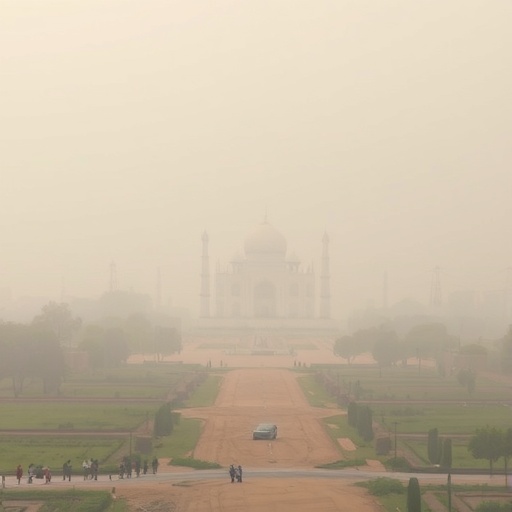
In a striking revelation made by researchers from India, the serious implications of PM10 pollution on public health and the economy have come into sharp focus. The study, titled “Estimating health and economic burden of PM10 pollution in Agra, India using AirQ+ and VSL approaches,” authored by Kushwaha, Saxena, and Kumar, sheds light on the pressing need to address air quality issues that plague urban centers worldwide. The study utilizes sophisticated methodologies such as the AirQ+ software and Value of Statistical Life (VSL) analyses, providing a comprehensive examination of the burdens posed by particulate matter less than 10 microns in diameter.
PM10 refers to particulate matter that can penetrate the lungs and enter the bloodstream, resulting in severe health consequences. The authors of this pivotal paper emphasize that in urban areas like Agra, where industrial activities, vehicular emissions, and geo-climatic conditions exacerbate air quality concerns, the health impacts are pronounced. They report alarming figures indicating that thousands more are likely affected by respiratory issues, cardiovascular diseases, and premature mortality due to exposure to high levels of PM10.
Using the AirQ+ model, the researchers estimate the health effects associated with the concentration of PM10 in Agra. This model incorporates data from various sources, including local air quality monitoring stations, health statistics, and environmental databases, to assess the relationship between particulate matter exposure and related health outcomes. The findings suggest that the economic cost related to these health outcomes is significant, raising immediate concerns for policymakers and public health officials.
The economic burden associated with PM10 pollution is substantial. By employing the VSL approach, which quantifies the value of reducing mortality risk, the study provides a clear monetary perspective on the impacts of air pollution. The researchers estimate that the total economic costs arising from health impacts attributed to PM10 pollution in Agra reach staggering figures. This financial analysis not only highlights the cost to society but emphasizes the urgent need for effective air quality management strategies to mitigate these burdens.
In addition to the immediate health repercussions of PM10 exposure, the study discusses long-term effects that can alter the quality of life for affected populations. Chronic respiratory conditions, cardiovascular diseases, and other non-communicable diseases are often exacerbated by poor air quality, leading to increased healthcare costs and loss of productivity. Such chronic conditions can impose lifelong limitations on affected individuals and their families, revealing a critical need for preventative measures.
The methodology employed in this research is rigorous, providing a robust framework to understand and tackle the health and economic impacts of air pollution. By using AirQ+ software alongside the VSL approach, the authors were able to model the scenarios specific to Agra, allowing for targeted solutions that local authorities can adopt. The specificity of the regional data not only strengthens the analysis but also makes the findings more actionable for stakeholders in the area.
The authors also address the need for interdisciplinary collaboration in order to effectively combat the challenges posed by air pollution. Environmental scientists, public health experts, urban planners, and policymakers must work hand-in-hand to devise innovative solutions that ensure sustainable urban development while safeguarding public health. Implementing such collaborative efforts can lead to improved air quality and enhanced public infrastructure, ultimately benefitting the economy.
Notably, this research serves as a wake-up call, not only for Agra but for other urban areas experiencing similar issues with PM10 pollution. The paper highlights the global nature of the air quality crisis and the responsibilities that come with urbanization and industrialization. As cities grow, the need for stringent air quality regulations becomes increasingly critical, and the insights derived from this study can guide many regions facing similar pollutants.
One of the most critical aspects of the study is its emphasis on public policy recommendations. Effective policies must be grounded in scientific research, and this study provides a framework that can be utilized by local governments to develop more effective regulations concerning emissions, industrial activities, and urban planning. Potential measures, such as stricter vehicular emission standards and increased green spaces, can significantly ameliorate the effects of PM10 pollution.
The urgency of addressing air quality is further compounded by the ongoing threats posed by climate change. Extreme weather events, rising temperatures, and changing precipitation patterns can intensify air pollution levels. This link between climate change and air quality is explored in the study, suggesting that future research must consider these intersections to develop adaptive strategies.
In conclusion, the research conducted by Kushwaha and colleagues serves as a vital contribution to understanding the complex interplay between air pollution, health, and economic burdens. Their extensive analysis of PM10 in Agra offers critical insights that can be leveraged to drive policy changes and promote healthier urban environments. As the world continues to grapple with pollution and its impacts, studies like this provide the evidence needed to catalyze meaningful change.
As scientists, advocates, and leaders work towards sustainable solutions, the findings from this research pave the way for a broader dialogue on air quality, climate actions, and public health. The collaboration of interdisciplinary stakeholders is essential for crafting policies that protect human health while sustaining economic growth. Thus, the knowledge generated from this comprehensive study is not only significant for Agra but has implications for cities globally.
Subject of Research: PM10 pollution and its health and economic impacts in Agra, India.
Article Title: Author Correction: Estimating health and economic burden of PM10 pollution in Agra, India using AirQ+ and VSL approaches.
Article References:
Kushwaha, D., Saxena, S.P. & Kumar, R. Author Correction: Estimating health and economic burden of PM10 pollution in Agra, India using AirQ+ and VSL approaches.
Sci Rep 16, 415 (2026). https://doi.org/10.1038/s41598-025-31519-8
Image Credits: AI Generated
DOI: 10.1038/s41598-025-31519-8
Keywords: PM10, air quality, public health, economic burden, Agra, India, AirQ+, VSL, pollution, health outcomes.


