

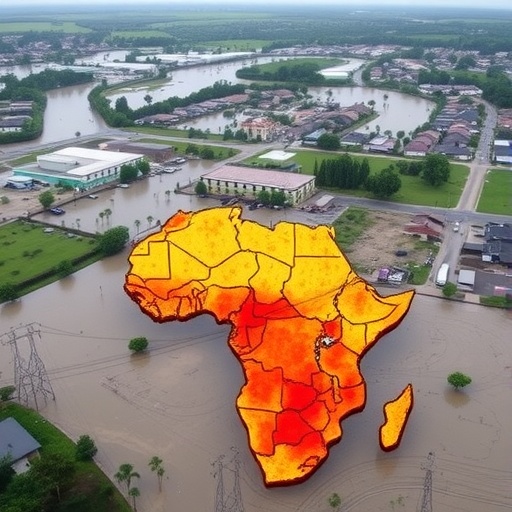
In the heart of Ethiopia’s Lake Tana Sub-Basin, a significant leap in flood vulnerability assessment is on the horizon. Researchers, Asitatikie, Mekonnen, and Melsse, are forging a path through the murky waters of climate change and land use dynamics using state-of-the-art machine learning techniques. Their groundbreaking study focuses on the Ribb and Gumara catchments, areas frequently beset by floods, threatening agriculture, infrastructure, and livelihoods. Understanding the intricate relationship between fluctuating climate patterns and land use practices is crucial for implementing effective flood risk management strategies, particularly in vulnerable regions like these.
Machine learning, a rapidly evolving field within artificial intelligence, enables models to learn from data and improve over time without human intervention. By employing these advanced algorithms, the researchers aim to generate predictive models that assess flood vulnerability with unprecedented accuracy. Their approach encompasses various data sources, including historical climate records, satellite imagery, and land cover maps. This multifaceted perspective allows for a comprehensive understanding of how environmental factors contribute to flooding, providing local authorities with the tools they need to mitigate risks.
Climate change poses a uniquely complex challenge, with shifting weather patterns leading to increased rainfall and altered hydrological cycles. In the Ethiopian context, this is especially pertinent given the region’s reliance on rain-fed agriculture. These agricultural practices, while traditional, are increasingly at odds with the unpredictability of climate effects. The Ribb and Gumara catchments serve as a microcosm for these challenges, where agricultural productivity faces the dual threats of both erratic weather and flooding events that have been intensifying over the years.
Land use dynamics further complicate the situation. The expansion of agricultural land, urban development, and deforestation are transforming the natural landscape. Each change in land use directly impacts water absorption, runoff rates, and consequently, the potential for flooding. By integrating land cover changes into their machine learning models, the researchers can account for these human-induced factors, providing a clearer picture of flood vulnerability.
The authors built their models using an extensive dataset that maps historical flooding events alongside climate variables such as precipitation patterns and temperature fluctuations. This collected information forms a substantial backbone for training machine learning algorithms, enabling them to recognize patterns indicative of high flood risk. Employing techniques such as decision trees, random forests, and neural networks, the models produce outputs that categorize areas within the catchments according to their vulnerability to flooding.
Results from the model indicate significant variances in flood vulnerability across different locales within the catchments. For instance, areas where urban development has increased are shown to face higher risks compared to regions with preserved natural vegetation. This knowledge is invaluable for local governments and policymakers as it allows them to prioritize intervention efforts where they might be most needed, potentially saving lives, infrastructure, and resources.
Moreover, the research emphasizes the importance of ongoing monitoring. Machine learning models thrive on fresh data; as new information about climate patterns and land use changes becomes available, feeding this data into the models will refine their accuracy. This continual updating process ensures that flood risk assessments remain relevant and actionable in the face of ongoing climate change and urbanization.
One of the key takeaways is the potential for machine learning to transform the way we address environmental risks. Traditionally, flood assessments relied heavily on historical data and were limited by human analysis capabilities. The adoption of machine learning not only speeds up the analysis process but also adds depth and precision, enabling data-driven decisions that are crucial in disaster risk management.
In the context of Ethiopia’s ambitious development goals, such models can drastically shape proactive approaches to flood management. By identifying at-risk areas, the government can implement early warning systems and develop infrastructure designed to alleviate flood impacts, thus promoting sustainable development pathways.
Collaboration among researchers, local governments, and communities is essential for the successful implementation of these findings. Engaging stakeholders ensures that the solutions developed from the research are practical and aligned with local needs. As Ethiopia continues to navigate the challenges of climate change, the integration of advanced technologies like machine learning will be crucial in building a resilient socio-economic framework.
The implications extend beyond Ethiopia; this research sets a precedent that can be applied in flood-prone regions around the world. The adaptability of the machine learning models allows for customization to different geographic and climatic conditions, making it a universally applicable tool for flood vulnerability assessment.
In conclusion, as the global community faces the mounting challenges posed by climate change, innovative solutions like the machine learning approach advocated by Asitatikie, Mekonnen, and Melsse represent a beacon of hope. By marrying technology with environmental science, there exists a pathway to enhanced resilience against natural disasters. This research not only contributes significantly to academic discourse but also lays a foundation for practical applications that could save lives and landscapes alike.
As the findings from this study continue to circulate, they may alter the trajectory of flood management policies not just in Ethiopia but across various nations facing similar vulnerabilities. It underscores the necessity of embracing modern technologies in our quest for sustainable solutions to age-old problems.
The future of flood risk assessment is here, and it is being reshaped by the power of machine learning.
Subject of Research: Flood Vulnerability Assessment using Machine Learning
Article Title: Machine learning approach for assessing flood vulnerability under changing climate and land use and land cover dynamics in ribb and Gumara Catchments, lake Tana Sub-Basin, Ethiopia.
Article References:
Asitatikie, A.N., Mekonnen, Y.A. & Melsse, D.W. Machine learning approach for assessing flood vulnerability under changing climate and land use and land cover dynamics in ribb and Gumara Catchments, lake Tana Sub-Basin, Ethiopia.
*i>Discov Sustain (2025). https://doi.org/10.1007/s43621-025-02038-3
Image Credits: AI Generated
DOI: 10.1007/s43621-025-02038-3
Keywords: Machine Learning, Flood Vulnerability, Climate Change, Land Use Dynamics, Ethiopia.


