


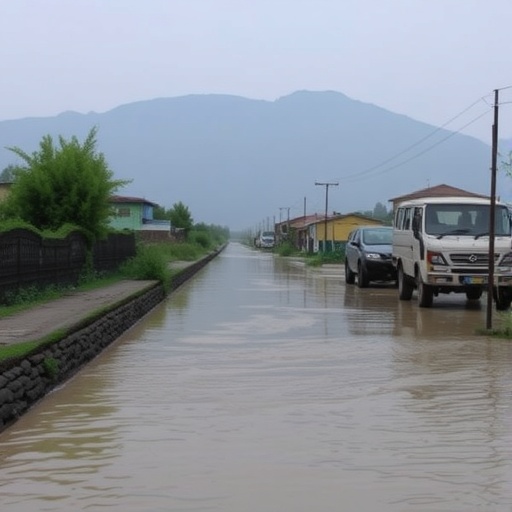
In the rapidly evolving sphere of environmental risk and disaster preparedness, the recent study “Multidimensional Vulnerability Assessment of Flood-Prone Rural Communities of Pakistan” offers an unparalleled deep dive into the cascading impacts of flooding on rural populations. This groundbreaking research, published in the International Journal of Disaster Risk Science, meticulously dissects the multifactorial vulnerabilities that exacerbate flood risk in Pakistan’s most susceptible rural sectors. As climate change accelerates hydrological extremes globally, understanding these nuanced vulnerabilities is critical not only for Pakistan but for flood-prone rural regions worldwide.
Flooding has long been recognized as one of the deadliest natural disasters, disproportionately affecting agricultural communities dependent on localized water cycles. The study contextualizes floods within a complex framework where physical, social, economic, and environmental factors intersect, creating a multidimensional vulnerability profile for rural communities. Unlike traditional analyses focusing narrowly on hydrological data or economic loss, this research integrates a broad spectrum of variables, offering a holistic vulnerability index that promises enhanced predictive power and policy relevance.
At the heart of this research lies an innovative methodological framework that synergizes quantitative data with qualitative field assessments. By combining satellite imagery, hydrological modeling, and participatory community engagement, the researchers were able to delineate the flood hazard zones with unprecedented granularity. This allowed for the precise identification of regions where vulnerabilities are compounded by geographic isolation, limited infrastructure, and socio-economic deprivation, factors often underestimated in conventional flood risk appraisals.
One of the study’s technical cornerstones is its conceptualization of vulnerability as a dynamic, multidimensional construct rather than a static or monolithic attribute. This perspective recognizes that vulnerability evolves as environmental conditions change alongside social and economic transformations within rural communities. Employing a composite index, the researchers evaluated exposure, sensitivity, and adaptive capacity, thereby capturing the fluid interplay between these determinants in flood risk scenarios.
The findings reveal startling spatial disparities in vulnerability within the flood-prone zones of Pakistan’s rural heartlands. Certain districts show alarmingly high composite vulnerability scores, stemming from factors such as poor access to emergency services, inadequate housing quality, and low levels of literacy, which impede effective disaster preparedness and response. Moreover, the agricultural livelihood dependence heightens sensitivity to floods, as recurrent inundations lead to crop failures and food insecurity, spiraling into long-term socio-economic destabilization.
From an infrastructural standpoint, the study illuminates significant gaps in resilience-building measures. Many communities lack robust flood control systems such as embankments or drainage networks, and these deficiencies are compounded by poor road connectivity that hinders evacuation and relief operations. Importantly, the research underscores that infrastructure design must transition from merely reactive flood defense to adaptive frameworks that integrate community-based knowledge and climate projections for sustained efficacy.
Another critical dimension explored is the socio-cultural fabric that influences vulnerability. Gender roles, social hierarchies, and access to information shape how different population groups experience and cope with floods. Women, children, and the elderly emerge as disproportionately affected cohorts due to mobility restrictions and limited participation in decision-making processes. This gendered analysis is pivotal for designing inclusive disaster risk reduction strategies that amplify marginalized voices and needs.
The environmental degradation aggravated by unsustainable agricultural practices and deforestation in upstream catchment areas was identified as a key exacerbator of flood hazards. Altered land cover exacerbates runoff and sedimentation, escalating flood peak and duration downstream. The study thus advocates for integrated watershed management as an essential component of flood mitigation, combining ecological restoration with community-driven conservation initiatives to enhance landscape resilience.
Policy implications drawn from this multidimensional vulnerability assessment are profound. The paper calls for a paradigm shift toward disaster governance that embraces interdisciplinary approaches, linking hydrology, socio-economics, and institutional capacities. It urges policymakers to prioritize targeted interventions in high-vulnerability zones identified by the composite index, ensuring resource allocation is optimized for maximal impact. Furthermore, capacity-building at local levels, inclusive governance, and investment in early warning systems are signaled as critical levers to reduce flood impacts.
The modeling tools developed in this study demonstrate potential integration with real-time disaster management systems. By incorporating dynamic vulnerability indices with meteorological forecasts, emergency responders can achieve proactive, data-driven responses. This could revolutionize how flood risks are communicated and managed, transforming communities from passive recipients of aid to active participants in resilience building.
Educational outreach is another domain where the study charts significant progress. Participatory workshops engaged local residents in vulnerability mapping and solution co-creation, fostering trust and community ownership of disaster risk measures. This bottom-up approach contrasts with conventional top-down interventions, setting a new standard for inclusive disaster risk reduction that addresses both technical needs and socio-cultural realities.
The global significance of this research is unmistakable. While rooted in Pakistan’s unique hydrological and socio-political context, the multidimensional assessment framework is highly transferable. As flood risks escalate worldwide due to climate change, this methodology offers an adaptable blueprint for policymakers and scientists to capture the intricate vulnerability matrices of diverse rural populations, ensuring that interventions are both equitable and efficacious.
Looking forward, the authors emphasize the necessity for continuous monitoring and iterative refinement of vulnerability assessments. Incorporating advances in remote sensing, machine learning, and social data analytics holds promise to enhance predictive accuracy and responsiveness. Cross-sector collaboration, involving governments, academia, civil society, and international agencies, will be indispensable to translating this cutting-edge science into tangible resilience outcomes.
In summary, the study “Multidimensional Vulnerability Assessment of Flood-Prone Rural Communities of Pakistan” stands as a landmark contribution to disaster risk science. It transcends simplistic hazard models by embracing the complexity of vulnerability in rural flood contexts. By weaving together hydrological, socio-economic, infrastructural, environmental, and cultural threads, the research paints a comprehensive portrait of flood risk, charting a strategic course for science-led, community-centered resilience in an era of mounting climatic challenges.
Cite Scienmag News
Violet Maxwell. (December 18, 2025). Assessing Flood Vulnerability in Pakistan’s Rural Areas. Scienmag. https://scienmag.com/assessing-flood-vulnerability-in-pakistans-rural-areas/
Violet Maxwell. "Assessing Flood Vulnerability in Pakistan’s Rural Areas." Scienmag, 18 December 2025, https://scienmag.com/assessing-flood-vulnerability-in-pakistans-rural-areas/. Accessed 3 September 2026.
Violet Maxwell. "Assessing Flood Vulnerability in Pakistan’s Rural Areas." Scienmag. December 18, 2025. https://scienmag.com/assessing-flood-vulnerability-in-pakistans-rural-areas/


