


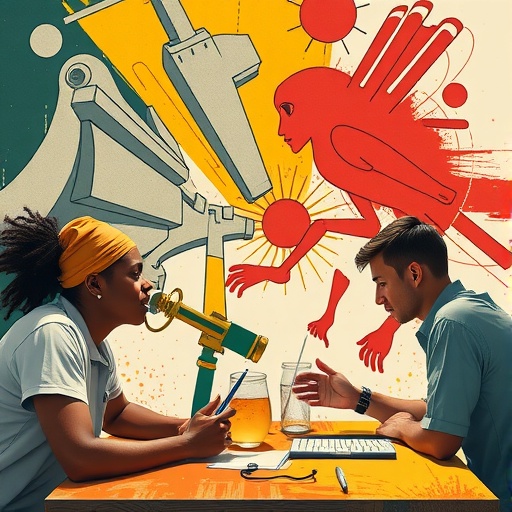
A groundbreaking study from the University of Eastern Finland reveals that integrating arts-based methods into leadership education can profoundly transform how future leaders grapple with the complex societal challenges of today and tomorrow. Over a decade, between 2013 and 2023, an innovative course focused on innovation cultures incorporated visual arts, music, drama, and play to enrich students’ learning experiences. This interdisciplinary approach reconceptualizes leadership learning by embedding artistic creativity and emotional exploration into traditional management education frameworks.
The study meticulously documents how arts-based pedagogies enhance critical dimensions of leadership development, notably emotional intelligence, creativity, and critical thinking. By engaging students in artistic expression and reflection, the course encouraged them to challenge entrenched assumptions and view leadership dynamics from fresh, multifaceted vantage points. This experiential learning environment mirrors the inherent complexity of modern workplaces, thus preparing students to navigate ambiguous, fast-evolving professional landscapes more effectively.
Central to the findings is the role of emotional intelligence in leadership effectiveness. Arts-based methods facilitate deeper emotional engagement and self-awareness, which are essential in managing interpersonal relationships and motivating teams. Through activities such as drama and music, students learn to read emotional cues and respond empathetically, skills that are increasingly valuable in diverse organizational contexts where collaboration and emotional labor are pivotal.
Creativity, another cornerstone skill, flourished as students experimented with various artistic media. The course fostered a safe space for exploration and failure, cultivating resilience and the boldness to innovate. Students reported heightened confidence both in academic settings and future professional endeavors, regardless of their prior exposure to the arts. This suggests that arts-based approaches democratize creativity, enabling a wider demographic of learners to access and benefit from creative thinking processes.
Critical thinking in the context of innovation pedagogy was invigorated through iterative reflection and group dialogue facilitated by arts integration. The arts challenged students to deconstruct normative leadership paradigms and to synthesize diverse perspectives into novel conceptual frameworks. This analytical rigor combined with imaginative inquiry equips students to identify underlying problems and articulate innovative solutions – a vital competence in leadership roles tasked with organizational transformation.
Collaborative learning emerged as an intrinsic benefit of the arts-centered curriculum. Group projects involving improvisational drama, collective music-making, and visual art installations promoted interpersonal trust and collective ownership of learning outcomes. Such environments simulate the networked, interdependent nature of modern work ecosystems, thus providing students with authentic practice in teamwork and co-creation.
From a pedagogical standpoint, implementing arts-based leadership education necessitates a sophisticated blend of skills among educators, including the ability to embrace uncertainty and fluidity in teaching processes. Robust institutional support was identified as crucial to foster an atmosphere where students feel secure enough to take creative risks. This underscores the importance of educational cultures that value experimentation and holistic development over rote learning and standardized assessment.
Professor Hanna Lehtimäki emphasizes that the emotional safety of learners is paramount, allowing them to engage fully with arts-based methodologies without fear of judgment. Such environments enhance not only individual learning but also foster a community ethos conducive to sustained innovation and empathy development. This finding aligns with broader trends in educational psychology that prioritize affective dimensions as critical to deep learning.
The study advocates for a comprehensive reform in business and leadership education to incorporate arts-based approaches alongside traditional methods. It argues that conventional curricula, predominantly focused on analytical skills and theoretical knowledge, inadequately prepare students for the social, emotional, and creative demands of contemporary leadership roles. By enriching pedagogy with arts, educational institutions can nurture well-rounded leaders equipped to handle complexity and change.
An important contribution of this research is its demonstration that arts-based methods offer more than just supplementary educational value—they fundamentally transform the cognitive and emotional capacities of leadership students. Empathy, critical thinking, and creative problem-solving are not peripheral competencies but essential tools for navigating the uncertainties of modern organizational environments and societal challenges.
By fostering these capabilities, the course supports the emergence of responsible and empathetic change leaders. These leaders are better attuned to the nuances of human dynamics and systemic forces shaping innovation cultures, making them adept at driving sustainable progress. This aligns with global calls for leadership paradigms that balance performance with social responsibility and ethical considerations.
Dr. Pasi Hirvonen, a university lecturer involved in the course, highlights that the fusion of arts and management education ignites students’ courage to experiment and innovate beyond traditional boundaries. The participation in arts-based learning emboldens students to embrace uncertainty and complexity, which are intrinsic to leadership tasks in volatile, uncertain, complex, and ambiguous (VUCA) contexts.
This decade-long pedagogical experiment at the University of Eastern Finland serves as a model for educational innovation, positioning arts-based methods as indispensable instruments in cultivating the next generation of leaders. As workplaces evolve with technological disruption and societal shifts, leadership education must adapt by fostering emotional intelligence, creativity, and critical thinking through immersive, artistic experiences.
In conclusion, this study provides compelling empirical evidence for the transformative impact of arts integration in leadership education. It challenges higher education institutions worldwide to rethink traditional pedagogies and embrace interdisciplinary approaches that facilitate holistic student growth. Only by doing so can we equip future professionals with the skills necessary to thrive in and positively shape a rapidly changing global landscape.
Cite Scienmag News
Courtney Benton. (October 28, 2025). Arts-Based Approaches Revolutionize Leadership Education: New Study Emphasizes Creativity and Empathy as Essential Skills for Future Leaders. Scienmag. https://scienmag.com/arts-based-approaches-revolutionize-leadership-education-new-study-emphasizes-creativity-and-empathy-as-essential-skills-for-future-leaders/
Courtney Benton. "Arts-Based Approaches Revolutionize Leadership Education: New Study Emphasizes Creativity and Empathy as Essential Skills for Future Leaders." Scienmag, 28 October 2025, https://scienmag.com/arts-based-approaches-revolutionize-leadership-education-new-study-emphasizes-creativity-and-empathy-as-essential-skills-for-future-leaders/. Accessed 3 September 2026.
Courtney Benton. "Arts-Based Approaches Revolutionize Leadership Education: New Study Emphasizes Creativity and Empathy as Essential Skills for Future Leaders." Scienmag. October 28, 2025. https://scienmag.com/arts-based-approaches-revolutionize-leadership-education-new-study-emphasizes-creativity-and-empathy-as-essential-skills-for-future-leaders/


