

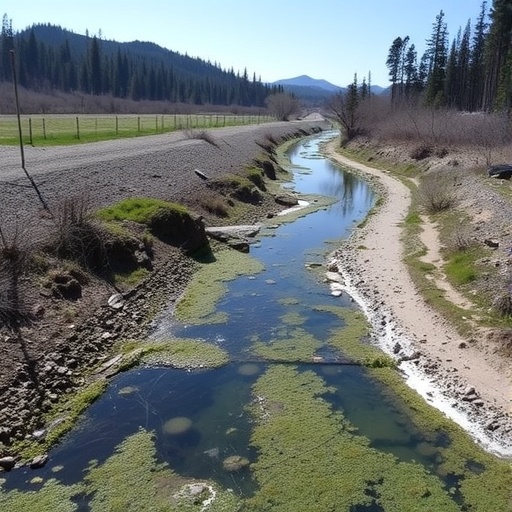
In an era where the purity of our water resources is increasingly under threat, a groundbreaking study sheds new light on the pressing issue of groundwater contamination. Researchers Ş. Şener, G. Şavran, and E. Şener present a meticulous evaluation of arsenic and nitrate contamination within alluvium aquifers, exploring both the hydrogeochemical properties of these systems and the consequential impacts on water quality and public health. This comprehensive analysis, recently published in Environmental Earth Sciences, offers an essential contribution to our understanding of the dynamics affecting vital groundwater reserves and the cascading risks they pose.
Groundwater contamination by arsenic and nitrate has become a global concern due to their widespread presence and significant health implications. Alluvium aquifers, characterized by unconsolidated sediments deposited by running water, often act as critical water sources for agricultural, industrial, and domestic use. The study at hand delves deeply into the geochemical intricacies governing the presence and mobility of such contaminants within these sedimentary aquifers, presenting data that is both compelling and essential for informed water resource management.
The research commences with an examination of the hydrogeochemical features defining the alluvium aquifers in the study area. By employing rigorous sampling and advanced analytical techniques, the team characterized the physicochemical parameters influencing aquifer chemistry. Factors such as pH, redox potential, dissolved oxygen, and ionic content were systematically investigated to decipher how these conditions affect the speciation, mobility, and persistence of arsenic and nitrate, two of the most concerning inorganic contaminants.
The dual presence of arsenic and nitrate represents a complex challenge with different yet overlapping pathways in groundwater contamination. Arsenic, often naturally occurring due to geological processes, can become mobilized under specific geochemical conditions such as reductive dissolution of iron oxides. Nitrate contamination, conversely, predominantly results from anthropogenic sources like agricultural runoff and improper waste disposal. The study’s data notably illustrate how these contaminants vary spatially within the aquifer matrix, revealing local hotspots that necessitate urgent attention.
A critical element of this research involves understanding how hydrogeochemical interactions regulate contaminant concentrations and distributions. For arsenic, the precise balance between oxidizing and reducing conditions determines whether this metalloid remains bound to sediment particles or is released into groundwater. The researchers highlight evidence of reductive mobilization mechanisms, suggesting that changes in groundwater chemistry, potentially driven by human activities or natural fluctuations, exacerbate contamination levels.
In parallel, nitrate’s behavior was assessed with particular emphasis on biochemical transformations, including denitrification processes. The study reveals that despite the presence of natural attenuation processes capable of reducing nitrate loads, persistent inputs from fertilizers and sewage overburden the aquifer system. This imbalance results in nitrate concentrations that regularly exceed WHO-recommended limits, posing significant health risks such as methemoglobinemia and potential carcinogenic effects.
The health risk assessment conducted as part of the research uncovers alarming implications for communities reliant on these groundwater sources. Chronic exposure to arsenic, even at low concentrations, is linked to numerous ailments including skin lesions, cardiovascular diseases, and cancers. Nitrate ingestion carries its own suite of health hazards, particularly dangerous for infants. The authors employ quantitative risk analysis models to estimate lifetime cancer risks and non-carcinogenic effects, underscoring an urgent need for mitigation strategies.
Importantly, the study integrates hydrogeochemical data with water quality indices to provide a holistic understanding of groundwater suitability for human consumption. By evaluating parameters such as total dissolved solids, electrical conductivity, and contaminant levels relative to international standards, the research delineates zones of safe and unsafe groundwater usage. This nuanced classification supports targeted interventions by policymakers and water managers aimed at protecting vulnerable populations.
From a methodological standpoint, the research embodies a multidisciplinary approach, combining fieldwork, laboratory analysis, and sophisticated statistical modeling. This integrative method enhances the robustness of conclusions drawn and allows for predictive assessments under varying environmental conditions. The innovative use of geochemical fingerprinting techniques provides new insights into contamination sources, pathways, and persistence mechanisms within alluvium aquifers.
The findings hold significant implications for environmental monitoring and regulatory frameworks. The demonstrated presence of elevated arsenic and nitrate levels in crucial groundwater reserves calls for adaptive management practices. Enhanced monitoring networks, stricter controls on agricultural inputs, and community education on water safety emerge as key recommendations that derive logically from the study’s outcomes.
Moreover, the research stresses the importance of considering hydrogeological variability in contamination assessments. The dynamic nature of alluvium aquifers, subject to seasonal recharge, sediment composition changes, and anthropogenic pressures, necessitates ongoing surveillance to detect emerging risks promptly. This perspective advocates for the integration of geochemical monitoring into routine groundwater management protocols.
The paper also emphasizes the role of sustainable groundwater use in safeguarding public health. Overexploitation of aquifers can accelerate contaminant mobilization by altering redox conditions or inducing saltwater intrusion. Consequently, the study contributes to the broader discourse on water security by highlighting the complex interplay between usage patterns and contamination risks in alluvial groundwater systems.
In closing, the work by Şener, Şavran, and Şener presents an indispensable resource for scientists, environmental planners, and decision-makers involved in managing groundwater quality. Their comprehensive evaluation offers a roadmap for addressing the dual threats of arsenic and nitrate contamination, blending scientific rigor with practical relevance. As freshwater scarcity and pollution intensify globally, such studies provide the empirical foundation needed to safeguard this critical resource for future generations.
The insights gained from this hydrogeochemical exploration extend beyond the studied region, resonating with other sections of the world grappling with similar contamination issues in alluvial aquifers. By detailing mechanisms, risk assessments, and potential mitigation pathways, this work propels the scientific community closer to achieving sustainable and safe groundwater utilization amid escalating environmental challenges.
Subject of Research: Evaluation of arsenic and nitrate contamination in groundwater in alluvium aquifers, including hydrogeochemical characteristics, water quality, and health risk assessment.
Article Title: Evaluation of arsenic and nitrate contamination in groundwater from alluvium aquifers: Hydrogeochemical features, water quality and health risk assessment.
Article References:
Şener, Ş., Şavran, G., & Şener, E. Evaluation of arsenic and nitrate contamination in groundwater from alluvium aquifers: Hydrogeochemical features, water quality and health risk assessment. Environmental Earth Sciences 85, 82 (2026). https://doi.org/10.1007/s12665-025-12804-1
Image Credits: AI Generated


