


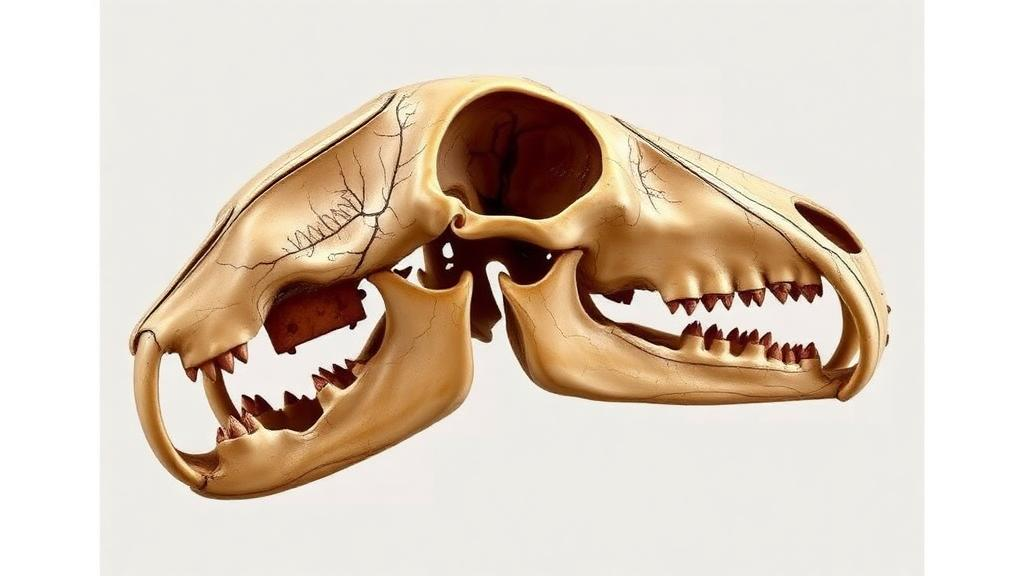
Deep in the Lesser Caucasus, at a fossil-rich site called Jradzor in northern Armenia, palaeontologists have unearthed a remarkably well-preserved skull that belonged to an animal few people would expect to find so far from Africa: a hyrax. These small, rodent-like mammals are today confined to sub-Saharan Africa and the Middle East, yet their fossil relatives once roamed across much of Eurasia. The newly described specimen, dated to about 3.3 million years ago, represents an entirely new genus and species of extinct hyrax, and it carries a name that will delight music lovers everywhere: Armenohyrax aznavouriani, honouring the legendary French-Armenian singer Charles Aznavour.
The discovery, published in the Swiss Journal of Palaeontology, is far more than a taxonomic curiosity. Hyraxes belong to the order Hyracoidea, a group of afrotherian mammals whose closest living relatives are elephants and manatees, an affiliation that has astonished naturalists since the eighteenth century. Early scientists repeatedly shuffled hyraxes between rodents and odd-toed ungulates before anatomical and, later, molecular evidence settled them firmly within Afrotheria alongside proboscideans and sirenians. Today only three genera survive, but the fossil record reveals a far richer past, including a poorly understood radiation of large, high-crowned-toothed forms that spread from Africa into Eurasia during the late Miocene.
The new skull, catalogued as IGS JRD-20/01 and housed at the Institute of Geological Sciences in Yerevan, was recovered from layer JZ-7 of the Jradzor section. Its age of 3.3 plus or minus 0.03 million years was established through a combination of argon-argon dating of an underlying volcanic ash and magnetostratigraphy, placing it in the early part of the European land mammal zone MN16, during the Villafranchian. The specimen belongs to a subadult animal, as shown by the simultaneous presence of a functional deciduous fourth premolar, erupted first and second molars, and a third molar still pushing through the gum. The zygomatic arches span roughly 120 millimetres, indicating a medium-sized hyracoid.
To study the fragile fossil without damaging it, the team scanned the skull with a high-resolution micro-CT scanner at the University of Tübingen, achieving a resolution of about 46 micrometres, and then digitally separated the bones using segmentation software at the JURASSICA Museum in Switzerland. A surface model was also generated with a structured-light scanner, and dental measurements were taken directly on the resulting three-dimensional models. The digitised skull is freely accessible on MorphoSource, allowing researchers worldwide to examine teeth and cranial structures that would otherwise require travel to Armenia.
Anatomically, the Jradzor skull is unmistakably that of a pliohyracid, one of the extinct, large-bodied hyraxes characterised by high-crowned cheek teeth that grew tall on the lip side of the jaw, tusk-like central incisors coated with enamel on their front faces, and a lophoselenodont chewing surface in which crescent-shaped ridges form a W-shaped pattern. Yet it also displays a striking peculiarity: the upper canine is entirely absent, leaving a continuous tooth row from the third incisor to the third molar without any gap. Among all known pliohyracids, only the much older African genus Prohyrax approaches a similar condition in another dental feature, and no other member of the family lacks the canine outright. This combination of traits, together with the absence of a mesostyle ridge on the fourth premolar, justified erecting a new genus.
The etymology is a double tribute. The generic name Armenohyrax combines Armenia, the country of discovery, with hyrax, while the species name aznavouriani memorialises Charles Aznavour, the celebrated French-Armenian singer and songwriter who died in 2018. The formal nomenclatural acts were registered in ZooBank before publication, and the holotype preserves the premaxilla, maxilla, parts of the frontal and zygomatic arch, parietal, pterygoid and basisphenoid, along with upper tooth series on both sides. A displaced right third premolar, trapped in sediment in the middle of the palate, adds a touch of taphonomic drama to an otherwise exceptionally complete specimen.
But the team did not stop at description. Because no formal phylogenetic analysis had ever been run on a representative sample of Neogene pliohyracids, the authors built a new character matrix of 84 traits, 25 of them newly devised, scoring 26 taxonomic units spanning living procaviids, Palaeogene African hyracoids and the Eurasian pliohyracids, with the Oligocene proboscidean Moeritherium trigodon as an outgroup. Parsimony analyses in PAUP*, run both with and without downweighting ordered multistate characters, recovered ten and seven most parsimonious trees respectively. In both sets of results, the pliohyracids in the strict sense emerged as a monophyletic family, united by numerous unambiguous shared derived traits including the hallmark labial hypsodonty of the cheek teeth, and the titanohyracids, a family of large Palaeogene African hyraxes, appeared as their sister group.
Within this family tree, Armenohyrax aznavouriani occupies a telling position: it is the sister species of Postschizotherium, a genus known from the Plio-Pleistocene of China, and together they form a clade sister to the classic genus Pliohyrax from the late Miocene of Greece. The enigmatic and incomplete Hengduanshanhyrax from Tibet proved the only unstable element, shifting between positions depending on the analytical weighting. Taking the preferred topology, the authors tentatively provided the first phylogenetic, stem-based definition of Pliohyracidae: the most inclusive clade containing Pliohyrax but not the titanohyracids Antilohyrax and Titanohyrax. They also recommend restricting the family name to this strict sense, arguing that broader definitions sweeping in Palaeogene genera such as Saghatherium would create a paraphyletic assemblage.
The phylogeny also reads as a travel itinerary. The two earliest-diverging pliohyracid genera, Parapliohyrax and Prohyrax, are African, confirming the family’s continental origin. The first Eurasian records, assigned to Prohyrax, appear in Turkey and Greece around 14.5 to 13 million years ago, coinciding with the middle Miocene climatic transition, when cooling and aridification likely dissolved the climatic barrier that had separated the two landmasses. From this western Asian foothold the family spread, with Sogdohyrax reaching Central Asia by the late Miocene. The close relationship between the Armenian Armenohyrax and the eastern Asian Postschizotherium suggests a late divergence in western to central Asia followed by dispersal northward into the Caucasus and eastward toward China, making the new species the last documented divergence in the family’s history.
The study closes with a research agenda rather than a full stop. Higher-level relationships between pliohyracids, the modern procaviid family and Palaeogene lineages remain unresolved, partly because the analysis excluded mandibles, lower teeth and postcranial bones, which are unknown for many fossil taxa. Abundant but under-revised Pliohyrax material from Greece and Turkey awaits study, and the poorly prospected fossil record of southern West and Central Asia may hold the key specimens that sharpen the family’s biogeographic story. Even living hyraxes may hide undiscovered diversity, as recent genetic work on tree hyraxes and the vast, subdivided range of the rock hyrax suggest. Armenohyrax aznavouriani, a canine-less hyrax singing its last Pliocene song in the Caucasus, is a reminder that one well-preserved skull can still rewrite a chapter of mammalian history.
Subject of Research: A new Pliocene hyracoid mammal from Armenia and the phylogeny of Pliohyracidae
Article Title: A new genus and species of Pliohyracidae ( Hyracoidea , Mammalia ) from the Pliocene of Jradzor, Armenia
Article References: Becker, D., Lefebvre, R., Saulnier Masson, R., & Vasilyan, D. (2026). A new genus and species of Pliohyracidae (Hyracoidea, Mammalia) from the Pliocene of Jradzor, Armenia. Swiss Journal of Palaeontology, 145, 179-198. https://doi.org/10.3897/sjp.145.181371
Image Credits: AI Generated
Keywords: Hyracoidea, Pliohyracidae, Armenohyrax aznavouriani, Jradzor, Armenia, Pliocene, palaeontology, phylogenetics, biogeography, hyraxes, fossil skull, Afrotheria
Cite Scienmag News
Gavin Prescott. (October 17, 2026). Armenian skull reveals a new Pliocene hyrax named in honour of Charles Aznavour. Scienmag. https://scienmag.com/armenian-skull-reveals-a-new-pliocene-hyrax-named-in-honour-of-charles-aznavour/
Gavin Prescott. "Armenian skull reveals a new Pliocene hyrax named in honour of Charles Aznavour." Scienmag, 17 October 2026, https://scienmag.com/armenian-skull-reveals-a-new-pliocene-hyrax-named-in-honour-of-charles-aznavour/. Accessed 17 October 2026.
Gavin Prescott. "Armenian skull reveals a new Pliocene hyrax named in honour of Charles Aznavour." Scienmag. October 17, 2026. https://scienmag.com/armenian-skull-reveals-a-new-pliocene-hyrax-named-in-honour-of-charles-aznavour/


