



view more
Credit: Use of images is limited to editorial coverage of scientific topics relating to the activities of the Max Planck Society. Any kind of commercial use (including, in particular, the exploitation of images by means of sale or incorporation in image databases or image catalogues) as well as any promotional use/use for merchandise purposes, disclosure to third parties or granting of related rights to third parties is expressly not permitted.
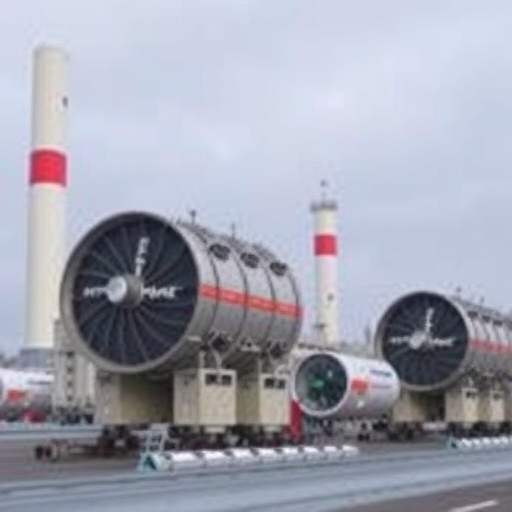
Can we fuel gas turbines with hydrogen instead of fossil fuels and cut 15% of global carbon dioxide (CO2) emissions? Gas turbines generate around 22% of the world’s electricity. Replacing fossil fuels is a key step towards more sustainable power generation. Hydrogen is widely considered a promising alternative fuel for gas turbines in both power generation and aviation. However, before hydrogen can be used safely on a large scale, researchers need to better understand how it affects the materials exposed to the extreme operating conditions inside turbines. While the interaction between hydrogen and metallic materials has been extensively studied at ambient temperatures, far less is known about its effects at elevated temperatures found in gas turbines. An international team of researchers has now investigated how hydrogen affects Nickel-base superalloys – the material of choice for gas turbines – at elevated temperatures. Their results indicate that hydrogen-induced embrittlement can be at least twice as severe, posing a significant challenge for components that must meet the highest standards of safety and reliability. Researchers of the Max Planck Institute for Sustainable Materials (MPI-SusMat) and their collaborators published new findings in the journal Nature Materials.
Why hydrogen trapping at elevated temperatures fails
“When hydrogen enters a Nickel-base superalloy at ambient temperatures, it is usually trapped at interfaces and dislocations. At elevated temperatures, hydrogen atoms migrate to carbon vacancies within carbides, causing their partial decomposition. Moreover, hydrogen and carbon atoms react and form methane. This highly pressurized methane exerts a high local internal pressure that weakens the interfaces, and promotes damage”, explains Dr Xizhen Dong, postdoctoral researcher at MPI SusMat and one of the first authors of the recent publication. Dong and her colleagues tested how hydrogen affects Nickel-base superalloys in a temperature range from 400°C to 1000°C. By combining atom probe tomography and density functional theory calculations, the researchers were able to show that the degradation mechanisms in Nickel-base superalloys exposed to hydrogen fundamentally change depending on the operating temperatures. The degradation only takes place at 400°C, while no methane formation is seen above that. “What we discovered here is essential especially for gas turbines and flying turbines, which, unlike stationary steam turbines, are frequently switched on and off and therefore experience a larger temperature and load spectrum where embrittlement effects can occur”, explains Professor Dierk Raabe, director at MPI-SusMat and one of the corresponding authors.
Designing hydrogen-resistant Nickel-base superalloys
Having shown that carbides are the entry gate for hydrogen-induced cracking, a future alloy design would aim to tailor the alloy’s microstructure by replacing carbides. Since carbides are widely used to strengthen high-performance alloys, new strengthening strategies will be required. Alternatively, a balance has to be found between mechanical strength gained from carbides and hydrogen embrittlement resistance. These findings underscore the need for temperature-specific mechanistic frameworks and predictive models to describe hydrogen-induced damage not only in Nickel-base superalloys, but also in other carbide-containing alloys, including steels and metal ceramic composites and pave the way for future hydrogen-fuelled gas turbine energy and air traffic systems. The research was led by scientists from the East China University of Science and Technology (China), Max Planck Institute for Sustainable Materials (Germany), and the Hunan University (China)
Journal
Nature Materials
Method of Research
Experimental study
Article Title
Hydrogen-induced damage in Ni-based superalloys at elevated temperatures
Article Publication Date
27-Jul-2026
Yasmin Ahmed Salem, M.A.
Max Planck Institute for Sustainable Materials
y.ahmedsalem@mpi-susmat.de
Office: +49 211 6792 722
Journal
Nature Materials
Method of Research
Experimental study
Article Title
Hydrogen-induced damage in Ni-based superalloys at elevated temperatures
Article Publication Date
27-Jul-2026
Cite Scienmag News
Faith Mcneil. (July 29, 2026). Are gas turbines ready for the hydrogen economy? Scienmag. https://scienmag.com/are-gas-turbines-ready-for-the-hydrogen-economy/
Faith Mcneil. "Are gas turbines ready for the hydrogen economy?" Scienmag, 29 July 2026, https://scienmag.com/are-gas-turbines-ready-for-the-hydrogen-economy/. Accessed 5 September 2026.
Faith Mcneil. "Are gas turbines ready for the hydrogen economy?" Scienmag. July 29, 2026. https://scienmag.com/are-gas-turbines-ready-for-the-hydrogen-economy/

