

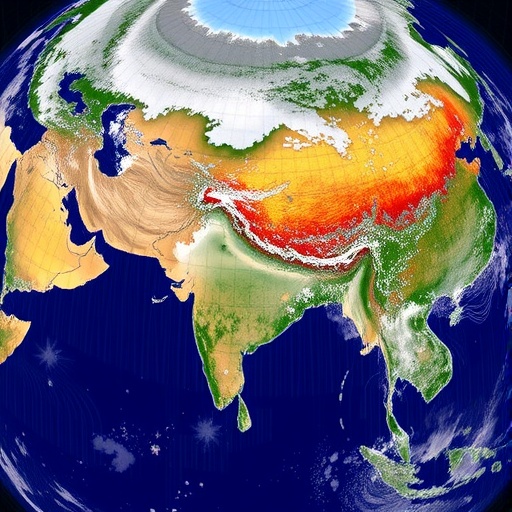
The South Asian summer monsoon is a vital climatic phenomenon responsible for delivering approximately 80% of India’s annual precipitation between June and September. This seasonal rainfall profoundly influences agriculture, water resources, and the overall socio-economic fabric of the region. In recent decades, shifts have been observed not only in the volume of monsoon rainfall but also in its spatial distribution. While total rainfall quantities have generally increased, a notable westward migration in the concentration of precipitation has emerged across the Indian subcontinent. Unraveling the driving forces behind such changes is critical for improving prediction models and managing the potential impacts on ecosystems and human livelihoods.
In an illuminating study published in Ocean-Land-Atmosphere Research on January 29, 2026, climatologists from the Indian Institute of Tropical Meteorology have uncovered a compelling link between early summer Arctic sea ice retreat and the intensity and distribution of late-season South Asian summer monsoon rainfall. This research highlights how diminishing polar sea ice, a widely recognized indicator of global warming, can exert profound influences far beyond the Arctic region itself by altering atmospheric dynamics and energy transport mechanisms that modulate monsoon behaviors.
Rising global temperatures are unevenly distributed across the planet, but the Arctic region is experiencing some of the most rapid warming and consequential sea ice loss. According to Hemantkumar S. Chaudhari, lead scientist on the study, the reduction in Arctic sea ice modifies the surface energy balance, thereby affecting atmospheric circulation patterns that extend into lower latitudes. These changes can disrupt the typical interactions between the ocean and atmosphere, altering weather systems as distant as the South Asian monsoon.
Using comprehensive observational datasets spanning from 1979 to 2022, the researchers analyzed the relationship between Arctic sea ice extent during June and July—the early summer period when sea ice variability is most pronounced—and subsequent monsoon rainfall over India in August and September. Their findings reveal a robust inverse correlation on interannual timescales: years characterized by reduced Arctic sea ice extent corresponded with amplified rainfall during the latter half of the monsoon season. Notably, this enhanced precipitation showed a clear spatial shift westward over the Indian subcontinent.
The study employed two independent rainfall datasets, the Global Precipitation Climatology Project (GPCP) and the Climatic Research Unit (CRU) data, to verify the consistency of these patterns. Both datasets confirmed statistically significant increases in rainfall over northwestern India coinciding with negative Arctic sea ice anomalies. This westward migration challenges traditional monsoon assumptions and underscores the need to understand extratropical drivers in predicting regional climate variability accurately.
To elucidate the physical mechanisms underpinning these observed correlations, the team utilized coupled climate model simulations encompassing atmosphere, ocean, land surface, and sea ice interactions. These models replicated key features of the observed changes, including the westward shift and intensified rainfall during the August-September window. The results suggest that declining Arctic sea ice triggers alterations in upper-level atmospheric circulation, particularly in the jet stream and planetary wave patterns, facilitating enhanced moisture transport and convergence over northwest India.
Such atmospheric dynamical pathways are crucial because they redistribute thermal energy and influence pressure gradients that dictate wind patterns critical for monsoon development. The diminished Arctic sea ice appears to weaken the meridional temperature gradient, leading to modifications in the upper troposphere that propagate downstream effects into the South Asian region. This chain of processes establishes a mechanistic link between polar climate perturbations and tropical monsoon rainfall variability.
These findings carry profound implications not only for regional climatic predictions but also for broader understanding of how Arctic amplification perpetuates global climate feedbacks. As Arctic sea ice continues its long-term decline under anthropogenic warming scenarios, the South Asian summer monsoon may intensify with a notably westward trajectory, increasing flood risks in areas less historically equipped with sufficient adaptive infrastructure. Accurate identification of such teleconnections provides a crucial step forward in improving climate resilience for large populations dependent on monsoon rainfall.
Looking ahead, the research team plans to broaden their investigations by integrating longer observational records and a wider array of climate model ensembles to capture variability and uncertainties more comprehensively. Such efforts will help ascertain whether the identified relationships persist under varying climate scenarios and refine predictive frameworks for monsoon rainfall responses to ongoing polar transformations.
According to co-author Samir Pokhrel, these advancements are essential for enhancing our capacity to forecast year-to-year monsoon fluctuations and to anticipate how future Arctic conditions might reshape South Asian climatic regimes. A deeper grasp of these interactions is critical as societies grapple with increasingly complex risks posed by climate change.
In conclusion, this groundbreaking study delineates an innovative pathway linking polar sea ice retreat with South Asian monsoon rainfall variability, emphasizing the interconnectedness of Earth’s climate systems. It highlights the necessity for multidisciplinary approaches combining observational and modeling techniques to unravel the complex feedbacks governing regional weather patterns in a warming world.
Subject of Research:
South Asian summer monsoon rainfall and its linkage with Arctic sea ice extent.
Article Title:
Arctic Sea Ice Meltdown Enhances the South Asian Summer Monsoon Rainfall
News Publication Date:
29-Jan-2026
Web References:
10.34133/olar.0129
Image Credits:
Chaudhari et al. 2026
Keywords:
Atmospheric science, Meteorology, Oceanography


