


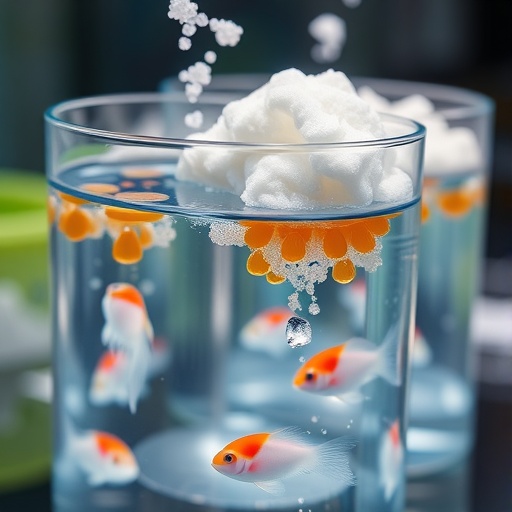
Every time a washing machine completes its final rinse or a sink of suds spirals down the drain, a fresh cargo of synthetic surfactants begins a journey that ends in rivers, lakes, and groundwater. These molecules — the chemical workhorses that make detergents foam, lift grease from dinner plates, and keep shampoos and cosmetics creamy — rank among the most abundant man-made compounds in the world’s freshwater systems. A study published in the journal Ecotoxicology on 20 August 2026 now offers one of the most detailed portraits yet of what happens when two of the most widely used anionic surfactants, Linear Alkylbenzene Sulfonate (LAS) and Sodium Dodecyl Sulfate (SDS), collide with living aquatic ecosystems. The message from a team of Brazilian researchers is sobering: at concentrations measured in mere milligrams per liter, these everyday chemicals kill, cripple reproduction, and physically deform developing embryos — and, crucially, they do so in strikingly different ways depending on which species encounters them.
The research was led by Vanessa Silva Granadeiro Garcia and Sueli Ivone Borrely of the Instituto de Pesquisas Energéticas e Nucleares (IPEN/CNEN) in São Paulo, working with Lenita de Freitas Tallarico, Maria Clara Feitosa Guimarães, and Eliana Nakano of São Paulo’s Instituto Butantan, and Flávio Kiyoshi Tominaga of the Universidade Federal de São Paulo. Rather than relying on a single model organism — the traditional shortcut of toxicology — the team assembled a battery of four bioassays spanning different branches of the aquatic food web: luminescent bacteria, a planktonic water flea, a bottom-dwelling amphipod crustacean, and a freshwater snail. The strategy reflects a growing conviction in ecotoxicology: a chemical’s true environmental hazard becomes visible only when it is tested against organisms with different body plans, feeding strategies, and life stages. Each organism was exposed to both surfactants across a gradient of concentrations, allowing the researchers to capture acute lethality, chronic reproductive damage, and the subtler sublethal effects that fall short of death yet can quietly erode a population’s ability to persist.
To understand why surfactants are an ecological worry, it helps to examine their molecular architecture. Every surfactant is amphiphilic: one end of the molecule is hydrophilic, or water-loving, while the other end is hydrophobic and shuns water in favor of oils and fats. This split personality is what lets surfactants wedge themselves into the boundary between grease and water, slashing surface tension and emulsifying dirt so it can be rinsed away. But the same property turns destructive once the molecules reach a lake or river. They can insert themselves into the lipid membranes that protect fish gills and invertebrate cells, disturbing ion balance and oxygen exchange, and in high loads they contribute to the depletion of dissolved oxygen and to eutrophication, the nutrient over-enrichment that chokes waterways with algal blooms. LAS, the highest-volume anionic surfactant in household detergents, and SDS, a staple of cleaning products, cosmetics, and laboratory reagents, are both designed to biodegrade — yet field studies cited by the new paper have documented incomplete degradation and lingering residues, including polar LAS metabolites, in surface waters and even in sources of drinking water.
The heart of the study is its carefully chosen cast of test organisms. The bacterium Vibrio fischeri emits light as a byproduct of normal metabolism, so any dimming of its natural glow offers a fast, sensitive readout of metabolic stress; Brazilian and international standards have long used this bioluminescence inhibition assay as a first screen for chemical toxicity. Daphnia similis, a tiny filter-feeding cladoceran, serves as a sentinel of freshwater quality because it sits low in the food web, is easily cultured, and responds quickly to dissolved contaminants. Hyalella azteca, an amphipod crustacean abundant in waterways of the Americas, adds a benthic perspective, since it forages near sediment where pollutants tend to accumulate. Finally, the embryos of the freshwater snail Biomphalaria glabrata develop inside transparent egg capsules, giving researchers a literal window on embryogenesis and an early-warning system for teratogenicity — the capacity of a chemical to produce structural malformations. For each surfactant and each species, the team calculated the E(L)C50: the concentration effective at producing a defined response in fifty percent of exposed organisms, whether that response is loss of bioluminescence, immobilization, or death.
When it came to LAS, the pecking order of vulnerability delivered one of the study’s central lessons. The amphipod Hyalella azteca proved the most sensitive species, followed by the water flea Daphnia similis, the snail Biomphalaria glabrata, and finally the bacteria, with E(L)C50 values falling between 5.04 and 28.47 milligrams per liter. In practical terms, lethality struck half of the exposed amphipods at 5.04 milligrams per liter — the lowest effect concentration recorded for any species against LAS in the study. The crustaceans’ fragility matters far beyond the laboratory bench. Amphipods and cladocerans are the grazing and shredding engine of freshwater food webs, converting algae and decaying detritus into protein for fish and other predators. A surfactant that removes these invertebrates at low doses does not merely kill individuals; it can starve the animals above them, simplify entire communities, and leave ecosystems less resilient to the next stressor.
SDS told a strikingly different story. This time the most sensitive organism was not a crustacean but Vibrio fischeri, whose bioluminescence dimmed at the study’s lowest recorded threshold, just 0.62 milligrams per liter. The water flea came next in sensitivity, followed by the amphipod and the snail, with effect concentrations spanning up to 36.87 milligrams per liter — the widest range recorded for either chemical. The reversal is more than a laboratory curiosity. LAS and SDS are chemical cousins, both anionic surfactants that behave similarly in a stream of washwater, yet their toxicity fingerprints diverge sharply across species. A regulatory framework that leans on a single convenient test organism could, in effect, certify one chemical as acceptably safe while missing entirely the hazard it poses to another branch of the tree of life. The bacteria’s acute sensitivity also carries a practical warning: Vibrio fischeri assays are frequently used as a rapid pre-screen for industrial effluents, and an organism that responds at sub-milligram-per-liter concentrations signals that even trace contamination registers biologically. It is precisely this kind of blind spot that a multi-species battery is designed to illuminate.
Some of the study’s most consequential findings emerged not from acute lethality tests but from longer exposures. When Daphnia similis was kept in water containing either surfactant across its reproductive cycle, the number of offspring it produced declined — a chronic effect that lethality figures alone would never reveal. In daphnids, whose populations surge and collapse in step with water quality, depressed reproduction is a direct forecast of ecological decline, because fewer mothers mean fewer grazers and less food for everything that eats them. The snail embryos delivered perhaps the most unsettling evidence of all: exposure to the surfactants produced both teratogenic and lethal effects, meaning developing animals either emerged malformed or never hatched at all. Because B. glabrata embryos pass through well-characterized developmental stages inside transparent capsules, deformities can be traced to specific windows of morphogenesis, making the snail a powerful model for flagging chemicals that sabotage embryonic development — a hazard class that standard adult toxicity tests routinely overlook.
The findings land in a world already saturated with these compounds. Surfactants are used in detergents, cleaning products, cosmetics, and a vast range of industrial processes, and their journey from drain to river is rarely interrupted completely. Field studies referenced by the Brazilian team have detected LAS in rivers in Brazil, Malaysia, and Poland, have followed its persistence and polar metabolites into drinking water sources, and have measured surfactant-laden effluents from textile mills and municipal treatment plants. Conventional sewage treatment removes a substantial fraction of these chemicals, but degradation is often incomplete, and combined sewer overflows, industrial discharges, and under-treated wastewater can deliver concentrated pulses directly into receiving waters. Remediation researchers have explored answers ranging from ultrafiltration membranes and adsorption onto low-cost materials to advanced oxidation driven by ultraviolet light and hydrogen peroxide, and even concentrated sunlight for surfactant-rich industrial effluents — but no single technology has made surfactant pollution a solved problem. Recent surveys cited in the study go so far as to describe LAS as a neglected traditional pollutant whose threats to surface waters extend to the national scale. Against that backdrop, acute thresholds in the low milligrams per liter range — and sublethal damage to reproduction and development — compress the margin of safety that aquatic ecosystems are assumed to enjoy.
For the study’s authors, the data demonstrate the importance of evaluating surfactant toxicity across multiple species and multiple biological endpoints, precisely because these stressors caused different adverse effects in the exposed organisms. The implications reach into chemical regulation and product design alike. Environmental risk assessments for consumer chemicals have often rested on a small set of standard test species; a battery that includes bacteria, planktonic crustaceans, benthic amphipods, and mollusk embryos captures a far wider swath of biological sensitivity. Sublethal endpoints deserve particular weight in that calculus: a concentration that leaves most of a population alive can still slash its birth rate, and developmental toxicity can echo through generations long after the chemical pulse has passed. As new surfactant chemistries are introduced to replace older formulations, the São Paulo results suggest that every candidate should face the same broad interrogation before it is released into the drain — and that monitoring programs should track not just whether organisms die, but whether they can still reproduce and develop normally.
The work, supported by IPEN/CNEN through the Projeto Intercentros program, by the International Atomic Energy Agency, and by Instituto Butantan, also carries a quieter message that reaches every household. The environmental life of a detergent does not end when the rinse cycle does: every bottle discharges molecules engineered to manipulate water and oil, properties that do not switch off at the end of a pipe. As the new study makes plain, the same chemistry that lifts grease from a dinner plate can dim bacterial light, silence a water flea’s reproduction, and twist a snail embryo out of shape before it ever hatches. The foam may vanish down the drain in seconds, but its biological consequences, the researchers show, keep traveling downstream.
Cite Scienmag News
Sloane Callahan. (August 30, 2026). Aquatic bioassays reveal toxicity of detergent surfactants LAS and SDS. Scienmag. https://scienmag.com/aquatic-bioassays-reveal-toxicity-of-detergent-surfactants-las-and-sds/
Sloane Callahan. "Aquatic bioassays reveal toxicity of detergent surfactants LAS and SDS." Scienmag, 30 August 2026, https://scienmag.com/aquatic-bioassays-reveal-toxicity-of-detergent-surfactants-las-and-sds/. Accessed 3 September 2026.
Sloane Callahan. "Aquatic bioassays reveal toxicity of detergent surfactants LAS and SDS." Scienmag. August 30, 2026. https://scienmag.com/aquatic-bioassays-reveal-toxicity-of-detergent-surfactants-las-and-sds/


