


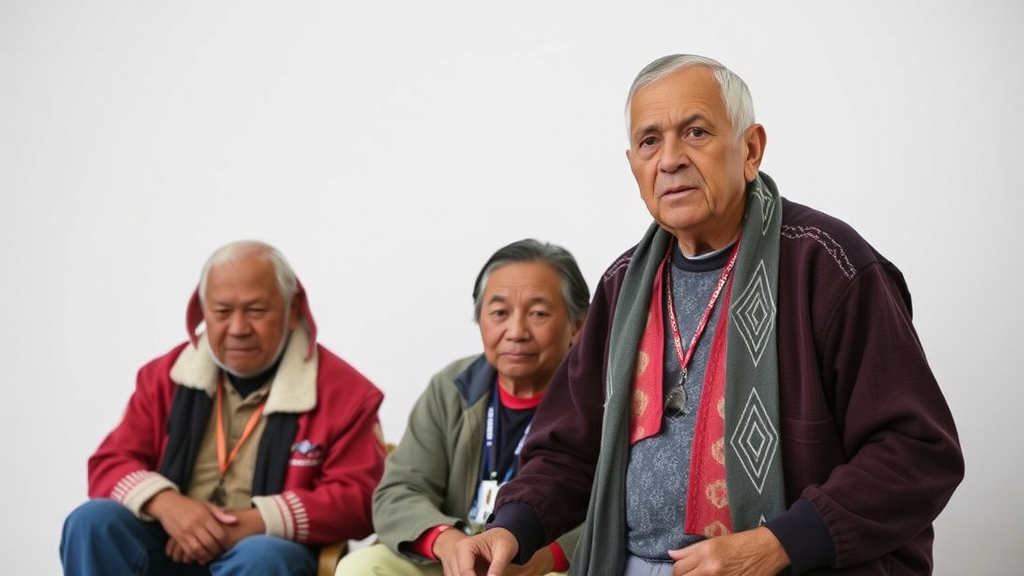
On the Fort Apache Reservation in eastern Arizona, a quiet revolution in suicide prevention is unfolding one classroom at a time, led not by clinicians or researchers but by Elders carrying generations of Apache knowledge. A new study published in SSM – Mental Health documents how the White Mountain Apache Tribe and the Johns Hopkins Center for Indigenous Health co-developed a theoretical model for the Elders’ Resilience Curriculum, a school-based preventive intervention in which Tribal Elders teach monthly lessons on Apache language, cultural values, and ways of life to elementary and middle school youth. The program, known in Apache as “Nohwi nalze dayúwéh bee goldoh dole” — “May our Apache ways continue” — has reached more than 2,400 young people ages 8 to 14. What makes the new research remarkable is not only the intervention itself, but the method behind it: a community-driven effort to decode how culture functions as medicine, and to articulate that mechanism in a form that other Native communities can adapt while protecting sacred teachings never meant to circulate widely.
The origins of the curriculum lie in grief and resolve. Following devastating youth losses, a delegation of White Mountain Apache Tribal leaders met with the Johns Hopkins Center for Indigenous Health to expand their long-standing public health partnership into mental health. In 2001, exercising its political sovereignty, the Tribal Council passed a resolution establishing the Celebrating Life System, a tribally mandated suicide surveillance and case management system that has been linked to documented decreases in suicide deaths and attempts. Building on that foundation, an Elders’ Council formed and emphasized the importance of passing Apache language and traditions to youth as an upstream defense against suicide risk, which peaks between ages 15 and 24. The Elders chose to intervene earlier, at a developmental stage when children can comprehend and retain teachings about identity, belonging, and resilience. Since 2015 the curriculum has been delivered in reservation schools through monthly lessons that include Elders speaking Apache, sharing songs and stories, and assigning seasonal responsibilities for youth to practice with their families.
Scientifically, the study addresses a stubborn gap in prevention science. Culturally grounded interventions — those designed from the ground up with culture, values, and Indigenous worldviews at the forefront — are deeply valued by Native communities, yet they remain under-evaluated in the empirical literature. Standard Western frameworks assume a linear pipeline from intervention development to efficacy testing to scale-up, an approach rooted in Eurocentric knowledge construction that privileges cognition over lived experience, spirit, and relationality. The research team, led by Victoria M. O’Keefe of the Cherokee Nation and Seminole Nation, deliberately Indigenized this process, replacing the linear model with a relational, orbital, and iterative one. The goal was twofold: to identify the core components of the Elders’ Resilience Curriculum and the mechanisms through which it works, providing a theoretical basis for evaluation and future scaling, while safeguarding Apache teachings that have historically been shared orally and never disseminated outside the Tribe.
The study employed a non-parallel convergent mixed methods design embedded in Indigenous Community-Based Participatory Research. Rather than treating community members as subjects, the team worked with a Community Advisory Board of ten White Mountain Apache members who reviewed the design, interpreted results, and shaped dissemination. Language itself was decolonized: partners preferred the term “youth strength factors” over “protective factors against suicide,” reframing the work as strengths-based life promotion rather than deficit reduction. The research unfolded in deliberate steps, beginning with a consensus survey completed by faculty and staff involved in the program, who rated 31 potential core components and 13 potential youth outcomes for importance. A virtual consensus meeting then resolved ambiguities, ultimately confirming 28 core components rated very important or useful, spanning program activities, format and setting, curriculum delivery, organizational support, and Elder knowledge and training.
The qualitative phases brought the community’s voice to the center of the analysis. Focus group discussions with Elders and in-depth interviews with youth, caregivers, teachers, and Tribal leaders illuminated what makes the program meaningful. Participants described the intergenerational bonds forged when Elders enter classrooms, with one Tribal leader noting that Elders carry the wisdom to navigate life’s hardships and that connection between generations is “definitely needed.” Another leader described the ripple effect of a single lesson: a student goes home, shares an Elder’s words about respect with a parent, and plants seeds of dialogue that spread through the classroom, the school, the home, and the larger community. Elders spoke of pride in carrying forward the tools their own ancestors shared with them, now teaching children how to use those tools to weather storms and solve problems.
To identify the theoretical mediators — the youth strengths the curriculum is meant to build — the team used Nominal Group Technique, a participatory method in which participants independently generate, rank, and prioritize ideas. Community mental health specialists, youth ages 11 to 13, and youth ages 14 to 17 each produced ranked lists of what keeps young people strong and connected. The final consensus identified four paramount strength factors: connection to family, connection to religion and spirituality including prayer, connection to Elders through learning from and helping them, and connection to culture, encompassing cultural history, activities, and traditional foods. Notably, youth prioritized sleep and sports, factors not currently addressed in the curriculum — an input that points toward possible new lesson topics as Elders continue iterating the program. Community members framed expected outcomes as “positive changes,” spanning mental, emotional, spiritual, and social health, academic achievement, identity, belonging, Apache language, and cultural continuity.
The study’s most innovative methodological step came with pile sorts, in which Elders, youth, and community mental health specialists sorted notecards representing core program activities, youth strengths, and potential outcomes, mapping the relationships among them. Participants consistently described the elements as interconnected rather than sequential — a reciprocal, relational web rather than a causal chain. When the research team drafted a conventional linear theoretical model showing activities producing strengths that produce outcomes, Community Advisory Board members pushed back decisively. One member explained that everything moves back and forth constantly, a give and take rather than “this causes this causes that.” The model, they insisted, had to be circular.
The community’s answer to how to visualize that circularity came from Apache teachings themselves. A community mental health specialist and artist shared that he pictured the model as a cottonwood tree, a symbol whose specific teaching cannot be written or shared outside the Tribe. In his visualization, the core components form the roots, the youth strength factors form the trunk, and the positive changes form the branches and leaves. Other specialists added that trees hold knowledge and keep growing, and that new leaves replacing old each year mirror how youth learn, grow, and gain strength. Elders on the Elders’ Council affirmed the teaching, noting that the color yellow in the artist’s painting represents life in Apache tradition. A White Mountain Apache graphic designer then digitized the model, producing a theoretical framework grounded entirely in the community’s own Knowledge System — a living, growing structure rather than a static flowchart.
The implications extend well beyond one reservation. Other American Indian and Alaska Native communities have expressed interest in adapting the curriculum, and this research offers a pathway for scaling culturally grounded programs while respecting their origins: other communities can follow the same participatory process to integrate their own languages, knowledges, and practices rather than importing Apache content. The study also carries lessons for mainstream prevention science, challenging rigid fidelity requirements and suggesting that Indigenous interventions should remain dynamic, evolving documents shaped by community experts rather than academic ones. Limitations include COVID-19 pandemic delays that forced retrospective reporting and a purposive sample not designed for generalizable statistics. Yet the strengths are substantial: the research supported the re-implementation of the curriculum in fall 2023, empowered local interpretation at every stage, and culminated in community dissemination. Ultimately, the cottonwood tree model stands as both a scientific framework and a cultural statement — evidence that suicide prevention can be rooted in sovereignty, sustained by Elders, and measured in the flourishing of the next generation.
Subject of Research: Co-developing a theoretical model for the Elders' Resilience Curriculum, an Indigenous culturally grounded school-based suicide prevention intervention of the White Mountain Apache Tribe
Article Title: The Elders’ Resilience Curriculum: Co-developing a theoretical model of an Indigenous culturally grounded preventive intervention
Article References: O’Keefe, V. M., Goklish, N., Sinquah, F. L., Grubin, F., Haroz, E. E., Sierra, V., Cwik, M., Suttle, R., Cosen, E., Velasquez-Brawley, V., Garcia, M., Rock, H., Pablo, E., Cosen, R., Whitesell, N., Gallo, J. J., Keshen, R., & Barlow, A. (2026). The Elders’ Resilience Curriculum: Co-developing a theoretical model of an Indigenous culturally grounded preventive intervention. SSM – Mental Health, 10, Article 100701. https://doi.org/10.1016/j.ssmmh.2026.100701
Image Credits: AI Generated
DOI: 10.1016/j.ssmmh.2026.100701
Keywords: White Mountain Apache Tribe, Indigenous mental health, suicide prevention, Elders' Resilience Curriculum, culturally grounded intervention, Community-Based Participatory Research, Apache language, intergenerational connection, cultural continuity, prevention science, youth resilience, self-determination
Cite Scienmag News
Glenn Wilkins. (September 21, 2026). Apache Elders’ Curriculum Offers Blueprint for Culturally Grounded Suicide Prevention. Scienmag. https://scienmag.com/apache-elders-curriculum-offers-blueprint-for-culturally-grounded-suicide-prevention/
Glenn Wilkins. "Apache Elders’ Curriculum Offers Blueprint for Culturally Grounded Suicide Prevention." Scienmag, 21 September 2026, https://scienmag.com/apache-elders-curriculum-offers-blueprint-for-culturally-grounded-suicide-prevention/. Accessed 5 October 2026.
Glenn Wilkins. "Apache Elders’ Curriculum Offers Blueprint for Culturally Grounded Suicide Prevention." Scienmag. September 21, 2026. https://scienmag.com/apache-elders-curriculum-offers-blueprint-for-culturally-grounded-suicide-prevention/


