


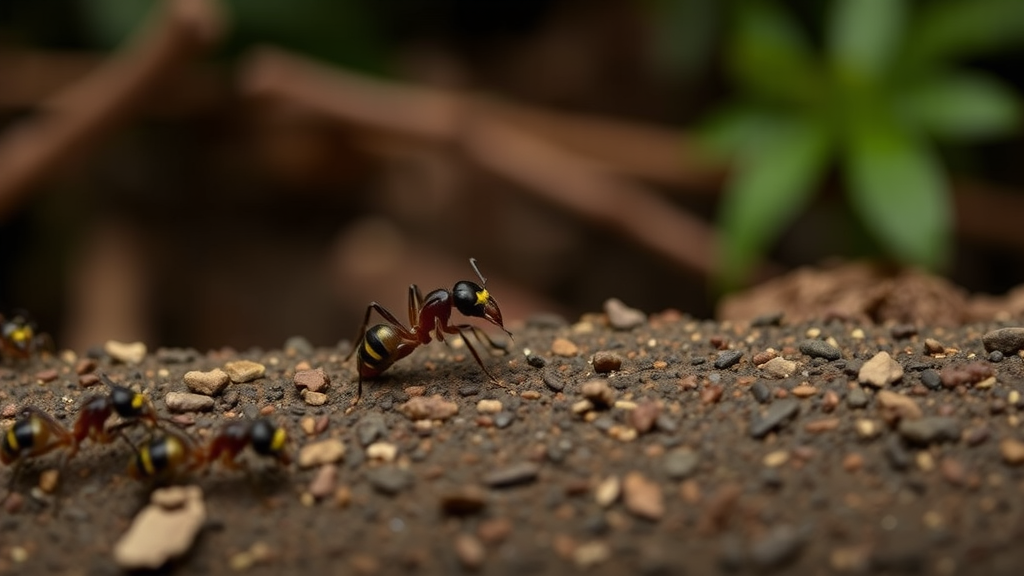
In the wooded foothills of Mount Hymettus, on the northern edge of Athens, an unusual ecological experiment has been unfolding without anyone planning it. The peri-urban forest of Agia Paraskevi sits at a boundary that ecologists find increasingly urgent to understand: a landscape where pine groves, phrygana scrub, footpaths, picnic areas, and suburban infrastructure press up against one another in a patchwork of disturbance and relative wildness. A new year-long study of the ants living in this forest suggests that, at least under moderate levels of human pressure, these communities may be far tougher than many researchers expected.
The research, led by Athanasia Ntouzou of the National and Kapodistrian University of Athens with colleagues including Jakovos Demetriou, Eleftheria Kyriazidi, Anastasia Misseyanni and Christos Georgiadis, is published in The Science of Nature. Between June 2022 and May 2023, the team deployed pitfall traps across the forest, capturing ground-dwelling arthropods in natural sites and in areas with clearly detectable human activity. After sorting and curating thousands of specimens, the researchers identified every ant to species level and subjected the resulting dataset to a battery of statistical tests designed to probe how, and whether, urban disturbance reshapes insect communities.
The team’s starting hypothesis was deliberately pessimistic. Drawing on ecological filtering theory, they predicted that anthropogenic habitat modification would act as a sieve, eliminating specialized soil-dwelling and leaf-litter species sensitive to drying microclimates and vegetation loss, and replacing them with hardy, disturbance-tolerant generalists. They laid out three sequential predictions: species richness and Shannon diversity should decline significantly with disturbance; community composition should shift measurably from specialist-dominated to generalist-dominated assemblages; and differences between communities should be driven by species turnover rather than simple species loss. In each case, the ants declined to cooperate with the hypothesis.
In total, the researchers identified 24 ant species across the study area, with 19 recorded in undisturbed sites and 21 in disturbed ones. Notably, not a single non-native species turned up in the traps, although one endemic Greek species, Camponotus laconicus, was detected. Non-metric multidimensional scaling of community composition showed substantial overlap between disturbed and undisturbed plots, with stress values of 0.169 and 0.122 for presence/absence and abundance data respectively, figures considered acceptable for interpretation. A permutational multivariate analysis of variance found no statistically significant partitioning between the two habitat types, whether the analysis used presence/absence data (p = 0.684) or abundance data (p = 0.073), although with abundance data disturbance explained roughly 19 percent of compositional variation, leaving the result tantalizingly close to the conventional significance threshold.
The finer statistical machinery was equally unambiguous. Indicator value analysis failed to identify any species reliably associated with either habitat type, meaning no ant in this forest qualifies as a simple disturbance fingerprint. Beta diversity partitioning, which separates the effects of species replacement from those of nested species loss, showed no significant differences between disturbed and undisturbed sites in turnover, nestedness, or overall dissimilarity, with p-values ranging from 0.728 to 0.779. Species richness and both Shannon and Simpson diversity indices were statistically indistinguishable between habitat types, and linear mixed-effects models confirmed the pattern across seasons: month of sampling exerted an overwhelming influence on ant activity, while disturbance itself had no significant effect, and the interaction between the two was similarly non-significant.
What did matter was the calendar. Species richness and abundance peaked in July, followed by April, October, and January, a seasonal rhythm typical of Mediterranean-type ecosystems where the hot, dry summer months coincide with maximum colony activity and worker foraging. Interestingly, disturbed habitats hosted more species and individuals in spring and summer, a pattern the researchers attribute to anthropogenic subsidies such as irrigation and littering, which boost soil moisture and resource availability precisely when the natural landscape is at its most parched. In October, as early autumn rains released ants from the constraints of summer drought, the balance tipped the other way, with undisturbed sites hosting the richer assemblages. Either way, the overall statistical verdict was clear: these are differences of timing and texture, not of fundamental community structure.
These findings align closely with the intermediate disturbance hypothesis, first proposed by Joseph Connell in 1978, which holds that biodiversity peaks at moderate levels of disturbance. In peri-urban settings, human activities such as planting, irrigation, and fertilization alter resource flows and generate microhabitats that can temporarily favor native species, potentially raising local diversity rather than eroding it. The absence of non-native ants in the traps strengthens the interpretation that this forest has not yet crossed the threshold where disturbance opens the door to invasive species. The researchers caution, however, that this resilience has a shadow side: disturbance of any intensity is known to facilitate biological invasions, and Attica’s defenses are thin. Only four of Greece’s 16 known alien ant species have been documented in the region, and the invasive Argentine ant, Linepithema humile, is already expanding through metropolitan Athens. Its eventual spread into peri-urban refugia could fundamentally rewrite the diversity patterns documented here, as it has in Portugal, Spain, Italy, and elsewhere around the Mediterranean.
The study is not without caveats, which the authors confront directly. Sampling relied on twelve traps selected from an initial network of 22, constrained by the labor-intensive task of sorting and identifying specimens, though the researchers argue the selected traps captured representative niches on both sides of the disturbance divide. Site proximity in a fragmented landscape raises concerns about spatial autocorrelation, but the team documented physical barriers such as paved corridors and drainage structures separating plots, and their multivariate results point to local disturbance severity rather than geography as the driver of any community differences. The authors also note that ants, with their specialized functional traits, cannot serve as a direct proxy for all arthropods, though their fine-grained sensitivity to soil and microhabitat alteration makes them excellent bioindicators of localized anthropogenic pressure. Expanding pitfall networks across broader regional and biome gradients, they argue, will be essential to test the generality of these results.
The broader message is one of cautious optimism for conservation planning in an urbanizing world. Attica’s urban footprint has exploded in recent decades, rising from roughly 17.7 percent land coverage in 1945 to 68.5 percent by 1995, with continued low-density sprawl since. Against that backdrop, the demonstration that a peri-urban forest can sustain intact, diverse, entirely native ant assemblages under moderate disturbance positions such green spaces as genuine biodiversity reservoirs rather than degraded remnants. The authors recommend management strategies that maintain microhabitat heterogeneity while curbing direct pressures like pollution and littering and forestalling the introduction of non-native species. Preserved and thoughtfully managed, these transitional landscapes may serve as ecological connective tissue across the urban grid, sheltering arthropod communities that intensifying urbanization would otherwise erase. The ants of Mount Hymettus, quietly going about their business beneath the pines, suggest that nature’s margins are not always its weakest points.
Subject of Research: Resilience of Mediterranean peri-urban ant communities to moderate urban disturbance
Article Title: Resilience of ant communities (Hymenoptera: formicidae) to moderate urban disturbance in a mediterranean peri-urban landscape
Article References: Ntouzou, A., Demetriou, J., Kyriazidi, E., Misseyanni, A., & Georgiadis, C. (2026). Resilience of ant communities (Hymenoptera: formicidae) to moderate urban disturbance in a mediterranean peri-urban landscape. The Science of Nature, 113(5), Article 104. https://doi.org/10.1007/s00114-026-02152-w
Image Credits: AI Generated
DOI: 10.1007/s00114-026-02152-w
Keywords: ants, Formicidae, urban ecology, peri-urban forest, intermediate disturbance hypothesis, biodiversity, Mediterranean ecosystems, Greece, invasive species, community ecology, pitfall trapping, bioindicators
Cite Scienmag News
Gavin Prescott. (September 12, 2026). Ants Prove Surprisingly Resilient to Moderate Urban Disturbance in Mediterranean Forest. Scienmag. https://scienmag.com/ants-prove-surprisingly-resilient-to-moderate-urban-disturbance-in-mediterranean-forest/
Gavin Prescott. "Ants Prove Surprisingly Resilient to Moderate Urban Disturbance in Mediterranean Forest." Scienmag, 12 September 2026, https://scienmag.com/ants-prove-surprisingly-resilient-to-moderate-urban-disturbance-in-mediterranean-forest/. Accessed 17 October 2026.
Gavin Prescott. "Ants Prove Surprisingly Resilient to Moderate Urban Disturbance in Mediterranean Forest." Scienmag. September 12, 2026. https://scienmag.com/ants-prove-surprisingly-resilient-to-moderate-urban-disturbance-in-mediterranean-forest/


