Monday, November 2, 2026
Science
No Result
View All Result
  • Login
  • HOME
  • SCIENCE NEWS
  • CONTACT US
  • HOME
  • SCIENCE NEWS
  • CONTACT US
No Result
View All Result
Scienmag
No Result
View All Result
Home Science News Psychology & Psychiatry

Ants Learn a Maze Fast but Forget It Within Days

October 29, 2026
in Psychology & Psychiatry
Glenn Wilkins
By Glenn Wilkins Scienmag Editorial Profile - Clinical Psychology
Reading Time: 3 mins read
0
Ants Learn a Maze Fast but Forget It Within Days

Ants Learn a Maze Fast but Forget It Within Days

65
SHARES
587
VIEWS
Share on FacebookShare on Twitter
ADVERTISEMENT

Worker ants of the species Dinoponera quadriceps can learn to navigate a visual maze to reach food, but they fail to show that learning when tested hours or days later, according to a new open access study published in the journal Animal Cognition. The findings suggest that in these solitary foraging ants, learned route information may be rapidly lost or suppressed rather than retained as lasting memory.

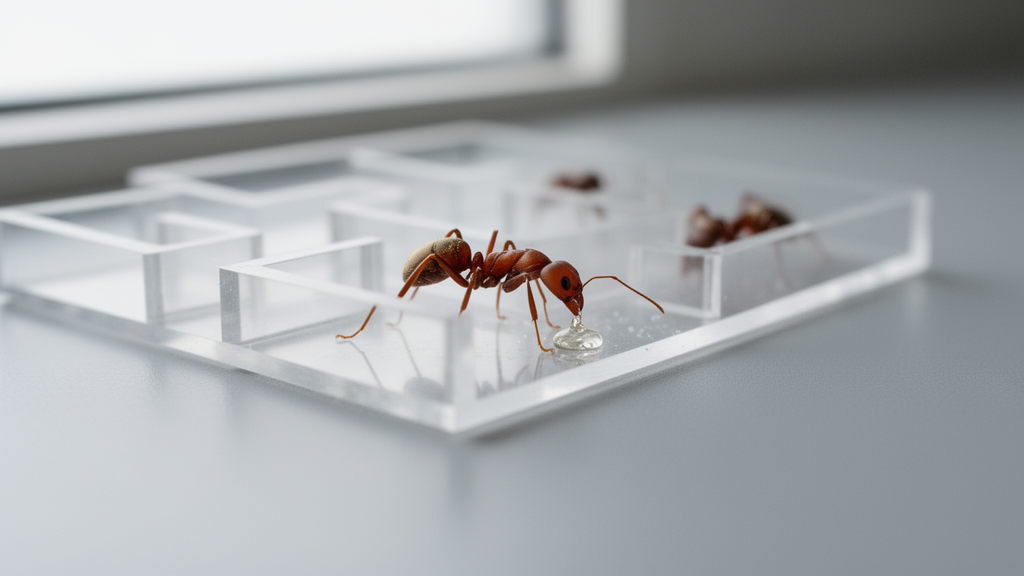
The research team, led by Igor Eloi and colleagues, tested associative learning, memory retention and individual learning profiles using a bifurcated maze with visual cues. Eighty-two workers drawn from ten colonies each underwent four days of individual training to locate a food reward placed in one arm of the maze. After training, each ant received an unrewarded retention test at one of three intervals: 24, 48 or 72 hours.

Thirty-eight of the 82 workers were classified as learners, defined by a consistent reduction in the time they took to find the reward across training sessions. Performance improved significantly by the final training session, and the learners were significantly faster than non-learners in their average latency to reach the reward. This indicates that the learner group was not simply composed of individuals with poorer overall foraging ability.

An unexpected pattern emerged when the researchers examined daily foraging activity. They found a significant negative correlation between an individual’s foraging activity and its learning performance, suggesting an activity-learning trade-off in which the most active foragers were slower to master the maze task.

The critical result concerned memory. Performance across all retention tests, from 24 hours to 72 hours after training, was static and statistically equivalent to the ants’ initial, naive performance in the very first training trial. In other words, although the workers had acquired a visually guided route during training, the behavioral expression of that learned information was not maintained in delayed unrewarded tests.

The authors propose several possible explanations for this retrieval deficit. It may reflect rapid forgetting, extinction-like responding in the absence of reward, retrieval failure, or interference from experiences after training. They also note that the pattern at intermediate intervals is consistent with non-monotonic retention, a shape of memory curve in which performance dips before potentially recovering.

From an ecological perspective, the researchers suggest that such a retrieval deficit could constitute an adaptation that prioritizes up-to-the-minute information. D. quadriceps is a ground-dwelling ant of dynamic forest habitats, where conditions on the forest floor can change quickly, making recently acquired information more valuable than older memories.

The study also highlights substantial individual variation in learning performance within a single species. The authors conclude that memory expression in solitary foraging ants may be strongly shaped both by ecological context and by individual foraging profiles, rather than following a uniform pattern across all workers.

Because the article is being shared early as a peer-reviewed, accepted version of record pending final edits, some details may change in the final published version. Even so, the central observation stands out: these ants can learn, but the learned route does not persist in delayed tests, a combination the authors summarize as associative learning without lasting memory.

Subject of Research: Associative learning and memory retention in the solitary foraging ant Dinoponera quadriceps

Article Title: Associative learning without lasting memory: a recency bias in Dinoponera quadriceps

Article References: Eloi, I., de Lima, M. L. C., Luchiari, A. C., & Araújo, A. (2026). Associative learning without lasting memory: a recency bias in Dinoponera quadriceps. Animal Cognition. https://doi.org/10.1007/s10071-026-02120-x

Image Credits: AI Generated

DOI: 10.1007/s10071-026-02120-x

Keywords: Dinoponera quadriceps, ants, associative learning, memory retention, maze navigation, foraging behavior, individual variation, Animal Cognition, insect cognition, recency bias, Associative, learning

Cite Scienmag News

Glenn Wilkins. (October 29, 2026). Ants Learn a Maze Fast but Forget It Within Days. Scienmag. https://scienmag.com/ants-learn-a-maze-fast-but-forget-it-within-days/

Glenn Wilkins. "Ants Learn a Maze Fast but Forget It Within Days." Scienmag, 29 October 2026, https://scienmag.com/ants-learn-a-maze-fast-but-forget-it-within-days/. Accessed 2 November 2026.

Glenn Wilkins. "Ants Learn a Maze Fast but Forget It Within Days." Scienmag. October 29, 2026. https://scienmag.com/ants-learn-a-maze-fast-but-forget-it-within-days/


Tags: animal cognitionant individual learning profilesant memory retentionant spatial memory lossantsants maze learningassociativeassociative learningassociative learning in antsDinoponera quadricepsDinoponera quadriceps foraging behaviorforaging behaviorindividual variationinsect cognitioninsect learning and memory studieslearningmaze navigationmaze training in solitary antsmemory retentionrapid forgetting in antsrecency biasshort-term vs long-term ant learningsolitarily foraging ant cognitionvisual maze navigation in ants
Share26Tweet16
Previous Post

GLP-1 Drug Use Linked to Better Survival in Diabetic Flesh-Eating Infections

Next Post

Cratons slowly thickened over billions of years, possibly driving more kimberlite eruptions

Related Posts

Time Online, Not Gender or Income, Best Tracks Problematic Internet Use in Turkish Youth
Psychology & Psychiatry

Time Online, Not Gender or Income, Best Tracks Problematic Internet Use in Turkish Youth

October 30, 2026
Integrated job support program keeps people with schizophrenia employed longer, three-year trial finds
Psychology & Psychiatry

Integrated job support program keeps people with schizophrenia employed longer, three-year trial finds

October 30, 2026
Psychosis risk calculator predicts remission and antidepressant use, not just conversion
Psychology & Psychiatry

Psychosis risk calculator predicts remission and antidepressant use, not just conversion

October 30, 2026
Discrimination and school belonging tied to teen suicidal thoughts, but no combined effect
Psychology & Psychiatry

Discrimination and school belonging tied to teen suicidal thoughts, but no combined effect

October 30, 2026
Sensitive employees may shape their own jobs through friendships and enjoyment at work
Psychology & Psychiatry

Sensitive employees may shape their own jobs through friendships and enjoyment at work

October 30, 2026
Vigorous workouts linked to quieter rumination in college students
Psychology & Psychiatry

Vigorous workouts linked to quieter rumination in college students

October 30, 2026
Next Post
Cratons slowly thickened over billions of years, possibly driving more kimberlite eruptions

Cratons slowly thickened over billions of years, possibly driving more kimberlite eruptions

  • Mothers who receive childcare support from maternal grandparents show more optimized

    Mothers who receive childcare support from maternal grandparents show more parental warmth, finds NTU Singapore study

    27656 shares
    Share 11059 Tweet 6912
  • University of Seville Breaks 120-Year-Old Mystery, Revises a Key Einstein Concept

    1061 shares
    Share 424 Tweet 265
  • Bee body mass, pathogens and local climate influence heat tolerance

    682 shares
    Share 273 Tweet 171
  • Researchers record first-ever images and data of a shark experiencing a boat strike

    546 shares
    Share 218 Tweet 137
  • Groundbreaking Clinical Trial Reveals Lubiprostone Enhances Kidney Function

    531 shares
    Share 212 Tweet 133
Science

Embark on a thrilling journey of discovery with Scienmag.com—your ultimate source for cutting-edge breakthroughs. Immerse yourself in a world where curiosity knows no limits and tomorrow’s possibilities become today’s reality!

RECENT NEWS

  • Trademarks Meet Patents in New Method to Spot Technology Opportunities
  • Reddit self-declarations offer auditable labels for demographic inference
  • Scots pine needles map trace element pollution in Polish industrial town
  • Dual-blockchain scheme secures vehicle handovers without pre-shared keys

Categories

  • Agriculture
  • Anthropology
  • Archaeology
  • Athmospheric
  • Biology
  • Biotechnology
  • Blog
  • Bussines
  • Cancer
  • Chemistry
  • Climate
  • Earth Science
  • Editorial Policy
  • Marine
  • Mathematics
  • Medicine
  • Pediatry
  • Policy
  • Psychology & Psychiatry
  • Science Education
  • Science News
  • Social Science
  • Space
  • Technology and Engineering

Subscribe to Blog via Email

Enter your email address to subscribe to this blog and receive notifications of new posts by email.

Join 5,150 other subscribers

© 2025 Scienmag - Science Magazine

Welcome Back!

Login to your account below

Forgotten Password?

Retrieve your password

Please enter your username or email address to reset your password.

Log In
No Result
View All Result
  • HOME
  • SCIENCE NEWS
  • CONTACT US

© 2025 Scienmag - Science Magazine

Discover more from Science

Subscribe now to keep reading and get access to the full archive.

Continue reading