

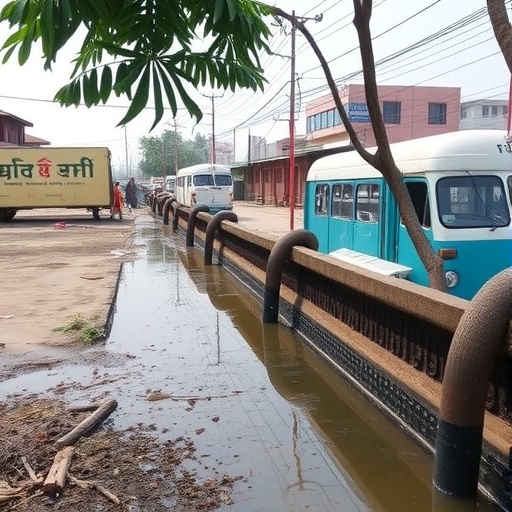
In the rapidly urbanizing landscapes of India, the silent threat of antimicrobial resistance (AMR) is gaining unprecedented urgency. A groundbreaking study led by Singh, Garg, Kumari, and colleagues, soon to be published in Nature Communications, sheds light on the labyrinthine dynamics of AMR genes within the wastewater systems of India’s metropolitan cities. Leveraging advanced metagenomic sequencing techniques, the research unveils a complex resistome profile embedded within the urban effluents, offering a critical glimpse into the environmental reservoirs that may fuel future public health crises.
India, home to some of the world’s most densely populated cities, generates vast quantities of municipal wastewater daily. This effluent, often a cocktail of domestic, industrial, and hospital discharges, provides an ideal milieu for the proliferation and horizontal gene transfer of antibiotic resistance determinants. The study employs shotgun metagenomics—a cutting-edge approach that sequences all genetic material from environmental samples—to comprehensively catalog resistance genes without the limitations of culture-based methods. This technique enables the researchers to detect a vast diversity of resistance elements with high resolution and sensitivity.
The findings reveal an alarming abundance and diversity of antimicrobial resistance genes (ARGs) across wastewater samples collected from multiple metropolitan hubs, including Delhi, Mumbai, Bengaluru, and Kolkata. These ARGs encompass resistance to a broad spectrum of antibiotics spanning beta-lactams, tetracyclines, macrolides, aminoglycosides, and critically important last-resort drugs such as carbapenems and colistin. The presence of extended-spectrum beta-lactamase (ESBL) and carbapenemase genes, which confer resistance to frontline beta-lactam antibiotics, signals a dire threat to clinical therapeutic efficacy.
Crucially, the study also highlights the prevalence of mobile genetic elements (MGEs) such as plasmids, integrons, and transposons that facilitate the horizontal transfer of ARGs between diverse bacterial taxa within wastewater ecosystems. This gene mobility accelerates the dissemination of resistance traits, effectively transforming environmental waters into genetic melting pots. The convergence of multiple ARGs on single MGEs amplifies the potential for multidrug resistance, further complicating treatment strategies against pathogenic infections.
Regional variations in resistome composition underscore the influence of local antibiotic usage patterns, sanitation infrastructure, and population density on the resistome landscape. Metropolitan areas with inadequate sewage treatment and high antibiotic consumption exhibited richer and more complex resistome profiles. These insights emphasize the urgent need for improved wastewater management, rigorous antibiotic stewardship programs, and integrated surveillance systems to curb environmental reservoirs of AMR.
The implications of these findings extend beyond India’s borders, reflecting a global challenge at the intersection of urbanization, environmental microbiology, and public health. Untreated or inadequately treated wastewater acts as a conduit for ARGs to enter natural water bodies, agricultural soils through irrigation, and ultimately the human food chain. This environmental dissemination of AMR threatens to undercut decades of medical advances and imperils achieving sustainable development goals related to health and sanitation.
By integrating metagenomic data with epidemiological parameters, the study pioneers new frontiers in understanding AMR ecology. This holistic perspective enables policymakers and healthcare professionals to anticipate resistance trends and formulate targeted interventions tailored to the unique microbial signatures of each urban environment. Emphasizing a One Health approach, the research advocates coordinated actions spanning clinical medicine, environmental engineering, and microbial ecology.
The methodological rigor of the study is bolstered by comprehensive bioinformatic analyses that filter and annotate millions of DNA sequences against curated AMR databases. This approach ensures robust identification of both known and novel resistance genes, thereby capturing emerging threats that conventional assays might overlook. The team’s meticulous cross-validation strategies enhance confidence in the resistome profiles and their subsequent risk assessments.
Furthermore, the temporal sampling framework adopted in this research unveils seasonal fluctuations in ARG abundance, likely driven by changes in antibiotic consumption, temperature, and hydrological patterns. Such temporal dynamics provide critical clues about the persistence and proliferation mechanisms of resistant bacteria in urban wastewater environments and inform the timing of intervention measures.
The study also alludes to the metabolic versatility of wastewater microbial communities that support ARG dissemination. Diverse bacterial hosts, including opportunistic pathogens and environmental commensals, harbor resistance determinants. This broad host range underscores the challenge of containing AMR, as environmental bacteria can act as reservoirs and vectors for gene transfer to human pathogens, thereby bridging ecological niches.
Policy frameworks in India are poised to benefit enormously from insights derived from metagenomic surveillance. By establishing genomic baselines and continuous monitoring networks, Indian cities can better align with global AMR containment strategies proposed by the World Health Organization and other international bodies. Such data-driven policies are indispensable for safeguarding antibiotic efficacy and protecting population health.
Crucially, public awareness and behavioral change form the cornerstone of combating the environmental spread of AMR. The study advocates for enhanced public education on responsible antibiotic use and improved sanitation practices, which, combined with infrastructural investments, can mitigate the proliferation of resistance genes in the environment. The integration of scientific findings into public health messaging is vital for sustaining the momentum against AMR.
Looking forward, the researchers call for expanding metagenomic surveillance to rural and peri-urban areas, which remain underexplored yet are likely significant contributors to the AMR reservoir. The development of cost-effective, rapid sequencing platforms tailored for field deployment will democratize access to this powerful technology and expand our understanding of AMR dissemination networks at finer spatial resolutions.
In summary, the pioneering work by Singh et al. exemplifies the transformative potential of metagenomics in decoding the complex ecology of antimicrobial resistance within urban wastewater. By illuminating the environmental dimension of AMR, this study not only provides a clarion call for action but also arms policymakers, scientists, and healthcare workers with the data needed to forge resilient, sustainable strategies against one of the 21st century’s most formidable public health threats.
Subject of Research:
Metagenomic analysis of antimicrobial resistance genes in wastewater from metropolitan cities in India
Article Title:
Metagenomic profiling of antimicrobial resistance in wastewater from metropolitan cities of India
Article References:
Singh, N.K., Garg, P., Kumari, S. et al. Metagenomic profiling of antimicrobial resistance in wastewater from metropolitan cities of India.Nat Commun (2026). https://doi.org/10.1038/s41467-026-70702-x
Image Credits: AI Generated


