


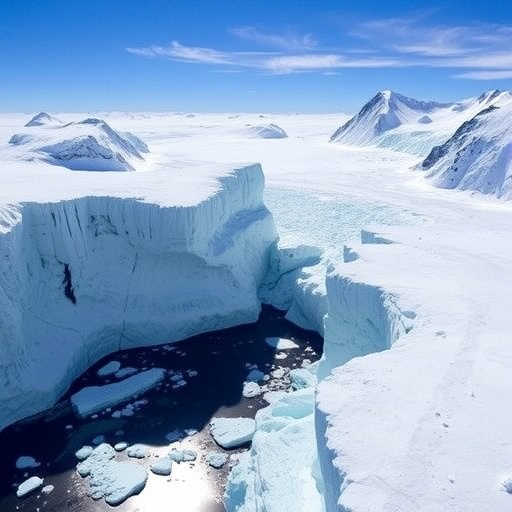
The Antarctic ice sheet, an immense reservoir of frozen water containing approximately 90% of the planet’s glacier ice, represents one of the most critical indicators and contributors to global sea-level rise. Should this vast expanse of ice melt entirely and discharge into the ocean, global sea levels would surge by an estimated 60 meters, fundamentally transforming coastlines worldwide. Now, groundbreaking research by a team led by Professor Shin Sugiyama at Hokkaido University has, for the first time, directly observed how surface meltwater from Antarctic glaciers percolates down to their bases, accelerating their flow toward the sea. This discovery challenges previously held assumptions and significantly advances our understanding of Antarctic glaciology under warming climatic conditions.
The study, published in the prestigious journal Nature Communications, focused on the Langhovde Glacier in East Antarctica, where researchers conducted unprecedented deep drilling operations. Utilizing a hot-water jet drilling method, the team penetrated more than 550 meters through the ice to install pressure sensors and cameras at the glacier base, unlocking critical data inaccessible through satellite observation. These instruments measured subglacial water pressure and captured visual evidence of processes occurring beneath hundreds of meters of ice, revealing dynamic interactions that directly influence glacier movements.
Central to the findings is the confirmation of hydrofracturing as a vital mechanism allowing surface meltwater to reach the glacier bed. Hydrofracturing occurs when meltwater accumulates in surface lakes and ponds, and its weight forces fractures within the ice. These fractures create conduits through which the water rapidly descends to the base. This phenomenon is crucial because the presence of pressurized water reduces friction between the glacier and the underlying bedrock. Essentially, water acts as a lubricant, decreasing the basal drag and enabling the ice to slide more swiftly towards the ocean, enhancing the glacier’s discharge of ice mass.
The researchers observed that during periods characterized by intense surface melting or exceptional rainfall, such as an event in January 2022, subglacial water pressure surged dramatically. Data showed water pressure supporting up to 97% of the ice’s overlying weight, a condition sufficient for slightly lifting the glacier off its bedrock foundation. Consequently, this reduced friction led to a 10 to 20 percent acceleration in the glacier’s basal sliding velocity. This evidence provides unequivocal confirmation that meltwater can substantially influence Antarctic ice dynamics—a process known to occur in glaciers in Europe, Greenland, and Alaska but previously unconfirmed directly in Antarctica due to technological challenges.
The implications of this study are profound. Antarctica has long been seen as more stable than other glaciated regions due to its extreme cold and relative isolation from surface melt. However, this pioneering research reveals that even the Antarctic ice sheet is vulnerable to the accelerating impacts of climate change, potentially leading to more rapid ice loss than models have predicted. As surface melting increases with global temperature rise, the resulting meltwater inputs to the ice base will likely intensify, promoting faster glacial flow and contributing to global sea-level rise at an accelerated pace.
Moreover, this research unveiled a surprising revelation about the sub-ice environment beneath Langhovde Glacier—a hidden ecosystem thriving in extreme conditions. The cameras installed in the boreholes captured images of colorful sea anemones and delicate stalked sponges nestled on boulders beneath an approximately three-meter-thick seawater layer, which itself was concealed beneath nearly 474 meters of solid ice. These organisms were found several hundred meters seaward beyond where the glacier loses contact with the seabed, illustrating remarkable biological adaptation to cold, dark, high-pressure environments.
The presence of this vibrant subglacial life challenges prior assumptions about Antarctic marine habitats and highlights the unknown biodiversity harbored beneath the continent’s ice cover. It opens new avenues of investigation into how these unique ecosystems function and survive in isolation, offering crucial insights into the resilience of life in extreme conditions and potential vulnerabilities in a changing climate.
Professor Sugiyama’s team demonstrated that understanding glacier dynamics is not solely a matter of physics and climatology but also entails a complex interplay with biological systems. The identification of such ecosystems beneath the ice underscores the urgent need to consider the ecological dimensions of glaciological and climate research to fully comprehend Antarctica’s role in the Earth system.
This study also emphasizes the importance of advanced field experimentation in complementing satellite observations and theoretical modeling. Direct measurements obtained from deep boreholes provide high-resolution temporal data on subglacial hydrology and ice movement that remote sensing alone cannot capture. The innovative application of hot-water drilling technology enabled the researchers to overcome formidable technical challenges, setting a new standard for glaciological investigations in harsh polar environments.
In conclusion, the research led by Professor Sugiyama marks a transformative step in Antarctic science. It conclusively proves that surface meltwater infiltration at the base of Antarctic glaciers accelerates glacial flow, thereby intensifying ice discharge into the ocean—a process with critical implications for future sea-level rise scenarios. At the same time, it reveals a hidden biosphere beneath the ice, whose discovery sparks profound questions about life’s adaptability and the interconnectedness of Earth’s physical and biological systems amid climate change.
As global warming advances, the findings of this work highlight an urgent warning for societies worldwide, particularly those inhabiting low-lying coastal regions vulnerable to rising seas. The accelerating ice loss from Antarctica threatens to exacerbate sea-level rise, influencing global climate patterns and human habitability. This underscores the imperative for continued research, enhanced monitoring, and proactive climate mitigation strategies to safeguard the planet’s future.
Cite Scienmag News
Violet Maxwell. (June 12, 2026). Antarctic Glaciers Accelerate Toward Ocean Due to Meltwater Impact. Scienmag. https://scienmag.com/antarctic-glaciers-accelerate-toward-ocean-due-to-meltwater-impact/
Violet Maxwell. "Antarctic Glaciers Accelerate Toward Ocean Due to Meltwater Impact." Scienmag, 12 June 2026, https://scienmag.com/antarctic-glaciers-accelerate-toward-ocean-due-to-meltwater-impact/. Accessed 3 September 2026.
Violet Maxwell. "Antarctic Glaciers Accelerate Toward Ocean Due to Meltwater Impact." Scienmag. June 12, 2026. https://scienmag.com/antarctic-glaciers-accelerate-toward-ocean-due-to-meltwater-impact/


