


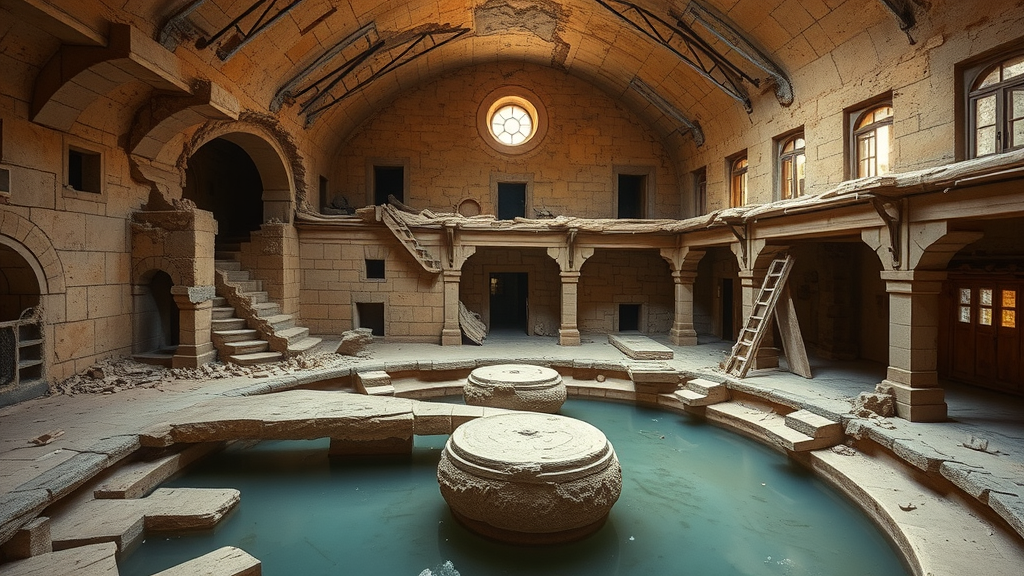
A Roman cold room in the ancient city of Stratonikeia, in southwestern Türkiye, has finally told the full story of its own life and death. Researchers have reconstructed the complete chronology of the Frigidarium of the city’s Roman Bath complex, from the moment its walls rose in the late first or early second century CE to the seismic event that brought monumental function to an end in the early seventh century. The study, published in Archaeological and Anthropological Sciences, combines optically stimulated luminescence dating of bricks, mortar, and sediment with a constrained Bayesian phase model, producing one of the most statistically explicit archaeoseismic timelines ever assembled for a single Roman building.
The team, led by Eren Şahiner of Ankara University’s Earth Sciences Application and Research Center, together with Tamer Koralay, Bilal Söğüt, Tunç Sezgin, and Yusuf Kağan Kadıoğlu, dated five specimens drawn from the Frigidarium’s fabric. Optically stimulated luminescence, or OSL, works by measuring the trapped charge accumulated in mineral grains such as quartz since they were last exposed to sunlight or heat. When a brick is fired or mortar quartz is exposed during preparation, its luminescence clock resets; from that moment, background ionizing radiation from the surrounding sediments, cosmic rays, and the sample’s own radioisotopes steadily winds the clock forward. In the laboratory, controlled optical stimulation releases the stored signal, and the intensity reveals the equivalent dose, the total radiation absorbed since the resetting event. Dividing that dose by the environmental dose rate yields an age.
What distinguishes this study is the rigor of its dose-rate protocol. The researchers documented every step, including grain-size-dependent attenuation of beta radiation, a carbonate water-equivalence correction specifically designed for lime-bound mortars, and an explicit assessment of gamma dose-rate heterogeneity. Lime mortars are notoriously difficult subjects for luminescence dating because their carbonate content alters the way water content and radiation attenuation interact, and the team applied the Carb-style modeling approach to handle this. Gamma dose-rate heterogeneity is a further subtlety: in a wall of compound masonry, where bricks and mortar alternate, the radiation field is not uniform, and a sample’s dose rate depends on the geometry of its immediate surroundings. Rather than treating this uncertainty as a nuisance to be ignored, the authors modeled the gamma-field geometry as a Bayesian nuisance parameter, propagating the dosimetric uncertainty of compound masonry directly into the final chronological posteriors.
The five OSL ages were then synthesized in a constrained Bayesian phase model, a framework adapted from the radiocarbon dating community, carrying only stratigraphic information and terminus post quem priors. In plain terms, the model was told only the relative order of events and the earliest possible dates, and then asked to reconcile the luminescence measurements into coherent phases of the building’s life. Three phases emerged. Primary construction of the Frigidarium falls in the late first to early second century CE, with a posterior median of 162 CE and a 95.4 percent highest-posterior-density interval spanning 60 to 323 CE. This is consistent with the flourishing of Roman bath architecture in Caria during the Antonine and Severan periods, when cities of western Anatolia competed to monumentalize their civic centers.
The second phase captures a repair episode, dated with a mode of 375 CE within an interval of 365 to 499 CE. The coincidence is striking: the great Eastern Mediterranean earthquake of 365 CE, generated near Crete and felt across the entire region, devastated coastal cities and is one of the most extensively documented seismic events of antiquity. The repair date aligns closely with that catastrophe, suggesting that the Frigidarium was damaged and subsequently restored in its aftermath. Archaeoseismology, the discipline that reads earthquake damage in ancient structures, has long catalogued tilted walls, displaced masonry blocks, and collapsed colonnades across the Mediterranean, but assigning absolute dates to such damage has remained difficult. Here, the luminescence clock provides an independent chronological anchor for a restoration that historical sources alone could never have pinned to this provincial city.
The third phase concerns the building’s terminal collapse. Under dosimetric priors alone, the model placed the collapse at a mode of 545 CE within a broad window of 405 to 802 CE, a range too wide to discriminate among the known seismic events of the period. The Eastern Mediterranean experienced what some scholars describe as seismic clustering between the fourth and sixth centuries, with major earthquakes in 494 CE and in 554 to 558 CE, as well as events around 610 to 630 CE. Any of these could, in principle, have delivered the fatal blow. The Bayesian model alone could not choose between them, and the authors were careful not to overstate what the luminescence data could resolve.
The decisive breakthrough came from archaeology rather than physics. Coins minted in 613 CE were found sealed beneath the collapse debris, providing a hard terminus post quem: the building could not have fallen before those coins were deposited. When this numismatic evidence was incorporated into the Bayesian model, the collapse window narrowed dramatically to 613 to 850 CE, with a mode of 633 CE. Within that refined window, the circa 610 to 630 CE seismic anchor dominates, achieving an overlap probability of 0.31 at a 25-year tolerance. The statistical conclusion is that a seismic trigger is the most probable cause of the terminal loss of the Frigidarium’s monumental function in the early seventh century CE, a period of chronic instability for the Eastern Roman Empire marked by Persian wars, plague, and persistent tectonic activity in western Anatolia.
Stratonikeia itself is an ideal laboratory for such work. Located in the Yatağan district of Muğla Province, the city has been the focus of long-running excavations directed from Pamukkale University, and previous studies have documented earthquake relics in the ancient city and at the nearby sanctuary of Hekate at Lagina. Earlier archaeometric investigations of Stratonikeia’s bricks, mortars, and building stones, including luminescence dating of bricks from the Erikli Basilica and characterization of the theater’s architectural stones, laid the groundwork for the present study. The Frigidarium, the cold room where bathers began or ended their circuit of the Roman baths, is a structurally massive space whose thick walls preserve a legible record of construction, repair, and destruction.
The methodological implications extend well beyond one building. Mortar dating by luminescence has matured over the past two decades, and reviews of the field have emphasized the need for transparent, reproducible dose-rate assessment, particularly for carbonate-rich materials. By publishing a fully documented protocol, treating gamma-field geometry as an explicit model parameter, and releasing the R and Python scripts implementing the dose-rate calculation, equivalent-dose modeling, and Bayesian phase chronology, together with full Monte Carlo posterior samples, the team has set a benchmark for how archaeoseismic chronologies should be constructed and reported. The approach converts scattered, imprecise age estimates into a coherent probabilistic narrative of a building’s biography.
For the wider public, the study offers something rare: a precise, quantified answer to the question of when a great Roman monument was born, when it was wounded, and when it died. The Frigidarium of Stratonikeia rose in the high empire, was patched after the great earthquake of 365 CE, and stood for roughly another two and a half centuries before an early seventh-century tremor ended its life as a functioning bath. In the layered ruins of Caria, the marriage of luminescence physics and Bayesian statistics is now capable of reading that biography directly from the walls themselves, giving voice to buildings that survived their own civilization by more than a millennium.
Subject of Research: Bayesian archaeoseismic chronology of the Stratonikeia Frigidarium using optically stimulated luminescence dating
Article Title: Bayesian archaeoseismic chronology of the Stratonikeia Frigidarium from construction to seismic collapse
Article References: Şahiner, E., Koralay, T., Söğüt, B., Sezgin, T., & Kadıoğlu, Y. K. (2026). Bayesian archaeoseismic chronology of the Stratonikeia Frigidarium from construction to seismic collapse. Archaeological and Anthropological Sciences, 18(10), Article 203. https://doi.org/10.1007/s12520-026-02564-9
Image Credits: AI Generated
DOI: 10.1007/s12520-026-02564-9
Keywords: luminescence dating, OSL, Stratonikeia, archaeoseismology, Bayesian modelling, Roman architecture, frigidarium, Roman baths, earthquake chronology, mortar dating, Anatolia, 365 CE earthquake
Cite Scienmag News
Courtney Benton. (September 23, 2026). Ancient Turkish Bath’s Collapse Dated to Early Seventh Century by Bayesian Luminescence Clock. Scienmag. https://scienmag.com/ancient-turkish-baths-collapse-dated-to-early-seventh-century-by-bayesian-luminescence-clock/
Courtney Benton. "Ancient Turkish Bath’s Collapse Dated to Early Seventh Century by Bayesian Luminescence Clock." Scienmag, 23 September 2026, https://scienmag.com/ancient-turkish-baths-collapse-dated-to-early-seventh-century-by-bayesian-luminescence-clock/. Accessed 4 October 2026.
Courtney Benton. "Ancient Turkish Bath’s Collapse Dated to Early Seventh Century by Bayesian Luminescence Clock." Scienmag. September 23, 2026. https://scienmag.com/ancient-turkish-baths-collapse-dated-to-early-seventh-century-by-bayesian-luminescence-clock/


