


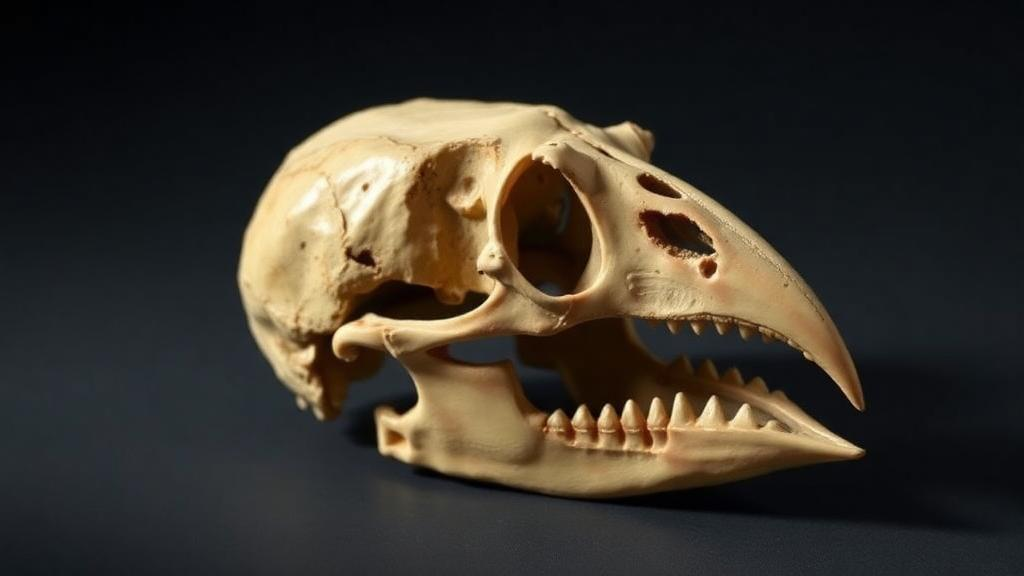
Deep in the laminated limestones of Las Hoyas, a fossil site in central Spain famous for preserving a 129 to 126 million-year-old wetland ecosystem in exquisite detail, palaeontologists have identified the first adult skull of a bird ever recovered from the entire European Early Cretaceous. The specimen, a fragmentary but partially articulated cranium designated MUPA-LH-13240 and housed at the Museo de Paleontología de Castilla-La Mancha in Cuenca, belongs to a brand-new species of enantiornithine bird, the dominant group of Mesozoic birds that vanished alongside the dinosaurs. The researchers have named it Gorgonavis alcyone, and its most striking feature is a slender, elongated snout that rewrites where and when specialised long-faced birds first appeared.
Enantiornithines were the most speciose and widespread clade of Mesozoic birds, and the Iberian Peninsula hosts the richest Early Cretaceous record of these animals anywhere outside China. Sites such as Las Hoyas and La Pedrera de Meià have yielded celebrated species including Iberomesornis romerali, Concornis lacustris and Eoalulavis hoyasi, alongside juvenile enantiornithines, a perinate, an isolated wing with preserved muscles, skin and feathers, and an adult postcranial skeleton. Yet despite decades of excavation and a wealth of feathers, isolated bones and partial skeletons, no adult cranial remains had ever surfaced at either locality. The new skull therefore fills a glaring gap in the European record, providing the first non-juvenile cranial anatomy of a pygostylian bird from the Early Cretaceous found outside China.
To coax anatomical detail out of the dense limestone, the team deployed micro-computed tomography at two facilities. A first scan at the Centro de Instrumentación Científica of the University of Granada, using a Xradia 510 VERSA ZEISS scanner with 2,026 projections and a voxel size of 18.521 micrometres, generated three-dimensional volumes of every preserved cranial bone. A second, higher-resolution pass at the University of Málaga, resolving 9,986 slices at 6 micrometres, allowed the researchers to segment and model the delicate premaxillary teeth. Digital imaging revealed a premaxilla with three to four pairs of teeth confined to the rostral half of the bone, a thin maxilla entirely lacking teeth, and a jugal bearing an elongated postorbital process set at nearly a right angle to the jugal bar.
That combination of characters is diagnostic. The premaxillary corpora are completely fused to one another, and the postdentary bones of the lower jaw are extensively fused, conditions seen in adult or near-adult enantiornithines such as Shangyang and Navaornis. Because enantiornithines fused compound bones in a known sequence, with premaxillary fusion occurring after the fusion of vertebral elements but before the full formation of the carpometacarpus, the researchers interpret the holotype as a subadult or older individual nearing skeletal maturity. The teeth themselves are strongly flattened labiolingually, ranging from 0.4 to 0.7 millimetres in mesiodistal length, with the fourth premaxillary tooth the largest, a pattern shared with the long-snouted Chinese enantiornithine Longipteryx.
Phylogenetic analyses placed the new species firmly within a distinctive family. The team scored MUPA-LH-13240 into two alternative morphological matrices, one modified from Benito and colleagues and another from Chiappe, Navalón and colleagues, and ran maximum parsimony searches in TNT with 10,000 replicates of random stepwise addition. The modified Benito matrix returned 264 most parsimonious trees of 1,441 steps, and Gorgonavis was recovered in a nested position within the enantiornithine family Longipterygidae in 100 percent of the trees, sitting as sister taxon to the subfamily Longipteryginae, which includes Longipteryx and Boluochia. The second matrix, yielding 17 most parsimonious trees of 923 steps, likewise placed Gorgonavis with the longipterygids in every tree. Implied weighting analyses at optimised k-values produced more resolved trees with the same longipterygid affinity.
Longipterygidae is a clade of enantiornithines defined by an elongated rostrum, and until now every known member came from the Jehol Biota of northeastern China, specifically the Yixian Formation dated to about 124.6 million years ago or the Jiufotang Formation dated to 122 to 120 million years ago. Gorgonavis, from Barremian deposits dated to 129 to 126 million years ago, is therefore the oldest enantiornithine showing significant rostral elongation anywhere in the world, and the first occurrence of this specialised condition outside the Jehol Biota. The discovery implies that some specialised early enantiornithine lineages had a far broader geographical and more ecologically diverse distribution than previously appreciated, hinting at faunal connections between the subtropical wetlands of Iberia and the lacustrine ecosystems of Early Cretaceous China.
To quantify the evolutionary significance of the elongated snout, the researchers assembled a comparative dataset of rostrum and orbit lengths from 27 Mesozoic bird species and two crown birds, taking scaled measurements with tpsDig2 and using the three-dimensional skull reconstruction of Gorgonavis as reference. They time-calibrated a phylogenetic tree with the paleotree package in R, generating 100 trees to account for stratigraphic uncertainty, and fitted a Phylogenetic Generalized Least Squares regression of log-transformed rostrum length against orbit length using Pagel’s correlation. The residuals of this regression serve as a proxy for relative rostral elongation, and mapping those residuals across the phylogeny with maximum likelihood revealed an evolutionary continuum: taxa with proportionally long snouts plot above the fitted line, while short-snouted forms plot below.
The results are revealing. Gorgonavis exhibits a rostrum two and a half times the length of its orbit, placing it within the lower range of long-snouted longipterygids, comparable in proportions to Shanweiniao. Among enantiornithines, the only taxa showing positive residuals, indicating a proportionally elongated rostrum, are contained within Longipterygidae. The most extreme long-snouted forms all belong to Euornithes, the clade leading to modern birds, including the Early Cretaceous Dingavis, the stem ornithurine Hesperornis and the living duck Anas. The most extreme short-snouted taxa include bohaiornithid enantiornithines such as Parabohaiornis, whose rostrum and orbit are nearly subequal in length. The phylogenetic distribution of residuals shows that longipterygids evolved relatively elongated rostra very early in avian history, exploring a tendency that Euornithes would later push to more extreme values.
Perhaps most intriguing is the way Gorgonavis builds its snout. In most known Early Cretaceous enantiornithines, the premaxilla is reduced and restricted to the anterior-most region, with the maxilla forming much of the lateral margin of the upper jaw, the plesiomorphic condition inherited from earlier birds. In elongated enantiornithines such as Rapaxavis, Longirostravis and even the bizarre Madagascar form Falcatakely, the maxillary processes of the premaxillae remain short and contribute little to a maxillary-dominated snout. Gorgonavis, however, has slender maxillary processes that extend for roughly half the tomial edge, meaning the premaxilla and maxilla contribute subequally to the rostral margin. This construction mirrors that of Euornithes such as Yanornis, Xinghaiornis and Hesperornis, and it represents a remarkable convergence between two avian lineages separated by at least 130 million years of evolution.
The new fossil also clarifies evolution within the longipterygid family itself. Gorgonavis shares a caudoventral extension of the premaxillary maxillary processes with the longipterygines, while exhibiting the straight rostrum, particularly the straight dentary, and smaller teeth characteristic of the longirostravines. This mosaic of characters suggests that some features shared across the family may be primitive for the clade, and it substantiates previous assertions that the distinctive traits of Longipteryx, including a more ventrally curved snout and large recurved premaxillary teeth, are derived rather than ancestral. The estimated three-centimetre skull is also disproportionately large for the tiny postcranium of Iberomesornis, whose complete axial skeleton measures about 5.5 centimetres, ruling out referral to any previously known Las Hoyas species and confirming Gorgonavis as a distinct, considerably larger bird, more similar in size to Shanweiniao. After decades of excavation, the discovery underscores that Las Hoyas remains a site of global importance, demonstrating that the great lability of avian craniofacial evolution reaches back to the earliest days of bird history, and that elongated snouts evolved multiple times independently among the flying dinosaurs of the Cretaceous.
Subject of Research: An isolated skull from Las Hoyas (Early Cretaceous, Spain) informs the early evolution towards elongated rostra in enantiornithine birds (Aves, Ornithothoraces)
Article Title: An isolated skull from Las Hoyas (Early Cretaceous, Spain) informs the early evolution towards elongated rostra in enantiornithine birds ( Aves , Ornithothoraces )
Article References: Nebreda, S. M., Chiappe, L. M., Navalón, G., Terol, J. C., Serrano, F. J., D. Buscalioni, Á., & Marugán-Lobón, J. (2026). An isolated skull from Las Hoyas (Early Cretaceous, Spain) informs the early evolution towards elongated rostra in enantiornithine birds (Aves, Ornithothoraces). Swiss Journal of Palaeontology, 145, 251-265. https://doi.org/10.3897/sjp.145.182813
Image Credits: AI Generated
Keywords: isolated, skull, Hoyas, Early, Cretaceous, Spain, informs, evolution, towards, elongated, rostra, enantiornithine
Cite Scienmag News
Gavin Prescott. (October 17, 2026). Ancient Spanish skull reveals early birds evolved long beaks far earlier than thought. Scienmag. https://scienmag.com/ancient-spanish-skull-reveals-early-birds-evolved-long-beaks-far-earlier-than-thought/
Gavin Prescott. "Ancient Spanish skull reveals early birds evolved long beaks far earlier than thought." Scienmag, 17 October 2026, https://scienmag.com/ancient-spanish-skull-reveals-early-birds-evolved-long-beaks-far-earlier-than-thought/. Accessed 17 October 2026.
Gavin Prescott. "Ancient Spanish skull reveals early birds evolved long beaks far earlier than thought." Scienmag. October 17, 2026. https://scienmag.com/ancient-spanish-skull-reveals-early-birds-evolved-long-beaks-far-earlier-than-thought/


