


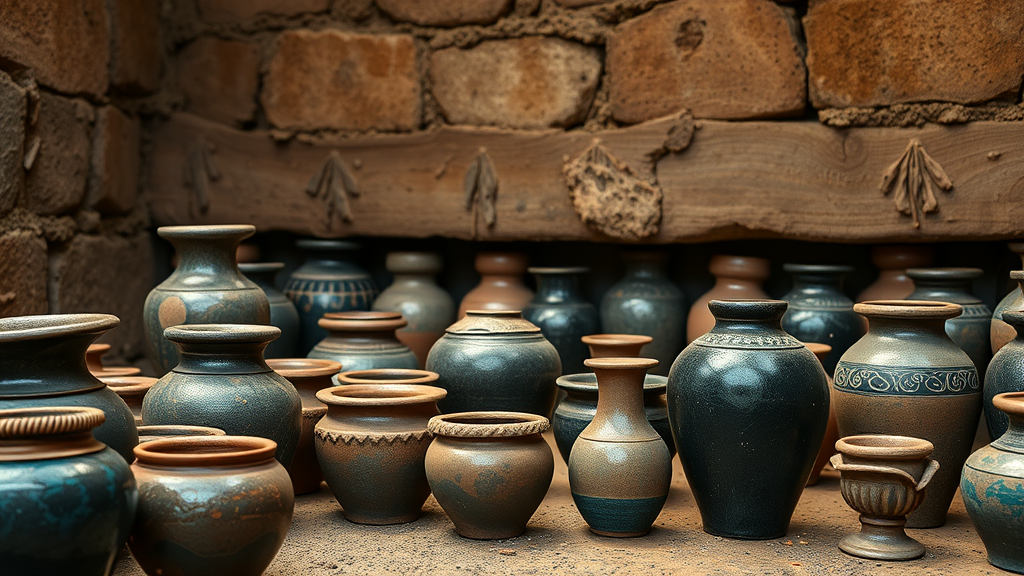
Long before Vesuvius buried it in ash, Pompeii may have been far more than a consumer of fine Mediterranean tableware. A new archaeometric study of Black Gloss pottery recovered from the city suggests that Pompeii hosted, or sat at the heart of, a major production center for the iconic black-slipped ceramics that graced Hellenistic and early Roman tables across Italy and beyond. The findings, published in Archaeological and Anthropological Sciences, challenge long-standing assumptions about where this ubiquitous ware was made and redraw the map of ceramic production in ancient Campania.
An international team led by Alejandro G. Sinner of the University of Victoria, together with colleagues from the University of Barcelona, the Catalan Institute of Classical Archaeology, and the University of Cincinnati, analyzed 57 ceramic individuals dated between the late fourth and early first centuries BCE. Crucially, the samples came not only from domestic consumption contexts but also from production areas within Pompeii itself, allowing the researchers to compare presumed local wasters and workshop debris with the fine tableware Pompeians actually used.
The team employed a three-pronged analytical battery. Wavelength-dispersive X-ray fluorescence, or WD-XRF, measured the elemental chemistry of each vessel, while powder X-ray diffraction, PXRD, identified the crystalline mineral phases preserved in the fired clay. Scanning electron microscopy coupled with energy-dispersive spectroscopy, SEM-EDS, then zoomed in on the famous black slip itself, revealing its microstructure and composition at the microscopic scale. Together these techniques provide chemical fingerprints that can distinguish clay sources and reconstruct ancient firing practices in ways that visual typology never could.
The chemical results revealed a polygenic assemblage, meaning the pottery found in Pompeii did not come from a single source. Instead, the material separated into several distinct compositional groups. One major group was interpreted as local or regional production associated with Pompeii or its immediate surroundings, lending quantitative weight to the idea that the city supported its own black gloss industry. Other groups corresponded to additional Campanian productions, including the celebrated Campanian A ware from the Bay of Naples, and one widely distributed group documented across the Italian peninsula and the western Mediterranean that shows striking compositional similarity to the Pompeian group. The data also identified a production compatible with materials linked to the Etruscan city of Chiusi in Tuscany, underscoring Pompeii’s connections to trade networks stretching well beyond Campania.
The mineralogical and microstructural analyses opened a window onto the potters’ kilns. Most of the productions used calcareous clays, rich in calcium compounds, and were fired at roughly 900 to 950 degrees Celsius, precisely the temperature window required to produce a durable, well-sintered ceramic body for this class of fine ware. By contrast, the low-calcareous Campanian A pottery had been fired at temperatures below or around 800 degrees Celsius, a distinctly different technological recipe that reflects the particular properties of the volcanic Bay of Naples clays used in that tradition.
The black slip itself, the defining feature of the ware, told an equally nuanced story. All of the slips proved to be iron-rich and illitic, consistent with the established Black Gloss manufacturing tradition in which a fine, iron-laden clay slurry is applied to the vessel and reduced in firing to produce the characteristic metallic black surface. But the study revealed considerable variability in slip thickness, vitrification, and adhesion, particularly within the Pompeian group. That variability reflects differences in technological control from workshop to workshop, and perhaps even from potter to potter, offering a rare glimpse of quality differences within a single production tradition.
Perhaps the most consequential finding concerns the mismatch between archaeological classification and chemical reality. Typological attributions, such as assigning a vessel to the famous Cales production on the basis of its shape and style, did not correspond to single production units in the compositional data. In other words, similar-looking vessels were being made in multiple places. The results therefore support a model of decentralized production in Campania, in which numerous workshops exploited similar calcareous clay resources while maintaining distinct compositional and technological identities. This picture replaces the older notion of a few dominant production centers flooding the market with a monolithic product.
The study forms part of the broader MedConTaCCt project, Mediterranean Connectivity: Economy, Trade and Commercial Circuits in the Roman West, funded by the Social Sciences and Humanities Research Council of Canada. As part of that project, nearly 600 Black Gloss samples have now been analyzed from consumption centers across the Italian peninsula, including Populonia, Pompeii and Gabii; from Sicilian sites such as Monte Iato and Morgantina; from southern French sites including Narbo, Loupian and Lattara; and from a string of Iberian ports and inland towns from Emporion to Valentia. The Pompeii dataset thus plugs into a vast comparative framework that allows individual vessels to be matched against reference groups spanning the entire western Mediterranean.
For archaeologists, the implications extend well beyond ceramics. Black Gloss pottery is one of the most common dating and diagnostic artifacts in Hellenistic and early Roman sites, and assumptions about its origin underpin reconstructions of trade routes, market systems and economic integration. Demonstrating that Pompeii participated actively in production, not merely consumption, positions the city as a node in regional supply networks decades before it became the famous Roman colony of the imperial era. The results also refine interpretations of how technological knowledge, particularly the demanding reduction-firing technique behind the black slip, spread among workshops that shared raw materials yet preserved their own manufacturing signatures.
The full dataset is being released in open access through the SMART database, the Server for Mediterranean Archaeometric Roman Tableware, ensuring that future researchers can test and extend these compositional groups as new samples accumulate. As the chemical atlas of Black Gloss pottery grows, the humble black-slippered cup on an ancient table is proving to be one of the most informative tracers of economic life in the Hellenistic and early Roman Mediterranean, and Pompeii, it turns out, was making its mark on that world long before the eruption preserved it in stone.
Subject of Research: Archaeometric provenance and technology analysis of Black Gloss pottery from Pompeii
Article Title: Made in Pompeii? New insights into the production, consumption and distribution of black gloss pottery
Article References: Sinner, A. G., Fernández, M. M. I., Palacios, C. O., Garrigós, J. B. I., Ribera, A., & Ellis, S. (2026). Made in Pompeii? New insights into the production, consumption and distribution of black gloss pottery. Archaeological and Anthropological Sciences, 18(10), Article 198. https://doi.org/10.1007/s12520-026-02542-1
Image Credits: AI Generated
DOI: 10.1007/s12520-026-02542-1
Keywords: Pompeii, Black Gloss pottery, archaeometry, WD-XRF, PXRD, SEM-EDS, Campanian A, ceramic technology, provenance studies, Hellenistic trade, decentralized production, Roman ceramics
Cite Scienmag News
Courtney Benton. (September 12, 2026). Ancient Pompeii Emerges as a Black Gloss Pottery Powerhouse, Chemistry Reveals. Scienmag. https://scienmag.com/ancient-pompeii-emerges-as-a-black-gloss-pottery-powerhouse-chemistry-reveals/
Courtney Benton. "Ancient Pompeii Emerges as a Black Gloss Pottery Powerhouse, Chemistry Reveals." Scienmag, 12 September 2026, https://scienmag.com/ancient-pompeii-emerges-as-a-black-gloss-pottery-powerhouse-chemistry-reveals/. Accessed 17 October 2026.
Courtney Benton. "Ancient Pompeii Emerges as a Black Gloss Pottery Powerhouse, Chemistry Reveals." Scienmag. September 12, 2026. https://scienmag.com/ancient-pompeii-emerges-as-a-black-gloss-pottery-powerhouse-chemistry-reveals/


