


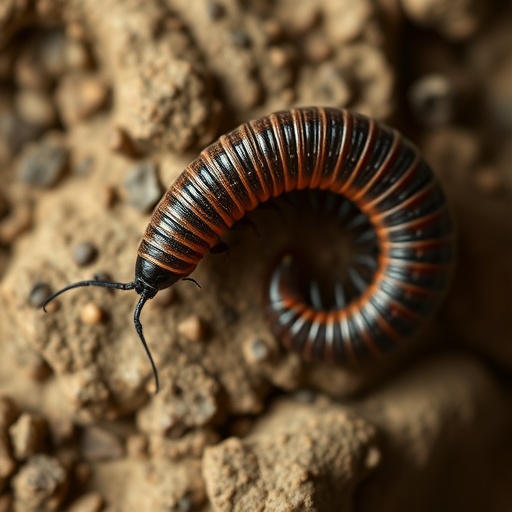
Long before the first vertebrates ever took their tentative steps on land, millipedes had already established themselves as the pioneer inhabitants of terrestrial ecosystems. These multi-legged decomposers played a crucial role in shaping the earliest terrestrial environments hundreds of millions of years before dinosaurs roamed. However, despite their ancient origins and ecological significance, the evolutionary history of millipedes remained fragmented, with significant gaps still obscuring our understanding of their lineage and diversification.
A recent breakthrough led by an international team spearheaded by researchers from Virginia Tech has unveiled a comprehensive and refined evolutionary framework for all living millipede orders. By integrating genomic data derived from living species alongside morphological insights gleaned from fossil records, the study reconstructs the millipede family tree with unprecedented resolution. This groundbreaking work, published in Current Biology, pushes back the origins of millipedes to nearly 460 million years ago, suggesting that their ancestry predates the oldest known fossils by approximately 35 million years. This timeline places them firmly as some of the earliest terrestrial colonizers, predating vertebrate terrestrialization by a significant margin.
The gap in millipede evolutionary knowledge hinged largely on two enigmatic and rarely encountered orders: Siphoniulida and Siphonocryptida. Both groups were elusive, existing in limited and hard-to-access habitats, which had left their genetic information unsequenced and their phylogenetic placement a mystery for over a century. Siphoniulida, minute millipedes that spend their entire lives in subterranean environments, and Siphonocryptida, restricted to a few known locales, were both likened to rare treasures by the researchers. Field expeditions to Mexico’s Los Tuxtlas and Spain’s Canary Islands were needed to collect live specimens, a formidable challenge due to their small size and cryptic lifestyle.
The first author of the study, Luisa “Fernanda” Vasquez-Valverde, highlights the difficulty of locating these creatures: “We spent over a week with ten team members searching through soil and leaf litter to find an adult just 10 millimeters long. Visually, they resembled tiny white nematodes. Only under the microscope were we able to confirm their true identity as millipedes.” This meticulous specimen acquisition was pivotal in filling one of the last missing branches of the millipede evolutionary tree.
By sequencing the genomes of these two groups and examining hundreds of genes across 82 millipede species, the team performed a comprehensive comparative analysis. They juxtaposed these genetic datasets with morphological characteristics from 29 fossil specimens. This integrative approach leveraged the power of Virginia Tech’s Advanced Research Computing resources to handle the voluminous genomics data, enabling researchers to reconstruct phylogenetic relationships that extend nearly half a billion years into the past.
One remarkable revelation from the analysis was the reassignment of Siphonocryptida. Contrary to prior assumptions, this group was not a distinct millipede order but instead nested within an already recognized lineage. Conversely, Siphoniulida was definitively placed among its closest relatives, finally resolving a longstanding debate about its evolutionary status. This resolution transforms the millipede tree of life, providing clarity on the sequence of diversification events that gave rise to modern millipede diversity.
The implications of dating millipede origins to nearly 460 million years ago are profound. This period, corresponding to the late Ordovician, predates the earliest definitive millipede fossils by millions of years and signifies that millipedes were among the earliest animals to initiate terrestrial ecosystems. Unlike the later proliferation of vascular plants and vertebrates, these primordial ecosystems lacked towering trees or flowering plants. Instead, early millipedes thrived on decaying mosses, microbial mats, and organic debris, acting as vital decomposers that recycled nutrients and maintained soil health for other emerging terrestrial life forms.
Furthermore, the study sheds light on the emergence of millipedes’ unique chemical defense mechanisms. These animals are known to be prolific chemical factories, producing an array of compounds that deter predators and microorganisms. The team traced the origin of these chemical defenses to approximately 260 million years ago, aligning with an era of intensified ecological competition. This timing marks a key evolutionary innovation that likely played a role in the ecological success and diversification of millipedes across various habitats.
Today, millipedes continue to serve as fundamental components of ecosystems worldwide, breaking down dead plant matter and facilitating nutrient cycling. However, despite their critical ecological functions, millipedes remain an understudied group, with thousands of species yet to be discovered and formally described. The current estimate suggests that the true global diversity of millipedes far exceeds the more than 14,000 species documented so far. This underrepresentation underscores the vast potential for future discoveries, which researchers like Vasquez-Valverde find endlessly exciting.
The combination of modern genetic techniques, fossil evidence, and advanced computational methods has thus not only resolved a major evolutionary puzzle but also invigorated the field of millipede research with new momentum. The study exemplifies how integrative science can illuminate the shadowy corners of the tree of life, enriching our understanding of life’s deep history—and with it, the origins of terrestrial ecosystems that eventually supported vertebrates and, ultimately, humanity.
The research effort was generously supported by the National Science Foundation and featured collaboration among scientists from various prestigious institutions including the Field Museum of Natural History, Hampden-Sydney College, Universidad de La Laguna, the Australian National Insect Collection, West Virginia University, and the Universidad Autónoma del Estado de Hidalgo. Their collective contributions reflect the global importance and interdisciplinary nature of unraveling evolutionary histories entrenched in Earth’s deep past.
The elucidation of millipede evolution also serves as a reminder of the critical role invertebrates have played in shaping the biosphere, often overshadowed by their more charismatic vertebrate counterparts. As these findings permeate scientific discourse and public awareness, millipedes—once obscure denizens of the underground—ascend as vital actors in the grand narrative of life’s terrestrial conquest.
In sum, by resurrecting the missing pieces of the millipede family tree, this landmark study revolutionizes our perception of these ancient arthropods. Their 460-million-year legacy as ecological engineers, pioneers of chemical defense, and unsung architects of land ecosystems offers a compelling testament to the power of combining genomic science, paleontology, and computational biology. This is a story of discovery at the intersection of time, survival, and the evolutionary ingenuity embedded in even the smallest of creatures.
News Publication Date: 12-Jun-2026
Web References:
https://doi.org/10.1016/j.cub.2026.05.035
Keywords
Millipede evolution, phylogenomics, terrestrialization, arthropods, chemical defense, biodiversity, decomposers, ancient ecosystems, molecular phylogeny, fossil calibration, biodiversity discovery, entomology
Cite Scienmag News
Gavin Prescott. (June 12, 2026). Ancient Millipedes Reveal Hidden Secrets from the Past. Scienmag. https://scienmag.com/ancient-millipedes-reveal-hidden-secrets-from-the-past/
Gavin Prescott. "Ancient Millipedes Reveal Hidden Secrets from the Past." Scienmag, 12 June 2026, https://scienmag.com/ancient-millipedes-reveal-hidden-secrets-from-the-past/. Accessed 3 September 2026.
Gavin Prescott. "Ancient Millipedes Reveal Hidden Secrets from the Past." Scienmag. June 12, 2026. https://scienmag.com/ancient-millipedes-reveal-hidden-secrets-from-the-past/


