

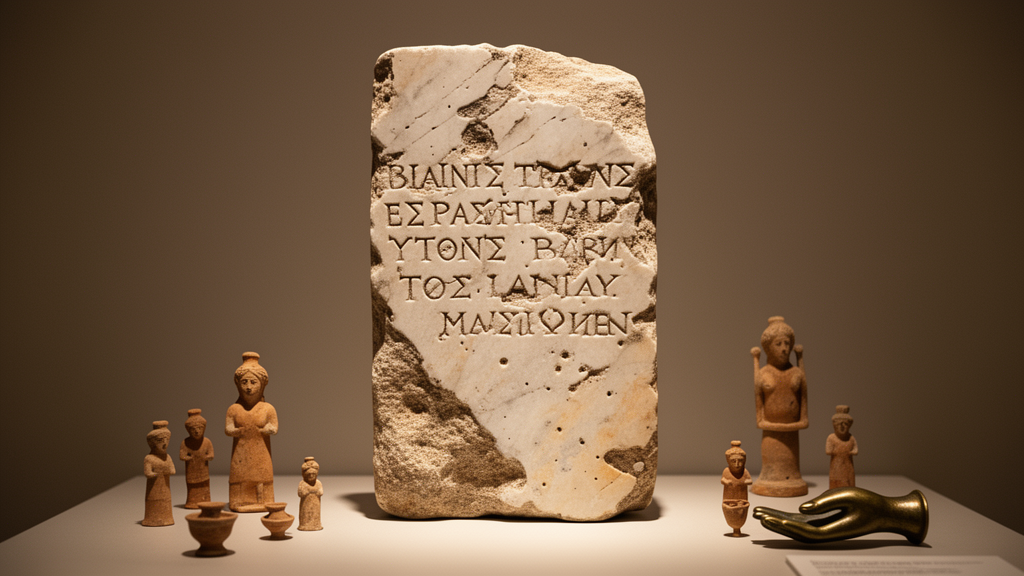
Tens of thousands of inscribed dedications survive from across the ancient Mediterranean, each one a small stone record of a person, family, or community acknowledging a god. Because they are so numerous and so scattered, these votive inscriptions have usually been studied region by region or case by case. A new study published in PLOS One by Moshe Blidstein takes a different approach: a computational
The scale of the corpus examined in the study deserves emphasis. Around 11,000 inscriptions spanning roughly a millennium represent only a fraction of the dedications once made, since most votive objects were perishable materials such as wooden tablets, wreaths, cakes, and animals that left no written trace. Stone and bronze dedications, especially those with formal inscriptions, were more likely to be commissioned by individuals or groups with resources, and more likely to survive. This means that any computational analysis of votive epigraphy is necessarily an analysis of a biased sample of ancient religious behavior, skewed toward wealthier dedicants, urban sanctuaries, and regions with favorable conditions for stone preservation. The study’s authors are careful to frame their findings as patterns in surviving evidence rather than direct measurements of belief, a caution that applies to nearly all quantitative work in ancient history.
The concept of the epigraphic habit, which the study controls for, has become central to the field since scholars first observed that the sheer volume of inscriptions rises and falls dramatically across periods. The habit peaked in many regions during the Roman Imperial period, when literacy, civic monumentality, and stone-carving infrastructure were widespread, and declined sharply in the later centuries of Late Antiquity. If more inscriptions of all kinds were carved in the second century CE than in the fourth, then a raw count of votive formulae would simply mirror that curve and tell us nothing specific about religious expression. By normalizing votive terminology against the total volume of inscriptions in each period and region, the study attempts to isolate changes that are specific to dedicatory practice rather than to the general fashion for putting text on stone.
The deities that show strong positive associations with explicit votive language are themselves informative about the religious landscape of Roman Asia Minor and the Near East. Men, a lunar and protective god of Phrygian and Pisidian origin, attracted dedications from soldiers, merchants, and local elites across the Anatolian plateau, and his sanctuaries often served communities of mixed background. Meter, the Anatolian mother goddess related to but distinct from the Greek Cybele, similarly drew personal, emotionally inflected devotion. Theos Hypsistos, the Most High God, was venerated by a cult whose adherents adopted some practices resembling Jewish observance without full conversion, and whose dedications are scattered widely across the eastern Empire. Hosios kai Dikaios, a personification of piety and justice worshipped particularly in the Aegean islands and coastal Asia Minor, rounds out the group. That these figures, rather than the Olympian deities of classical literature, dominate the statistically significant correlations is a reminder that lived religion in the Imperial period centered heavily on local and regional cults.
The negative correlations are equally revealing. Athena, whose cults were among the oldest and most institutionally embedded in the Greek world, rarely received dedications described with the explicit vow language that became common elsewhere. Dedications to emperors, which flourished as an expression of loyalty in the Imperial cult, likewise tended to follow their own formulaic conventions. This suggests that votive terminology was not simply a general stylistic fashion that spread uniformly across all sanctuaries. Instead, it appears to have been tied to particular cultic environments, perhaps reflecting different kinds of transaction between worshipper and deity. A vow made and fulfilled implies a negotiated exchange, a request made in advance and paid afterward, and some cults may have encouraged or formalized this contractual framing more than others.
The relationship between votive formulae and stated motives, such as dreams or divine commands, points toward a similar conclusion. In many surviving dedications, the worshipper explains that the god appeared in a dream and requested the offering, a practice associated with incubation sanctuaries where the sick slept in hopes of healing, such as those of Asclepius. The finding that explicit vow language and explicit dream reports tend not to co-occur suggests two partly distinct modes of dedication: one framed as the fulfillment of a promised exchange, the other as obedience to a direct divine instruction. Ancient worshippers and sanctuary officials evidently drew on a repertoire of ways to narrate why an offering was made, and the choice among them may reflect the type of sanctuary, the nature of the favor received, or local epigraphic conventions.
The regional pattern, with explicit votive terminology far more common in Asia Minor and the eastern provinces than in mainland Greece before the fourth century CE, aligns with broader scholarly observations about the cultural distinctiveness of the Roman East. Anatolia in particular has long been recognized as a region of dense, competitive religious activity, where traditional Anatolian cults, Greek civic religion, Persian-influenced worship, Jewish communities, and eventually Christianity coexisted and interacted. The convergence of the epigraphic pattern with this picture lends credibility to the computational results. It also raises the question of what happened after the fourth century, when the regional gap appears to narrow. One possibility is that conventions spread from the East westward; another is that Christian dedicatory practice, which inherited and transformed earlier formulae, gradually homogenized expression across the Greek-speaking world.
The chronological rise of vow terminology through the Imperial period and into Late Antiquity intersects with a long-standing debate about the character of religion in these centuries. Older scholarship often described the Imperial era as a time of growing personal piety, in contrast to the supposedly civic and collective religion of the classical polis. More recent work has challenged this narrative, showing that personal devotion was vibrant in earlier periods as well, and that civic religion remained robust well into the Roman era. The quantitative pattern documented in the study does not settle the debate, but it gives it a firmer evidential footing: whatever the reality of personal religiosity in earlier centuries, the explicit linguistic marking of dedications as fulfillments of vows became markedly more prominent over time, and that change in expression is itself a historical phenomenon requiring explanation.
One plausible factor is the changing social composition of dedicants. In the classical Greek world, votive offerings were often made by cities, magistrates, and aristocrats commemorating military victories or civic achievements, and the inscriptional conventions reflected public, monumental purposes. By the Roman period, dedications more frequently came from private individuals of modest means, including women, freedmen, slaves, and occupational groups, seeking healing, safety, or prosperity. The formulaic language of the fulfilled vow, concise and standardized, may have suited these smaller, more personal dedications, which required less elaborate text and could be carved cheaply by semi-professional workshops. The spread of the formulae may thus track the democratization of the dedicatory habit as much as any change in religious sentiment.
The methodological challenges acknowledged in the study are worth spelling out, because they shape how confidently the results can be interpreted. Dating is the most serious. A large proportion of Greek inscriptions cannot be dated precisely; they are assigned to broad periods on the basis of letterforms, formulae, prosopography, or archaeological context, sometimes spanning a century or more. Any chronological analysis therefore smooths and blurs the underlying pattern, and a trend that appears gradual may in fact reflect the uneven distribution of securely dated material. Tagging poses its own difficulties: deciding whether a damaged or abbreviated text contains a votive formula, or whether a particular name refers to a deity or a person, requires interpretive judgment that can introduce inconsistency even when applied carefully. The study’s transparency about these limitations is a model for computational work in the humanities.
The deeper interpretive problem, separating epigraphic convention from religious mentality, has parallels in many domains of ancient history. Written formulae are conservative and can long outlive the practices or attitudes that originally motivated them; conversely, a new formula can spread because it is fashionable among stonecutters rather than because worshippers changed their behavior. When vow language increases in the inscriptions, this could mean that more dedications genuinely arose from vowed exchanges, or that scribes and carvers increasingly chose to describe dedications in those terms regardless of the underlying circumstances. The study does not claim to resolve this ambiguity, but by mapping the pattern precisely, across regions, deities, and centuries, it provides the empirical foundation on which such questions can be argued with evidence rather than impression.
The approach also demonstrates the value of the large digital corpora that have transformed the study of antiquity in recent decades. Projects that have gathered, digitized, and standardized hundreds of thousands of Greek and Latin inscriptions make analyses like this one possible at all, and the GIST corpus of votive texts in particular represents a substantial investment in making dedicatory evidence collectively visible. As comparable corpora grow for other languages and regions, similar studies could extend the analysis to Latin dedications, to Egyptian demotic evidence, or to the epigraphy of the early Christian church, allowing the Greek pattern documented here to be situated in a wider Mediterranean comparative frame.
Finally, the study speaks to a question that extends beyond antiquity: how religious expression is shaped by the media through which it is recorded. Inscriptions were a public, durable, and costly medium, and what people chose to carve reflected both their devotion and the conventions of the genre. The rise and fall of formulae on stone is thus a record of the interaction between belief, social practice, and communicative technology. Understanding that interaction in the ancient world offers a useful vantage point for thinking about how religious sentiment is expressed, standardized, and transmitted in any era, including one in which digital media are creating their own vast, biased, and convention-laden records of human practice.
Subject of Research: Distant reading of ancient Greek votive inscriptions
Article Title: Ancient Greek votive epigraphy: Ancient religion between individual choice and cultural trends
Article References: Blidstein, M. (2026). Ancient Greek votive epigraphy: Ancient religion between individual choice and cultural trends. PLOS One, 21(10), e0361143. https://doi.org/10.1371/journal.pone.0361143
Image Credits: AI Generated
DOI: 10.1371/journal.pone.0361143
Keywords: ancient Greek religion, votive inscriptions, epigraphy, digital humanities, distant reading, PLOS One, Roman Imperial period, Late Antiquity, dedicatory formulae, religious mentalities, Asia Minor, epigraphic habit
Cite Scienmag News
Scienmag. (October 19, 2026). Ancient Greek Votive Inscriptions Reveal Shifting Patterns of Personal Religion. https://scienmag.com/ancient-greek-votive-inscriptions-reveal-shifting-patterns-of-personal-religion/
Scienmag. "Ancient Greek Votive Inscriptions Reveal Shifting Patterns of Personal Religion." Scienmag, 19 October 2026, https://scienmag.com/ancient-greek-votive-inscriptions-reveal-shifting-patterns-of-personal-religion/. Accessed 19 October 2026.
Scienmag. "Ancient Greek Votive Inscriptions Reveal Shifting Patterns of Personal Religion." Scienmag. October 19, 2026. https://scienmag.com/ancient-greek-votive-inscriptions-reveal-shifting-patterns-of-personal-religion/


