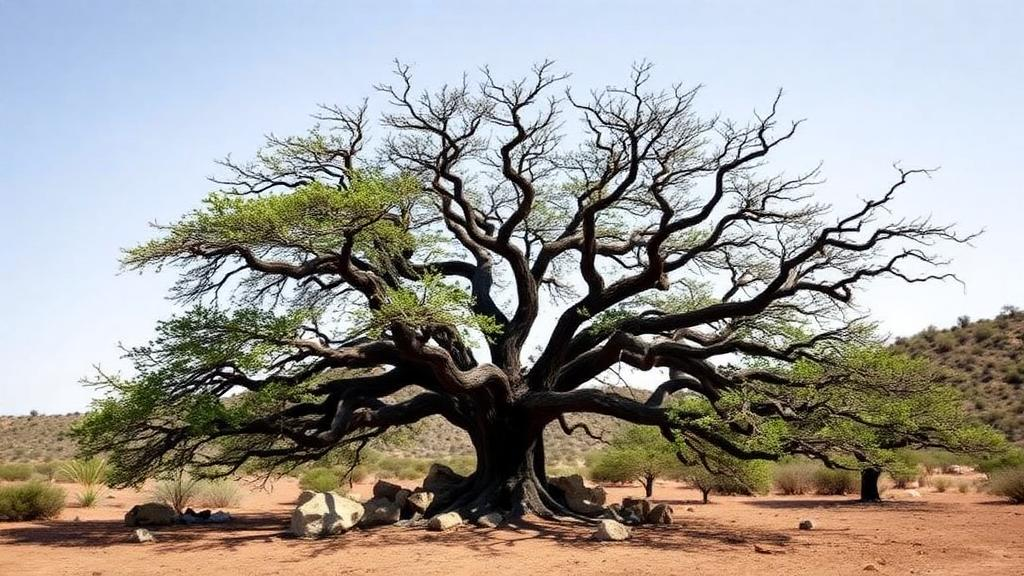
On the parched, metal-rich hills of northern Euboea grows the only oak found nowhere else in Greece: Quercus trojana subsp. euboica, a shrubby, leather-leaved tree confined to roughly three square kilometres of serpentine substrate. In August 2021, a catastrophic wildfire swept through about 51,200 hectares of the island, burning the largest part of the species’ entire known range. Yet when researchers returned in July 2025 to collect leaves from three surviving natural populations, many of the scorched individuals had already resprouted from their stems. What they brought back from those field campaigns is now the first quantitative dataset on leaf morphometric diversity for this critically endangered endemic – and it reveals a striking pattern: leaf shape stays remarkably stable across populations, while leaf size varies dramatically.
The study, published in the Biodiversity Data Journal, sampled 301 leaves from 31 georeferenced individuals across three populations: Kerasia1 (14 trees), Kerasia2 (11 trees) and Prokopi (6 trees). Field teams maintained a minimum spacing of 20 to 30 metres between sampled individuals to reduce the chance of collecting leaves from close relatives, and took roughly ten mature, fully expanded, sun-exposed, south-facing leaves from the upper canopy of each tree, avoiding any damaged by herbivores or disease. The leaves were pressed in paper tea bags, dried under ambient conditions, and later scanned at 600 dpi on a flatbed scanner with millimetric paper included in every image for scale calibration.
The technical heart of the work is a custom Python pipeline built on NumPy, OpenCV, scikit-image and Matplotlib. Each scanned photograph was first calibrated semi-automatically: an operator clicked two points on the millimetric paper in an interactive window, entered the real-world distance between them, and the software computed a pixel-to-millimetre conversion factor from the Euclidean pixel distance. These calibration factors were stored in a JSON file and treated as a fixed, manually reviewed dataset. Segmentation then converted each colour image to greyscale and separated leaves from background using Otsu’s method, which picks the threshold that minimises intra-class variance between foreground and background pixels. Morphological closing with a 15-by-15-pixel rectangular element bridged shadow-induced gaps at leaf margins, and a 5-by-5-pixel opening removed small noise artefacts before contours were extracted with the cv2.findContours algorithm, retrieving only outermost boundaries.
Quality control was built into the workflow rather than left to chance. Every photograph generated an overlay showing detected contours colour-coded by leaf identity and labelled with unique IDs, allowing manual inspection before any downstream analysis. Objects with implausible areas – anything outside 500 to 50,000 square millimetres – were discarded to exclude ruler fragments, debris and image artefacts. Fourteen size and shape variables were extracted per leaf via the regionprops function of scikit-image and converted into physical units using each image’s specific calibration factor. All measurements were exported to a single CSV file for statistical analysis in R.
The results are unambiguous. Mean leaf area in the Prokopi population reached 1,015.2 square millimetres – approximately 1.5 times greater than in Kerasia1 (648.1 mm²) and Kerasia2 (715.0 mm²). Similar patterns held for perimeter, major and minor axis length, Feret diameters and convex area. In sharp contrast, shape-related parameters such as solidity, aspect ratio and circularity showed low variation amongst populations, indicating that overall leaf outline is more conserved than leaf dimensions. The petiole-to-lamina ratio, by comparison, exhibited high intraspecific variability within all three populations, reflecting considerable individual-level variation in petiole length relative to blade length.
Multivariate statistics sharpened the picture. A Principal Component Analysis explained more than 75% of total morphometric variance in just two dimensions: PC1 accounted for 50.2% and PC2 for 25.1%. PC1 was defined by size-related variables – convex area, leaf area, perimeter, minor and major axes and Feret diameters – tracing an overall leaf size gradient across individuals. PC2 captured shape variation, driven by width-to-length ratio, solidity and aspect ratio, reflecting differences in leaf expansion and morphological roundness. In the ordination space, Prokopi separated clearly from both Kerasia populations along PC1, consistent with its larger leaves, while Kerasia1 and Kerasia2 overlapped along both axes yet showed differentiation along PC2.
A Linear Discriminant Analysis confirmed population-level structuring. LD1 separated Prokopi from both Kerasia populations, and LD2 partially discriminated between Kerasia1 and Kerasia2 – a notable finding given the geographical proximity of the two sub-populations. Despite sharing the same general local range, they maintain distinct phenotypic signatures across several leaf traits. The authors suggest that micro-geographic environmental filters or demographic processes, such as post-fire regeneration structure, may leave measurable morphometric signatures – a hypothesis that can be directly tested with the genomic data currently being generated for the species.
Why would one population grow leaves half again as large as another? The clear separation of Prokopi in multivariate space, driven by size traits, is consistent with the known influence of genetic differentiation due to isolation by distance and of local environment on leaf variation in oaks. Comparable amongst-population differentiation has been reported in common-garden experiments of other oak species: in Quercus petraea, mean specific leaf area ranged from 9.95 to 12.39 square metres per kilogram across nine European provenances grown under uniform conditions, with significant genetic differentiation tied to the climate of origin. However, latitudinal gradients in absolute leaf size in oaks appear to reflect phenotypic plasticity rather than genetic differentiation. Because the Euboean leaves were collected in a single season from natural populations, the relative contributions of plastic responses to micro-environmental heterogeneity and of genetic differentiation to the large Prokopi leaf size cannot yet be separated. One clue points to environment: only understorey individuals were found at Prokopi, where the severely reduced density suggests potential further range shrinkage following the 2021 megafire and ongoing anthropogenic pressures.
The conservation implications are considerable. Quercus trojana subsp. euboica is protected under Presidential Decree 67/81 and listed in the Red Data Book of Rare and Threatened Plants of Greece. A molecular phylogeographic study of Quercus section Cerris found that it shares no nuclear DNA variants with the wider Quercus trojana and recommended treating it as an independent species, as originally described by Papaioannou in 1949; the present study retains the subspecies rank only for consistency with Greek legal protection acts pending formal taxonomic revision. Before the 2021 fires, the population was estimated at roughly 10,000 individuals across less than three square kilometres, but no comprehensive post-fire demographic assessment has been carried out and the number of surviving individuals remains unquantified. The species has shown historical resilience before: after a 1977 forest fire destroyed its main distribution area, it recovered successfully through sprouting without a marked reduction in its occupied range.
The morphometric baseline established here provides a quantitative reference for tracking future population-level changes alongside genomic monitoring tools, and the studied differentiation supports conserving each population as a distinct unit. For a narrow endemic with a fragmented distribution, the high within-population variability – particularly in the petiole-to-lamina ratio – may reflect micro-environmental heterogeneity on the ophiolitic substrates of northern Euboea, and such standing intraspecific variation is increasingly recognised as a key component of adaptive capacity in oaks, where phenotypic plasticity is highlighted as a source of short-term resilience to climate-driven stress. Whether the Euboean oak’s leaves can keep recording its recovery through another fire cycle is now a question the data itself will help answer.
Subject of Research: Leaf morphometric variation in the narrow endemic Greek oak Quercus trojana subsp. euboica
Article Title: Intraspecific leaf morphometric diversity in the endangered and narrow endemic Quercus trojana subsp. euboica ( Fagaceae ): a quantitative dataset from three natural populations in Euboea, Greece
Article References: Lyrou, F., Tourvas, N., & Aravanopoulos, F. (2026). Intraspecific leaf morphometric diversity in the endangered and narrow endemic Quercus trojana subsp. euboica (Fagaceae): a quantitative dataset from three natural populations in Euboea, Greece. Biodiversity Data Journal, 14, Article e199459. https://doi.org/10.3897/bdj.14.e199459
Image Credits: AI Generated
Keywords: Quercus trojana subsp. euboica, leaf morphometrics, endemic oak, Euboea, conservation, wildfire recovery, PCA, LDA, phenotypic plasticity, serpentine substrates, Greece, biodiversity
Cite Scienmag News
Margaret Porter. (October 16, 2026). Ancient Greek Oak Survived a Megafire – Its Leaves Now Tell Scientists How. Scienmag. https://scienmag.com/ancient-greek-oak-survived-a-megafire-its-leaves-now-tell-scientists-how/
Margaret Porter. "Ancient Greek Oak Survived a Megafire – Its Leaves Now Tell Scientists How." Scienmag, 16 October 2026, https://scienmag.com/ancient-greek-oak-survived-a-megafire-its-leaves-now-tell-scientists-how/. Accessed 16 October 2026.
Margaret Porter. "Ancient Greek Oak Survived a Megafire – Its Leaves Now Tell Scientists How." Scienmag. October 16, 2026. https://scienmag.com/ancient-greek-oak-survived-a-megafire-its-leaves-now-tell-scientists-how/