


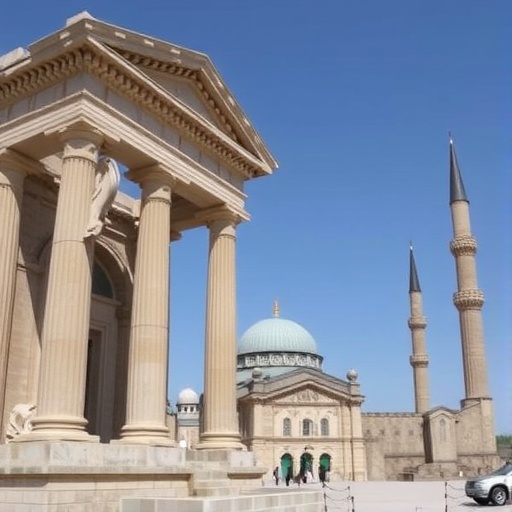
A recently unearthed Greek inscription beneath a column in Syria’s Great Mosque of Homs is reigniting a profound archaeological and historical investigation into the ancient city of Emesa’s religious landscape. This discovery directly challenges previous assumptions and offers fresh insight into the enigmatic transformation of a prominent sacred site originally dedicated to the sun god Elagabalus, subsequently becoming a church, and ultimately evolving into the mosque that stands today. The inscription not only enriches our understanding of the Roman period religious architecture but also sheds light on the intercultural and interreligious dynamics across millennia.
The city of Emesa, now modern-day Homs, has long been recognized as a critical cultural and commercial crossroads in Syria. The Great Mosque, with its distinctive architectural features and deep historical layers, has intrigued scholars for decades attempting to trace the site’s original identity. Restoration works beneath one of its monumental columns have revealed a previously hidden Greek inscription which may hold the key to locating the ancient Temple of the Sun, a religious complex dedicated to the solar deity venerated by Emesa’s inhabitants during Roman times.
The inscription, engraved in Greek on the granite base of a column measuring about one meter square, was uncovered during extensive archaeological work under challenging conditions marked by years of regional instability. Its formal, symmetrical layout employing neat horizontal lines and a decorative framing aligns with common styles of ceremonial dedications from the imperial Roman period. The text’s tone is notably heroic and militaristic, presenting a royal warrior figure—portrayed metaphorically as the wind, storm, and leopard—who triumphs over adversaries with commanding authority.
Dr. Maamoun Saleh Abdulkarim, an esteemed professor of archaeology and history at the University of Sharjah, has meticulously analyzed this inscription in his latest research. He proposes that the renewed evidence firmly anchors the Temple of Elagabalus beneath the present mosque, thus recontextualizing the site’s religious identity through successive epochs. His findings underscore the layered and negotiated process whereby pagan, Christian, and later Islamic communities modified and reinterpreted the spatial and sacred uses of this urban landmark.
Emesa’s complex religious transition from paganism to Christianity, and eventually to Islam, reflects broader phenomena across the ancient Near East, where architectural continuity often masked profound ideological and spiritual shifts. The inscription itself, although epic and somewhat lacking in detailed narrative, offers tangible proof of the city’s pagan origins intertwined with its later transformations. Significantly, textual irregularities suggest that Greek was a written lingua franca coexisting with everyday Aramaic, revealing sociolinguistic dynamics in Roman Syria.
The discovery also provides invaluable evidence about the social and political roles the cult of Elagabalus played in the region. This cult did not merely embody local religious cohesion but escalated to imperial prominence when a high priest of the temple rose to become Roman Emperor Elagabalus. His reign was marked by attempts to elevate the sun god as the supreme deity of the empire, influencing both religious practice and imperial ideology in a manner rarely seen in Roman history.
The archaeological context of the inscription—buried beneath the mosque floor and found in pristine condition—allows scholars to reexamine the architecture’s urban stratigraphy. Prior assumptions had posited alternative locations, such as the archaeological tell near the Islamic Citadel of Homs, as the site of the ancient Temple of the Sun. Dr. Abdulkarim’s study challenges these views, emphasizing the importance of architectural layering in understanding urban religious continuity rather than rupture.
This revelation not only deepens our grasp of Emesa’s past but also illustrates the gradualism inherent in religious change. Pagan and Christian communities coexisted in Emesa for extended periods before Christianity became dominant. These transitions were neither abrupt nor unilateral but involved negotiation, adaptation, and synthesis of beliefs and spatial claims. Insights like these are critical in appreciating the nuances behind religious and cultural transformations that shape civilizations.
From a technical standpoint, the inscription’s stylistic elements reflect common epigraphic practices of the Roman Empire’s eastern provinces, including the use of formal, boxed text and a martial register that symbolized power. Such inscriptions served as tools of political propaganda and divine legitimization, asserting the authority of regional rulers connected to the imperial cult. The similarity of the motifs with other known solar worship artefacts supports the hypothesis of the inscription’s original connection to Elagabalus’s temple complex.
Moreover, the study highlights the interdisciplinary value of combining archaeology, epigraphy, heritage conservation, and architectural history in reconstructing ancient urban narratives. In this context, the convergence of textual analysis, material culture, and architectural remains provides a holistic understanding of the and the city’s spiritual evolution. This approach is essential for future conservation efforts and cultural heritage policies in conflict-affected regions like Syria.
Ultimately, the Great Mosque of Homs is more than a religious edifice; it is a palimpsest of human history wherein power, faith, and identity have been inscribed across epochs. The inscription’s discovery reminds us that sacred spaces embody evolving narratives that outlast individual religions, serving instead as enduring centers of urban and societal cohesion. The site’s layers narrate a story of negotiation and transformation fundamental to understanding the Middle East’s religious and cultural tapestry.
As research continues, this groundbreaking inscription promises to foster renewed international interest in Emesa’s archaeological and historical significance. It challenges entrenched historical assumptions and opens the door to fresh scholarly debates about the complexities of religious transition and politicized worship in the Roman Empire and early Byzantine periods. The ongoing work, published in the Shedet archaeology journal, is set to become a crucial reference point for future studies of the ancient Levant.
In conclusion, the Great Mosque of Homs encapsulates a rare continuity of sacred space, marked by a seamless yet complex religious metamorphosis from pagan sun worship to Christian sanctity and finally Islamic devotion. The recently decoded Greek inscription offers compelling new evidence preserving the memory of ancient cult practices and imperial power in Emesa. It underscores the importance of archaeological discoveries in challenging and refining our understanding of historical identities embedded in the fabric of our modern cities.
Cite Scienmag News
Courtney Benton. (February 24, 2026). Ancient Greek Inscription Sparks New Debate Over Roman Temple Beneath Syrian Mosque. Scienmag. https://scienmag.com/ancient-greek-inscription-sparks-new-debate-over-roman-temple-beneath-syrian-mosque/
Courtney Benton. "Ancient Greek Inscription Sparks New Debate Over Roman Temple Beneath Syrian Mosque." Scienmag, 24 February 2026, https://scienmag.com/ancient-greek-inscription-sparks-new-debate-over-roman-temple-beneath-syrian-mosque/. Accessed 3 September 2026.
Courtney Benton. "Ancient Greek Inscription Sparks New Debate Over Roman Temple Beneath Syrian Mosque." Scienmag. February 24, 2026. https://scienmag.com/ancient-greek-inscription-sparks-new-debate-over-roman-temple-beneath-syrian-mosque/


