


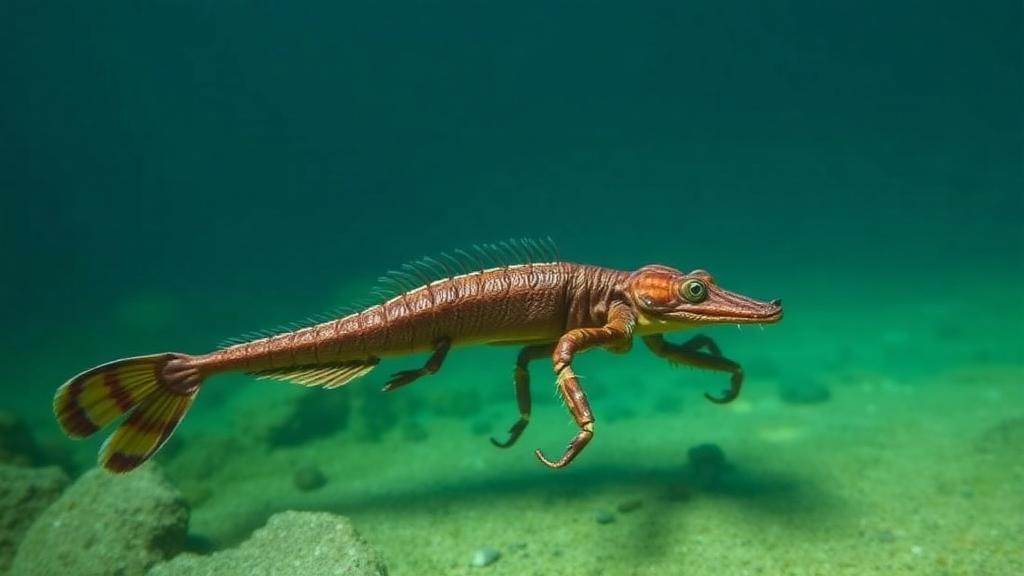
For decades, paleontologists have pictured the first four-limbed vertebrates—the stegocephalians, the sprawling ancestors of every amphibian, reptile, bird and mammal alive today—paddling through quiet freshwater swamps and rivers. A sweeping new review published in Fossil Record challenges that cozy image, arguing that many of the world’s most famous early tetrapod localities were far saltier than traditionally believed. The study, by Michel Laurin of the Sorbonne Université, reexamines fossil sites spanning the Late Devonian through the Early Permian and finds that the evidence for freshwater habitats is often far weaker than the textbooks suggest.
The heart of the problem is a long-standing habit of interpretation. If a fossil site lacks clearly marine creatures—echinoderms, cephalopods, coral reefs—researchers have routinely labeled it freshwater. But that logic ignores the enormous range of environments between the open ocean and a mountain stream: deltas, estuaries, lagoons, and vast epicontinental seas flushed with river water, much like the modern Baltic Sea. These brackish transitional settings also suppress stenohaline marine animals that cannot tolerate salinity swings, so their absence proves little. Sedimentology compounds the problem. Most sediment on Earth ultimately ends up in the sea, and roughly three-quarters of surviving sedimentary rock was deposited in and around shallow seas, meaning coastal deposits should dominate the fossil record. If most early stegocephalian fossils come from sites interpreted as freshwater, something seems anomalous.
The review documents case after case where marine influence was overlooked or minimized. At Mazon Creek, the celebrated Illinois Lagerstätte that has yielded some of the finest Carboniferous fossils ever found, tidal rhythmites—finely laminated sediments recording daily and monthly tidal cycles—went unnoticed for roughly thirty years despite intensive fieldwork. Kuecher and colleagues concluded in 1990 that evidence of Westphalian tides may have been misinterpreted or overlooked elsewhere, and tidal deposits have since been recognized at other Eastern Interior Coal Basin sites originally called non-marine. Weathering destroys the delicate laminations that betray tidal deposition, and most excavations, which rely on split rock rather than cored samples, are ill-suited to detecting them. Recent work has even shown that tidal channels leave sedimentary structures strikingly similar to river meanders, blurring the line between fluvial and marine signatures.
The bias runs deep in the history of vertebrate paleontology. The Old Red Sandstone of Britain and the Baltic, which produced the earliest described Devonian fishes, was long assumed freshwater largely because its armored fish were likened to freshwater ganoids and appeared without marine invertebrates. Yet later work found Lingula brachiopods in the Wood Bay Formation of Spitzbergen above vertebrate-bearing beds, and early strontium isotopic studies suggested at least some Old Red Sandstone deposits were marine. A parallel story unfolded at Miguasha in Quebec, home of the famous Escuminac Formation and its iconic Eusthenopteron and Bothriolepis. When Schultze proposed a coastal marine setting in the 1970s and 1980s, one prominent reviewer dismissed the idea as so unrealistic it scarcely merited serious attention. Isotopic analyses soon delivered a strong marine signal for Bothriolepis canadensis, and the formation is now interpreted as a brackish estuary.
Isotopic chemistry has become the sharpest new tool in this debate, but the review shows it must be wielded with care. Strontium isotope ratios in the ocean are globally homogeneous at any given time, while rivers carry strontium signatures reflecting local bedrock. A departure from the coeval marine ratio therefore indicates limited exchange with the ocean—but not necessarily freshwater. Continental salt lakes, coastal lagoons, and restricted epicontinental seas can all produce non-marine strontium values. The modern Baltic Sea illustrates the point: in its most freshwater-influenced corner, the ratio runs hundreds of parts per million above the Atlantic value, yet it is emphatically a sea. Sulfur isotopes, abundant in seawater and scarce in rivers, are similarly informative but similarly ambiguous, since evaporites dissolved in a drainage basin can mimic marine signatures. Oxygen isotopes are less sensitive still, because oxygen is equally abundant in fresh and salt water.
Applying these caveats reshapes the picture at classic sites. At Joggins, Nova Scotia, the UNESCO-listed sea cliffs that yielded the oldest known amniotes have long been called an intramontane freshwater basin. But Carpenter and colleagues’ analyses of a xenacanthid shark tooth and a sarcopterygian scale produced strontium values they themselves called equivocal, merely indicating the environment was unlikely to have been fully marine. Meanwhile the faunal evidence points strongly coastward: framboidal pyrite, agglutinating foraminifers, echinoderm fragments, and punctate brachiopod pieces in the open-water facies, all within a succession of transgressive-regressive cycles. The authors concluded that Joggins records fluvial deposition into shallow brackish waters—essentially vindicating an 1865 interpretation of the site as coastal.
The review also dismantles the traditional reputation of the
The review also dismantles the traditional reputation of certain fossil groups as reliable freshwater indicators. Xenacanth sharks, long treated as archetypal freshwater predators of the Paleozoic, have been found in demonstrably marine deposits, and their teeth carry isotopic signals that can be read either way depending on assumptions. Microconchids, small spiral tubeworms that commonly accompany stegocephalian remains, likewise span a broad salinity range. When a bonebed contains xenacanths, microconchids, and lungfish together, as at the Birthday Bonebed in Utah’s Halgaito Formation, the assemblage is compatible with a brackish coastal setting, especially since the bonebed lies in the lower half of a formation that interfingers with marine facies. The strontium results reported there were described as consistent with tooth formation in an environment with some freshwater influence, but freshwater influence is precisely what a delta or estuary delivers; such a signal does not distinguish a river from a river mouth. Lungfish illustrate the interpretive trap particularly well, because living dipnoans are freshwater, yet by the Carboniferous some lineages still inhabited the sea, so their presence in a Paleozoic site cannot settle the salinity question.
The temporal pattern emerging from the updated dataset is itself suggestive. If early stegocephalians were predominantly freshwater animals, their fossil record should be distributed roughly like the freshwater sedimentary record. Instead, the richest and most celebrated vertebrate-bearing intervals of the Devonian, Carboniferous and earliest Permian cluster in coastal plains, deltas and estuarine systems, the very environments where long-term sedimentation and rapid burial favor fossilization. This does not prove that every stegocephalian lived in brackish water, but it weakens the traditional assumption that freshwater swamps were their primary habitat and raises the possibility that the group’s early evolutionary history, including the water-to-land transition itself, unfolded along saline margins rather than in continental interiors.
Such a shift would carry consequences beyond paleoecology. Physiological scenarios for the origin of terrestrial locomotion, the evolution of amniote eggs, and the timing of vertebrate invasions of land often presuppose freshwater staging grounds. If many key events occurred in brackish deltas and estuaries, models of osmoregulation, egg evolution and habitat transition may need revision. The review also has a methodological lesson for the field: paleoenvironmental labels inherited from nineteenth- and early twentieth-century literature have been propagated through generations of textbooks, so that a freshwater interpretation, once published, tends to be cited rather than retested. Breaking that cycle requires the kind of detailed, bed-by-bed inventories with precise geographic and stratigraphic control that the author calls for, since shorelines migrate rapidly in geological terms and carcasses can drift far from their living habitat before burial.
None of this means the freshwater interpretation is wrong everywhere. Some localities genuinely record continental settings, and the review acknowledges that the evidence varies greatly in quality from site to site. The claim is more modest and more provocative: the default assumption should be neutrality rather than freshwater, and the burden of proof should fall on those who exclude marine influence, not on those who suspect it. Given that transitional environments are among the most favorable for fossilization, and that the absence of stenohaline marine taxa can be explained by turbidity, rapid sedimentation and salinity fluctuation rather than by distance from the sea, the balance of evidence increasingly favors saltier habitats for many of the animals that first walked, hopped and hauled themselves onto land. The stegocephalians, it appears, may have learned to live on land from a starting point that was a little saltier than most paleontologists have liked to admit.
Subject of Research: Habitat of early stegocephalians (Chordata, Vertebrata, Sarcopterygii): a little saltier than most paleontologists like?
Article Title: Habitat of early stegocephalians ( Chordata , Vertebrata , Sarcopterygii ): a little saltier than most paleontologists like?
Article References: Laurin, M. (2024). Habitat of early stegocephalians (Chordata, Vertebrata, Sarcopterygii): a little saltier than most paleontologists like?. Fossil Record, 27(3), 299-332. https://doi.org/10.3897/fr.27.123291
Image Credits: AI Generated
DOI: 10.3897/fr.27.123291
Keywords: Habitat, early, stegocephalians, Chordata, Vertebrata, Sarcopterygii, little, saltier, than, most, paleontologists, like
Cite Scienmag News
Gavin Prescott. (October 18, 2026). Ancient Four-Limbed Vertebrates May Have Thrived in Brackish Coastal Waters. Scienmag. https://scienmag.com/ancient-four-limbed-vertebrates-may-have-thrived-in-brackish-coastal-waters/
Gavin Prescott. "Ancient Four-Limbed Vertebrates May Have Thrived in Brackish Coastal Waters." Scienmag, 18 October 2026, https://scienmag.com/ancient-four-limbed-vertebrates-may-have-thrived-in-brackish-coastal-waters/. Accessed 18 October 2026.
Gavin Prescott. "Ancient Four-Limbed Vertebrates May Have Thrived in Brackish Coastal Waters." Scienmag. October 18, 2026. https://scienmag.com/ancient-four-limbed-vertebrates-may-have-thrived-in-brackish-coastal-waters/


