


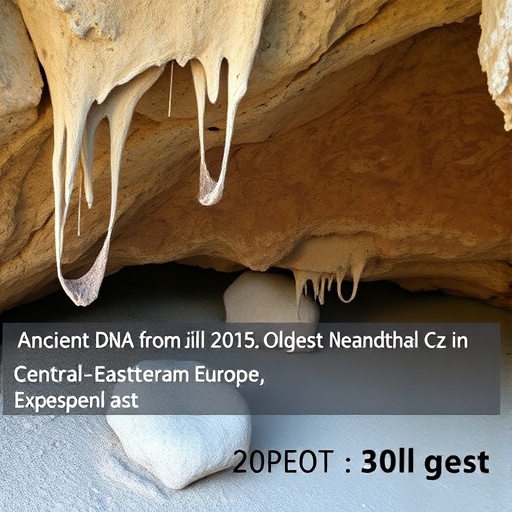
A groundbreaking international research collaboration, recently published in the prestigious journal Current Biology, unveils unprecedented genetic insights into Neanderthals through the meticulous analysis of ancient mitochondrial DNA extracted from eight teeth discovered within Poland’s Stajnia Cave. This study marks a historic first in paleoanthropology, as it successfully reconstructs the genetic profile of a small, cohesive group of Neanderthal individuals cohabiting this Central-Eastern European site during a single, well-defined chronological phase approximately 100,000 years ago.
Until now, human evolutionary genetics have been largely hindered by fragmented data sets originating from isolated fossils or scattered remains sourced from disparate regions and chronological layers. The ability to analyze multiple specimens from the same geographical and temporal context allows scientists to piece together a more coherent genetic mosaic, shedding light on the internal dynamics of small Neanderthal communities. Dr. Andrea Picin, lead investigator and professor at the University of Bologna, emphasizes that this achievement expands our understanding of Neanderthal social biology by revealing the intricate relationships within a close-knit population previously inaccessible to genetic analysis.
The Stajnia Cave findings also provide compelling evidence about maternal lineages spanning large swaths of western Eurasia. The mitochondrial genomes recovered from these Polish Neanderthals cluster firmly within a genetic branch shared by contemporaneous and geographically distant groups found from the Iberian Peninsula in the west, through southeastern France, all the way to the northern Caucasus. Such a distribution suggests a broad dispersal of this maternal lineage prior to the eventual succession by newer Neanderthal populations characterized by distinct mitochondrial haplotypes.
Intriguingly, two of the eight teeth, identified as belonging to juvenile Neanderthals, and one from an adult individual share identical mitochondrial DNA sequences. This pattern hints strongly at direct maternal relationships within the sampled group, signifying a family or closely related kin group residing together in the cave. Such findings open new avenues for exploring Neanderthal social structures, reproductive behaviors, and group cohesion, areas that have remained elusive due to the paucity of genetic data from single archaeological contexts.
The study’s implications extend beyond regional genetics and social structures; it also challenges prevailing chronological frameworks applied to key Neanderthal fossils from other European sites. Of particular interest is the comparison with the Mandrin Cave fossil known as Thorin, discovered in southeastern France. Thorin’s mitochondrial genome closely matches that of the Stajnia individuals, yet its age has been controversially assigned to roughly 50,000 years ago based on radiocarbon dating. The new genetic evidence, combined with archaeological context, underscores the necessity to approach radiocarbon calibrations near their methodological upper limits with caution, as misdating can distort interpretations of population dynamics and migrations.
Co-coordinator Sahra Talamo from the University of Bologna highlights the importance of integrating archaeological, radiocarbon dating, and genetic data for robust chronological frameworks. Her remarks underscore a broader methodological lesson for paleoanthropology: that multi-disciplinary datasets must converge to produce accurate and replicable timelines, especially when dealing with samples at the fringe of radiocarbon dating’s technical resolution.
From an archaeological standpoint, the findings at Stajnia decisively argue that Central-Eastern Europe was not a peripheral or marginal refuge for Neanderthals but stood as a vital nexus for understanding their population movements, demographic exchanges, and technological transmissions during the Middle Paleolithic era. This reevaluation invites a reconsideration of the geographic and cultural landscapes that shaped Neanderthal evolution, positioning southern Poland as a critical observation point where biological, environmental, and cultural lines intertwined dynamically.
The Stajnia Cave discoveries also highlight the technical sophistication required for extracting and sequencing ancient DNA, especially from osseous material thousands of generations old. The successful retrieval of high-quality mitochondrial genetic sequences necessitated stringent contamination controls, innovative extraction protocols, and advanced sequencing technologies. These technical achievements enhance prospects for future research into Neanderthal and early Homo sapiens populations across Eurasia and deepen our understanding of hominid genetic diversity.
Moreover, the identification of related individuals within the same small group provides a rare glimpse into how Neanderthals maintained kinship ties over time and possibly structured their social groups around family units. Such genetic corroboration complements morphological and archaeological evidence, converging on a picture of Neanderthals as entities possessing complex social behaviors analogous in many respects to modern humans.
The revelation that this mitochondrial lineage once dominated western Eurasia before the advent of more recent Neanderthal lineages has far-reaching implications for studying the evolutionary history of Neanderthals, including adaptive responses to environmental and climatic pressures. It raises questions regarding the mechanisms of lineage replacement and genetic turnover, potentially influenced by migration, competition, or climatic events that altered population structures.
Lastly, these insights collectively emphasize the transformative power of interdisciplinary research at the interface of genomics, archaeology, and paleontology. The Stajnia Cave findings are not merely incremental; they herald a new era where comprehensive genetic portraits of long-extinct hominins become attainable, permitting deeper investigation of our close evolutionary relatives’ biological and cultural narratives.
In summation, the Stajnia Cave Neanderthal molecular analyses rewrite crucial chapters of human prehistory, casting Central-Eastern Europe as a dynamic stage for Neanderthal life. This research exemplifies how integrated scientific approaches are essential to unravel the complex tapestry of ancestral human populations, offering unprecedented clarity on how Neanderthals lived, moved, and related within their environments tens of thousands of years ago.
News Publication Date: [Not specified in the source content]
Web References: [Not specified in the source content]
References: Published in Current Biology
Keywords
Neanderthal genetics, mitochondrial DNA, Stajnia Cave, Central-Eastern Europe, paleoanthropology, Middle Paleolithic, kinship analysis, radiocarbon dating, population dynamics, hominin evolution, ancient DNA sequencing, Neanderthal maternal lineages
Cite Scienmag News
Juliet Wilcox. (April 20, 2026). Ancient DNA from Stajnia Cave Uncovers Oldest Neanderthal Group in Central-Eastern Europe. Scienmag. https://scienmag.com/ancient-dna-from-stajnia-cave-uncovers-oldest-neanderthal-group-in-central-eastern-europe/
Juliet Wilcox. "Ancient DNA from Stajnia Cave Uncovers Oldest Neanderthal Group in Central-Eastern Europe." Scienmag, 20 April 2026, https://scienmag.com/ancient-dna-from-stajnia-cave-uncovers-oldest-neanderthal-group-in-central-eastern-europe/. Accessed 3 September 2026.
Juliet Wilcox. "Ancient DNA from Stajnia Cave Uncovers Oldest Neanderthal Group in Central-Eastern Europe." Scienmag. April 20, 2026. https://scienmag.com/ancient-dna-from-stajnia-cave-uncovers-oldest-neanderthal-group-in-central-eastern-europe/


