

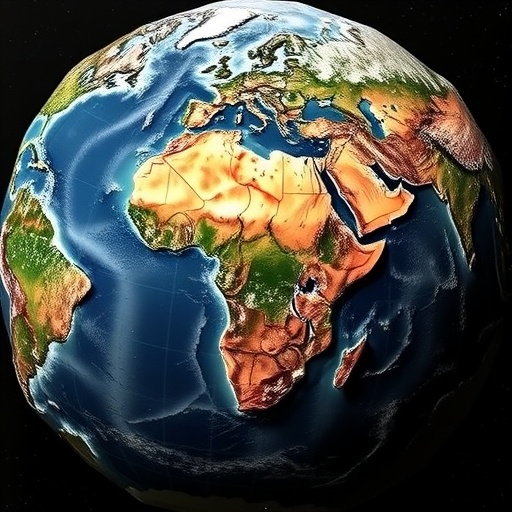
A groundbreaking study by a team of researchers led by Wang et al. has brought to light new insights into the origins of Earth’s early continental crust. Published in Commun Earth Environ, this pivotal research explores the diverse genesis of continental crust and provides evidence of a significant geodynamic transition that occurred around 3 billion years ago. This period of Earth’s history has long fascinated geologists and Earth scientists, primarily because it marks a transformative epoch wherein the planet’s geological and tectonic processes initiated a shift that has implications for our understanding of continental formation.
The genesis of continental crust is a complex narrative intertwined with Earth’s primordial history. For millennia, scientists have debated the processes contributing to the development of early landmasses. In this study, the authors utilize an innovative approach, examining rock samples and geological formations to piece together the puzzle surrounding crustal formation. Their findings suggest that the processes were not monolithic but rather diverse, hinting towards a range of geodynamic environments operating at that time. This diversity poses questions about the prevailing theories of crust formation that have dominated geological discourse.
Furthermore, the research draws on a comparison between existing continental crusts and the early geological formations identified in ancient rock records. The implications of varied crust genesis cannot be overstated, as they shed light on how tectonic movements, divergent plate boundaries, and subduction zones might have played roles in shaping early Earth. By studying isotopic variations and mineral compositions, the authors highlight how differing conditions influenced the rate and style of crust formation in early Earth’s history.
One of the significant revelations from this research is the suggestion that the geodynamic conditions present in Earth’s early years were markedly different from those we observe today. The authors argue that the transition at around 3.0 billion years ago signifies the onset of plate tectonics as we know them. This geodynamic shift likely catalyzed major geological processes that were essential for the evolution of the continental crust, such as volcanic activity, sediment deposition, and metamorphism. The findings advocate for a reevaluation of how we perceive the relationship between tectonic processes and crustal development.
To further substantiate their claims, Wang and his team meticulously analyzed a range of geological data collected from diverse regions. Their interdisciplinary approach combines geological mapping, geochemical analysis, and modern analytical techniques such as isotopic fingerprinting. The results underscore the significance of environmental factors in crust formation, revealing a complex interplay between thermal, chemical, and mechanical processes that merit further exploration.
Moreover, the study emphasizes the importance of understanding early planetary processes, not just for Earth, but for other planetary bodies in our solar system. The findings imply that other rocky planets or moons might share similar crust formation processes, shaping our conceptual framework for astrobiology and planetary geology. It opens up enticing possibilities about the conditions necessary for crustal development in environments previously thought to be inhospitable to such processes.
The implications of this research extend beyond geology and into the realm of Earth’s ongoing evolution. As the authors discuss, understanding how early crust formed can provide crucial insights into the evolution of the atmosphere, hydrosphere, and biosphere, all of which have interdependencies on geological processes. These systems have co-evolved through geological time, and unraveling one may lead to discoveries about the others.
This study delves into critical debates about uniformitarianism versus catastrophism in geological processes, questioning whether the processes that shaped the early Earth are akin to those we observe today. The findings advocate for a more nuanced view, suggesting that while some processes persist, others may have existed under unique conditions that no longer apply. This perspective challenges geologists to think critically about the assumptions underlying past theories of crustal formation.
The paper also discusses potential avenues for future research spawned by these discoveries. For instance, further investigation into specific geological formations could yield more targeted data regarding crust genesis. The authors recommend an interdisciplinary approach, combining insights from geology, geochemistry, and even astrobiology to build a comprehensive model of early Earth conditions. Such collaborative research could lead to innovative breakthroughs in our understanding of planetary crusts across the solar system.
Public curiosity about Earth’s geological history is vast, and studies like this add vital pieces to the intricate puzzle of our planet’s past. Engaging outreach efforts will be necessary to translate this complex scientific narrative into accessible knowledge for the public. Educators, scientists, and science communicators must work together to disseminate these findings, making them relevant and exciting to a broader audience.
In conclusion, Wang et al.’s research is a landmark contribution to the field of Earth sciences, opening up new dialogues on the genesis of continental crust and its implications for understanding Earth’s geological narrative. As these discoveries continue to unfold, they will undoubtedly influence future inquiries and could reshape foundational theories within the geological community. The past, it seems, holds an ongoing mystery rife with opportunities for exploration, and this research serves as a compelling invitation to delve deeper into the Earth’s geological history.
Subject of Research: The diverse genesis of early Earth’s continental crust and its geodynamic transitions.
Article Title: Diverse genesis of early Earth’s continental crust hints the geodynamic transition at about 3.0 Gyrs ago.
Article References:
Wang, H., Cai, K., Sun, M. et al. Diverse genesis of early Earth’s continental crust hints the geodynamic transition at about 3.0 Gyrs ago. Commun Earth Environ (2025). https://doi.org/10.1038/s43247-025-02973-z
Image Credits: AI Generated
DOI:
Keywords: Early Earth, continental crust, geodynamics, tectonics, geological processes, planetary formation.


