


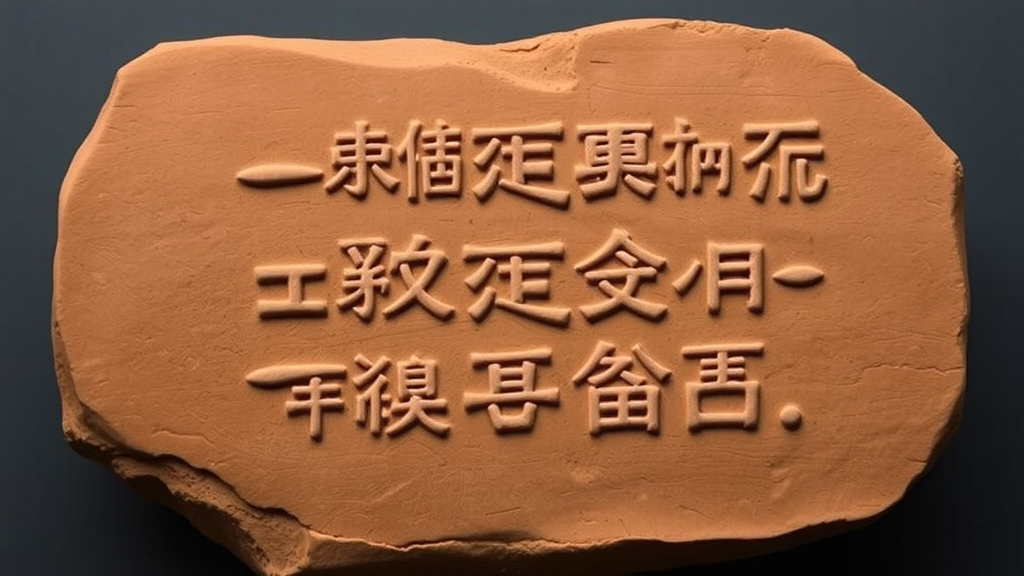
A humble block of fired clay, pulled from a bronze-casting workshop pit at the Guanzhuang site in Henan Province, China, has just settled one of the longest-running debates in Chinese archaeology. For decades, scholars have argued about how the elegant inscriptions on Shang and Zhou dynasty bronze vessels were actually produced. The vessels themselves could only tell part of the story, because the finished inscriptions showed no obvious tool marks that pointed decisively to any single technique. Now, a team led by researchers at Zhengzhou University and Shandong University has reported the discovery of six fragments of an inscribed clay mold block that could be physically reassembled, and the evidence preserved on its surface is unambiguous.
The fragments came from pit H1573, part of a bronze workshop dating to the Early Spring and Autumn period at Guanzhuang, a walled site in Xingyang that has been under excavation for years. When the researchers fitted the pieces back together, they found something extraordinary: the character strokes on the same surface displayed both convex and concave profiles. That seemingly small detail is the smoking gun. It shows that the craftsman first carved recessed, concave characters into a leather-hard clay block and then pressed fine clay strips into those grooves, building up raised, convex characters on top. This two-step process, known in the literature as the modeling method or clay-strip technique, had long been hypothesized but never directly demonstrated from an excavated artifact.
The analytical work behind this conclusion is as important as the discovery itself. Because the mold fragments are precious and fragile, the team relied entirely on non-destructive methods. Super-depth-of-field microscopy allowed them to examine the three-dimensional profiles of individual strokes at high magnification, revealing the telltale combination of sunken grooves and raised ridges within single characters. Confocal laser scanning microscopy provided precise topographic maps of the surfaces, quantifying the depth and height of the features. Micro-computed tomography, or Micro-CT, peered inside the clay block without cutting it, imaging the internal structure of the inlaid strips and their relationship to the carved grooves beneath them. Together, these techniques built a virtual reconstruction of the craftsman’s actions more than two and a half thousand years ago.
To understand why this matters, one has to appreciate how Chinese ritual bronzes were made. Unlike the lost-wax casting common in the ancient Near East and Mediterranean, early Chinese founders used the piece-mold method: a clay model of the vessel was sculpted, molds were formed around it in sections, and the model was trimmed down to serve as the core around which the molten bronze would be poured. The decoration on the finished vessel was essentially the negative of what had been worked on the mold surfaces. Inscriptions, however, posed a special problem, because the raised characters that appear on many bronzes had to be created as recesses or reliefs on the appropriate mold or core surfaces, and the logical chain of steps was far from obvious.
Scholars proposed several competing theories over the twentieth century. Some argued that inscriptions were carved directly into the clay molds or cores with knives, working from the finished vessels backward. Others suggested that characters were formed separately and attached, either as pre-cut clay pieces glued onto the mold surface or as raised modeling of fresh clay. Japanese and Chinese researchers, including influential studies by Hayashi Michitaro and later synthetic work by scholars such as Li Feng, debated whether the long, flowing inscriptions of the Western Zhou period, with their distinctive raised outlines and occasional guide ridges, could plausibly have been carved directly or must have been built up by hand. Without surviving intermediates, the argument risked circling forever. As the new study emphasizes, reconstructing ancient craft processes ultimately demands direct archaeological evidence rather than inference from finished products alone.
The Guanzhuang block delivers exactly that evidence, and it comes with an architectural surprise: the reassembled block appears to be an independent insert, designed to be embedded into the core of the mold assembly rather than being an integral part of the core surface itself. This modularity aligns with a broader pattern in Chinese bronze production, where standardized modules and reusable components appear in decoration as well as text. It means that the founder could prepare the inscription separately, on a convenient flat block, and then set it into the core, a workflow that both simplified the work and explains some of the peculiarities seen on surviving vessels.
Crucially, the Guanzhuang find does not stand alone. It corroborates technological practices suggested by earlier discoveries at two other major foundry sites. At Xiaomintun in Anyang, the great Late Shang bronze-casting district associated with the capital at Yinxu, excavations uncovered mold fragments bearing evidence consistent with inscribed inserts. At Luoyang Beiyao, a Western Zhou foundry excavated in the 1970s, similar indications of clay-strip work were recorded. Taken together, the three finds trace a continuous technological tradition: the modeling method was in use from the Late Shang period, through the Western Zhou, and into the Eastern Zhou, surviving at least until the Early Spring and Autumn period represented at Guanzhuang. What had been a patchwork of hints now reads as a coherent, long-lived craft practice.
The implications reach beyond technology into the history of writing itself. Bronze inscriptions, or jinwen, are among the most important sources for early Chinese history, recording royal grants, lineages, military campaigns, and legal transactions. The famous Da Ke Ding, with its hundreds of characters, has been a touchstone in the debate precisely because its long, neat, raised inscription seemed hard to explain by direct carving. Studies arguing for the prevalence of the clay-strip technique in the mid to late Western Zhou now gain physical confirmation of the underlying method. Knowing how the characters were formed also informs how epigraphers interpret stroke morphology, joins, and occasional flaws in cast inscriptions, and it clarifies the division of labor within foundries, where a specialist might prepare text blocks that other workers integrated into complex mold assemblies.
The discovery also highlights the value of revisiting workshop contexts with modern instrumentation. Molds and cores are made of fired clay, materials that rarely survive intact and that are easy to overlook among the mass of kiln waste and debris at foundry sites. Reassembling fragmented mold blocks is painstaking work, and the convex-plus-concave signature at Guanzhuang might have been dismissed as damage or wear without microscopic and tomographic scrutiny. The study’s authors, including Xiping Hui, Qingzhu Wang, Sicong Ding, Xiangping Gao, Siran Liu, and Guohe Han, combined field archaeology with laboratory science, and their reconstruction of the pit’s contents, the block’s assembly, and the internal structure of the inlaid strips forms a mutually reinforcing body of evidence.
For the archaeology of ancient China, the Guanzhuang inscribed clay mold block resolves key uncertainties about how Shang and Zhou bronze inscriptions were cast, and it does so in the most persuasive way possible: with the craftsman’s own handiwork still preserved in the clay. It confirms the continuity of a sophisticated technique across roughly a millennium of bronze production, demonstrates the modular thinking of early Chinese founders, and underscores a methodological lesson that resonates far beyond this single pit.finished products can mislead; the processes that made them leave traces only in the workshop. Where those traces survive, modern imaging can read them, stroke by stroke, and turn century-old hypotheses into settled knowledge.
Subject of Research: The casting technique of inscriptions on Shang and Zhou dynasty bronze vessels, based on an inscribed clay mold block from Guanzhuang
Article Title: The casting of inscriptions on Shang and Zhou bronzes: new evidence from an inscribed clay mold block discovered at Guanzhuang
Article References: Hui, X., Wang, Q., Ding, S., Gao, X., Liu, S., & Han, G. (2026). The casting of inscriptions on Shang and Zhou bronzes: new evidence from an inscribed clay mold block discovered at Guanzhuang. Archaeological and Anthropological Sciences, 18(10), Article 204. https://doi.org/10.1007/s12520-026-02569-4
Image Credits: AI Generated
DOI: 10.1007/s12520-026-02569-4
Keywords: Guanzhuang, bronze inscriptions, Shang dynasty, Zhou dynasty, piece-mold casting, clay-strip technique, modeling method, Micro-CT, archaeometallurgy, Henan archaeology, Spring and Autumn period, jinwen
Cite Scienmag News
Courtney Benton. (September 24, 2026). Ancient Clay Mold Reveals How Chinese Craftsmen Cast Bronze Inscriptions. Scienmag. https://scienmag.com/ancient-clay-mold-reveals-how-chinese-craftsmen-cast-bronze-inscriptions/
Courtney Benton. "Ancient Clay Mold Reveals How Chinese Craftsmen Cast Bronze Inscriptions." Scienmag, 24 September 2026, https://scienmag.com/ancient-clay-mold-reveals-how-chinese-craftsmen-cast-bronze-inscriptions/. Accessed 4 October 2026.
Courtney Benton. "Ancient Clay Mold Reveals How Chinese Craftsmen Cast Bronze Inscriptions." Scienmag. September 24, 2026. https://scienmag.com/ancient-clay-mold-reveals-how-chinese-craftsmen-cast-bronze-inscriptions/


