


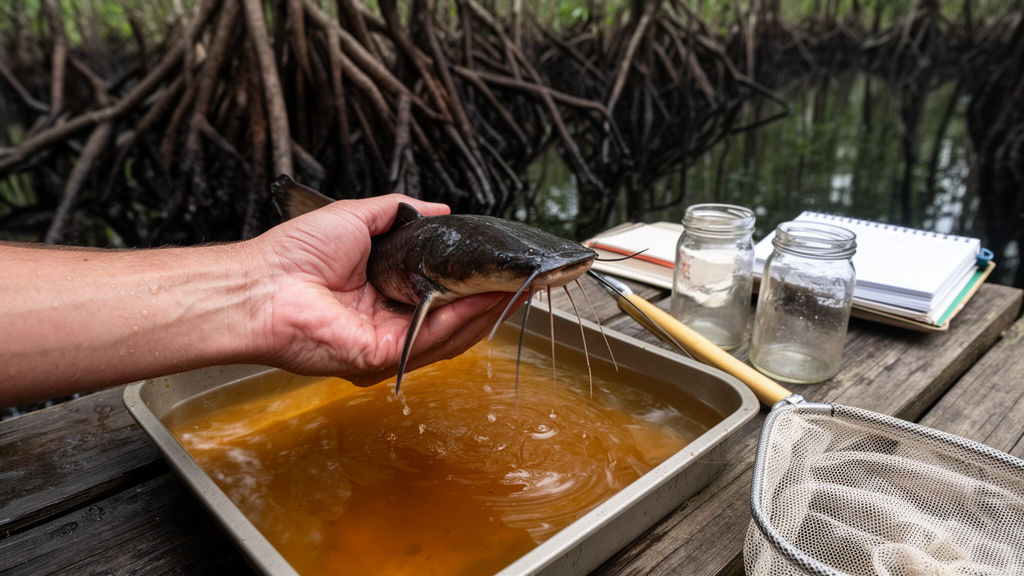
A rare, burrowing catfish from the acidic peat swamps of Southeast Asia has turned out to occupy one of the most surprising positions in its family tree. Using three mitochondrial genes, researchers have shown that the genus Encheloclarias is the sister group to all other clariid catfishes, apart from the enigmatic Indian genus Horaglanis. The split between Encheloclarias and the rest of the family is estimated at a mean of 46.8 million years ago, with a 95% credibility interval running from 50.0 to 41.4 million years, making this little-known lineage far older than its handful of species might suggest.
Encheloclarias was established by Myers in 1937 to reclassify a clariid species originally described as Heterobranchus tapeinopterus by Bleeker in 1853. It is one of only three genera of the family Clariidae, the walking catfishes, found in Asia, alongside Clarias and Horaglanis. The family is otherwise African, where it reaches its greatest generic diversity with 14 genera, including Clarias, which occurs on both continents.
Six valid species of Encheloclarias are currently recognized, most known from only a few specimens, which points to their possible rarity. The smallest species, Encheloclarias baculum, reaches a reported maximum standard length of 5.7 centimeters, while the largest, Encheloclarias velatus, reaches 16.9 centimeters. These fishes inhabit acidic peat swamp habitats in Malaysia, Singapore, Indonesia, and Brunei, where they burrow into the peat soil layer.
Despite their ecological distinctiveness, information on their biology, morphology, and especially their osteology has remained limited, and their phylogenetic position was, until now, virtually unknown. Within the family, Encheloclarias possesses an adipose fin, a feature it shares with only a few African taxa such as Heterobranchus, Dinotopterus, and the species Clarias ngamensis. Although these fins look similar externally, their structure differs: in the African taxa the adipose fin is supported by elongated neural spines, whereas in Encheloclarias there is no such osteological support.
For that reason, the shared presence of the fin had not been considered evidence of a close relationship. Earlier morphology-based work by Teugels and Adriaens in 2003 suggested that Horaglanis and Encheloclarias probably descended independently from Asian Clarias based on zoogeographical evidence. Subsequent phylogenetic studies of clariids, by Devaere and colleagues in 2007 and Pouyaud and colleagues in 2009, did not include Encheloclarias at all.
The absence of phylogenetic information on the genus has limited discussion of the evolution of the family as a whole, including the question of whether the adipose fin in clariids arose once or several times, and whether its presence in Encheloclarias represents the ancestral or a derived condition for the family. To resolve the question, the new study reconstructed the phylogeny of 13 of the 16 clariid genera using three mitochondrial markers: the cytochrome b gene, roughly 600 base pairs long; the cytochrome oxidase subunit I gene, roughly 655 base pairs; and the 16S rRNA gene, roughly 700 base pairs. The researchers newly determined these sequences from three specimens of Encheloclarias curtisoma collected with dipnets from three peat swamp forests in western Peninsular Malaysia: Pondok Tanjung, North Selangor, and Ayer Hitam.
Tissue samples were taken after euthanasia by rapid cooling in ice water, a procedure recommended in the welfare literature, preserved in 95% ethanol, and the specimens were fixed in 10% formalin for two weeks before transfer to 70% ethanol. All three are deposited in the Zoological Reference Laboratory at Universiti Sains Malaysia. The dataset was completed with cytb, COI, and 16S sequences from GenBank and BOLD covering, alongside Encheloclarias curtisoma, 12 further genera and 28 species of Clariidae.
Three African genera, Uegitglanis, Platyclarias, and Xenoclarias, could not be included. The closely related Heteropneustes fossilis, of the family Heteropneustidae, served as a near outgroup, with the more distantly related ariid catfish Occidentarius platypogon as a more distant outgroup. DNA was extracted from fin clips using a modified CTAB method, each gene was amplified separately by PCR with published primer sets, and successful products were purified and sequenced bidirectionally by Sanger technology at a commercial laboratory in Selangor, Malaysia.
The protein-coding genes were aligned by hand without any indels, while the 16S sequences were aligned automatically with MAFFT under default parameters. Separate analyses of each marker first checked for conflicting phylogenetic signals; finding no supported incongruence, the authors combined all three genes into an alignment of 3,107 nucleotide positions. A Maximum Likelihood tree was built with RAxML-NG, treating the data as four partitions, the non-coding 16S gene and the first, second, and third codon positions of the combined cytb and COI genes, with models selected by ModelTest-NG and node support assessed from 1,000 bootstrap replicates.
A time-calibrated Bayesian tree was then inferred under a relaxed molecular clock in BEAST2, with the age of the most recent common ancestor of the Heteropneustidae and Clariidae constrained to 50 million years, corresponding to the maximum age of the oldest known clariid fossil. Two independent MCMC runs of 100 million generations each were performed, and 25% of the resulting trees were discarded as burn-in before computing the maximum credibility consensus tree. The resulting trees place Encheloclarias consistently as the sister group to all other clariid genera, excluding Horaglanis.
The genus Clarias itself proved paraphyletic, with all African genera nested within it. African clariids form a monophyletic group, supported by a bootstrap proportion of 80% and a posterior probability of 1, that is sister to Clarias dussumieri, a South Asian species from the Indian subcontinental region. Other Asian Clarias species form their own monophyletic group, with a bootstrap proportion of 79% and a posterior probability of 1, sister to the clade combining the African clariids and Clarias dussumieri.
The African species with elongated neural spines also form a monophyletic group, supported by a posterior probability of 1. Although roughly 48% of the total dataset consisted of missing data, this neither destabilized the tree topology nor weakened support at the nodes of interest. Horaglanis required special care.
In the full dataset it was recovered outside the Clariidae, as the sister group to a clade comprising the Heteropneustidae and the rest of the Clariidae, a hypothesis consistent with earlier morphology-based proposals. However, Horaglanis showed a much longer branch than any other taxon, reflecting a faster rate of mitochondrial substitution that could mislead phylogenetic inference. Because the genus was not the focus of the study, the authors excluded it from the main analyses, and its removal did not affect the position of Encheloclarias or other relationships.
The time-calibrated analysis further estimated the mean age of the crown group of Encheloclarias curtisoma at 5.1 million years, with a 95% credibility interval of 7.8 to 2.8 million years, though this estimate rests on a single species and the authors note that genetic examination of other Encheloclarias species is needed to date the genus's crown group and thereby determine the minimum timing of its colonization of peat swamps. The findings carry both evolutionary and conservation weight. They reject the two previous hypotheses about the genus's affinities, a close relationship to adipose-finned African taxa or to Asian Clarias, and imply that the adipose fin evolved independently twice in the family, once in Encheloclarias and once in the African lineage, a conclusion reinforced by the different internal structure of the fins.
The early divergence of Encheloclarias also means the possibility that its fin condition represents the ancestral state for the family cannot be dismissed, although phylogeny alone cannot settle the question, since three scenarios for the ancestral fin configuration appear equally parsimonious. The estimated 46.8-million-year split is consistent with the early diversification timeline of the Clariidae proposed by Lundberg and colleagues in 2007 using different calibrations and methods. As an ancient, species-poor lineage confined to acidic peat swamps, Encheloclarias underscores the uniqueness of Southeast Asia's peat swamp fauna, where genetic evidence suggests some lineages adapted to these conditions millions of years ago before diversifying in isolation.
Subject of Research: Phylogenetic position of the Southeast Asian catfish genus Encheloclarias inferred from mitochondrial DNA
Article Title: Mitochondrial evidence on the phylogenetic position of the Southeast Asian catfish genus Encheloclarias Myers, 1937 ( Actinopterygii : Siluriformes : Clariidae ): Evolutionary and conservation implications
Article References: Lavoué, S., Jamaluddin, J. A. F., Muhammad-Rasul, A. H., Ilham-Norhakim, M. L., & Zain, K. M. (2024). Mitochondrial evidence on the phylogenetic position of the Southeast Asian catfish genus Encheloclarias Myers, 1937 (Actinopterygii: Siluriformes: Clariidae): Evolutionary and conservation implications. Acta Ichthyologica et Piscatoria, 54, 235-241. https://doi.org/10.3897/aiep.54.122366
Image Credits: AI Generated
Keywords: Encheloclarias, Clariidae, walking catfish, mitochondrial DNA, phylogenetics, peat swamp forests, adipose fin, Southeast Asia, molecular clock, conservation, taxonomy, Mitochondrial
Cite Scienmag News
Margaret Porter. (October 26, 2026). Ancient catfish lineage from Southeast Asian peat swamps revealed as earliest branch of its family. Scienmag. https://scienmag.com/ancient-catfish-lineage-from-southeast-asian-peat-swamps-revealed-as-earliest-branch-of-its-family/
Margaret Porter. "Ancient catfish lineage from Southeast Asian peat swamps revealed as earliest branch of its family." Scienmag, 26 October 2026, https://scienmag.com/ancient-catfish-lineage-from-southeast-asian-peat-swamps-revealed-as-earliest-branch-of-its-family/. Accessed 26 October 2026.
Margaret Porter. "Ancient catfish lineage from Southeast Asian peat swamps revealed as earliest branch of its family." Scienmag. October 26, 2026. https://scienmag.com/ancient-catfish-lineage-from-southeast-asian-peat-swamps-revealed-as-earliest-branch-of-its-family/


