


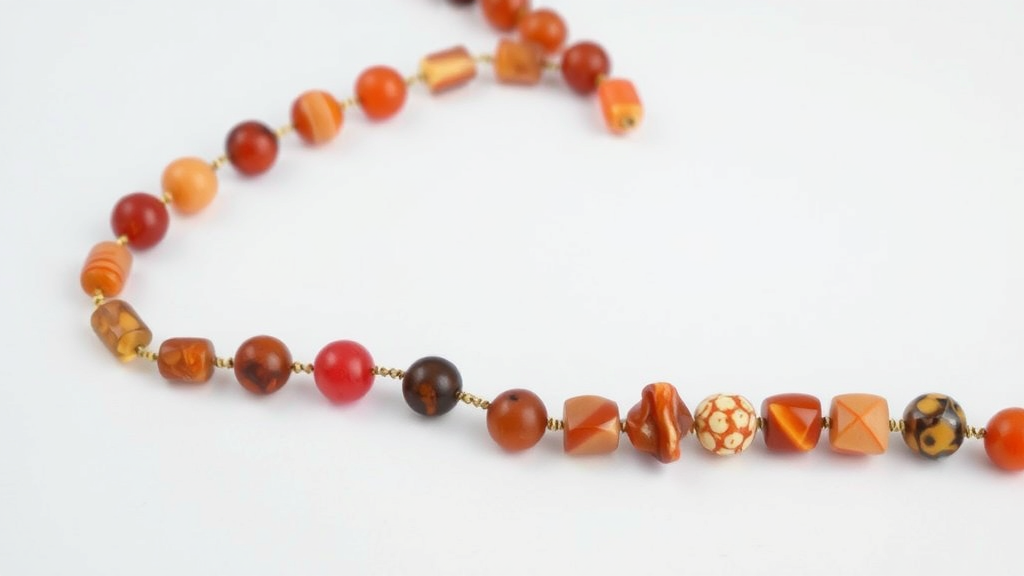
Thousands of years before Thailand became famous for its gem trade, small orange-red carnelian beads were buried with the dead at settlements in the Lopburi region of Central Thailand. Where those beads came from has been debated for decades, because carnelian, a reddish variety of chalcedony, can in principle be found in many parts of Asia, and the region itself hosts local deposits. A new study published in Archaeological and Anthropological Sciences takes on that question with a combination of high-precision chemistry and detailed analysis of manufacturing traces, and its answer is striking: none of the carnelian beads recovered from the Iron Age sites of Tha Kae and Noen Din were made from the stone that lies, geologically speaking, in the region’s own backyard.
The research team, led by Wannaporn Rienjang of Thammasat University together with colleagues including Fiorella Rispoli, Jonathan Mark Kenoyer, Randall W. Law, Montira Seneewong Na Ayutthaya, Akkaranai Kwanyou and Abhisit Salam, examined beads from Iron Age layers at the two sites, which date to a period spanning roughly the fifth century BCE to the fifth century CE. Their approach combined two complementary lines of evidence. The first is geochemical: using Laser Ablation Inductively Coupled Plasma Mass Spectrometry, or LA-ICP-MS, the researchers sampled the trace-element fingerprint of each bead and compared it with reference geological sources. The second is technological: systematic documentation of bead shapes, drilling methods and surface features reveals which workshop traditions produced them, because different craft communities used recognisable techniques that persist through time.
LA-ICP-MS works by directing a focused laser at a microscopic spot on the artefact, vaporising a tiny amount of material that is then swept into a mass spectrometer. The instrument measures the relative abundances of dozens of elements, many present only at parts-per-billion levels. Because carnelian deposits formed under different geological conditions absorb different suites of trace impurities, these chemical profiles can act like fingerprints distinguishing, for example, carnelian from the massive volcanic floods of the Indian Deccan Traps from material found in Thailand’s own Lopburi deposits. Crucially, the method is close to non-destructive: the ablation craters are so small they are invisible to the naked eye, making it suitable for museum-quality artefacts and grave goods alike.
The geochemical results were unambiguous on one central point. Not a single bead in the assemblage matched the composition of the local Lopburi carnelian, despite the fact that this material was available to the ancient inhabitants of the region. This finding effectively closes a long-running debate in Southeast Asian archaeology. Earlier scholars had questioned whether the agate and carnelian beads appearing across Iron Age Southeast Asia really were imports, suggesting instead that local craftsmen might have exploited nearby raw materials and imitated foreign styles. The new chemical evidence from Tha Kae and Noen Din shows that, at least in Central Thailand, the raw stones themselves arrived from elsewhere, carrying their geological identity with them across the sea.
Where exactly they came from depends on the layer in which the beads were found. All of the beads recovered from the earlier Iron Age contexts were geologically sourced to the Deccan Traps, the enormous province of layered volcanic rock covering much of western and central India, which hosts some of South Asia’s most famous carnelian sources, including those worked for millennia by the bead-making specialists of Khambhat in Gujarat. Combined with the team’s technological observations, the picture for the earlier Iron Age is remarkably coherent: the shapes and manufacturing techniques of these beads are South Asian, the stones are South Asian, and the trade in carnelian ornaments in the Lopburi region at this time appears to have been primarily tied to direct or indirect interactions with the Indian subcontinent.
The later part of the sequence tells a different and perhaps more intriguing story. Beads from the Proto-Dvaravati layer, the transitional period preceding the emergence of the early historic Dvaravati civilisation of Central Thailand, appear to have been produced from carnelian sourced outside the Deccan Traps. In other words, by this later phase the supply network had diversified. The study argues that the Proto-Dvaravati carnelian trade expanded to encompass more varied regions, some of which may have had only direct or indirect connections with South Asia. Rather than a single pipeline from the Deccan, the Lopburi elite were now drawing on a broader and more tangled web of exchange routes, potentially involving intermediate nodes across maritime Southeast Asia, where Indian-style bead industries had taken root at port settlements and manufacturing centres.
The technological side of the study involved recording bead morphology and drilling techniques with methods including scanning electron microscopy, which can resolve the microscopic striations left by different drilling tools. Drilling technology is a powerful indicator of workshop tradition because it is learned through apprenticeship and resists stylistic fashion. A bead drilled with a diamond-tipped drill, or with a copper or stone drill of a particular taper and speed profile, bears internal marks that trained analysts can distinguish, in much the same way that a firearms examiner reads rifling marks. Together with overall bead shape and the techniques used for shaping and polishing, these traces allow researchers to assign artefacts to production traditions even when the raw material itself has been traded far from home.
Why did Iron Age communities in Central Thailand prize these imports so highly? The authors argue that throughout both the earlier Iron Age and the Proto-Dvaravati periods, emerging local elites appear to have exerted control over the carnelian bead trade, using beads that contained foreign elements, foreign raw materials, foreign technologies and foreign shapes, as symbols of power and status. This fits a wider pattern in Iron Age Southeast Asia, where exotic ornaments made of carnelian, agate, glass and gold are concentrated in rich burials and are widely read as markers of rising social hierarchy. A carnelian bead was not merely decoration; it was proof of connection to distant networks, encoded in a material whose origin could be neither verified nor replicated locally. Controlling access to such objects was a way of controlling prestige itself.
The Tha Kae and Noen Din assemblages are particularly valuable for tracing this shift because the two sites were excavated within the Thai-Italian Lopburi Regional Archaeological Project, which established a well-controlled stratigraphy and chronological sequence for the region, linking the local Iron Age to the better-known cultures of Northeast Thailand and the Mun Valley. Tha Kae, though its deposits have suffered from post-depositional disturbance in the monsoonal tropical environment, yielded grave goods from dated burial phases, while Noen Din contributed beads whose technological features have already reshaped understanding of stone bead drilling in Iron Age Southeast Asia. Anchoring the beads in secure layers allowed the researchers to compare early and late trade patterns within a single region, a comparison rarely possible in island Southeast Asia where many beads surfaced through unstratified contexts.
The study also demonstrates how methodological advances continue to transform archaeology’s ability to read ancient globalisation. Trace-element sourcing by LA-ICP-MS has now been applied to carnelian beads from Mesopotamia, East Africa, Mongolia, Nubia and early China, building a growing reference framework against which Southeast Asian finds can be compared. Each new assemblage adds to that comparative database, sharpening the resolution with which ancient exchange routes can be mapped. For Central Thailand, the message of the orange beads is that the region was plugged into Indian Ocean exchange from the very beginning of its Iron Age, and that as the Proto-Dvaravati era dawned, its elites were not passive recipients but active players who broadened their sources, monopolised the flow of exotic goods and turned a handful of imported red stones into the visible currency of political power.
Subject of Research: Geochemical and technological provenance analysis of Iron Age carnelian beads from Central Thailand
Article Title: Investigating the origins of carnelian beads from Tha Kae and Noen Din, Central Thailand
Article References: Rienjang, W., Rispoli, F., Kenoyer, J. M., Seneewong Na Ayutthaya, M., Kwanyou, A., Law, R. W., & Salam, A. (2026). Investigating the origins of carnelian beads from Tha Kae and Noen Din, Central Thailand. Archaeological and Anthropological Sciences, 18(10), Article 207. https://doi.org/10.1007/s12520-026-02557-8
Image Credits: AI Generated
DOI: 10.1007/s12520-026-02557-8
Keywords: carnelian beads, Thailand, Iron Age, LA-ICP-MS, Deccan Traps, Proto-Dvaravati, South Asia trade, Tha Kae, Noen Din, bead manufacturing techniques, archaeometry, ancient exchange networks
Cite Scienmag News
Courtney Benton. (September 26, 2026). Ancient Carnelian Beads in Thailand Traced to Indian Deccan Traps by Laser Geochemistry. Scienmag. https://scienmag.com/ancient-carnelian-beads-in-thailand-traced-to-indian-deccan-traps-by-laser-geochemistry/
Courtney Benton. "Ancient Carnelian Beads in Thailand Traced to Indian Deccan Traps by Laser Geochemistry." Scienmag, 26 September 2026, https://scienmag.com/ancient-carnelian-beads-in-thailand-traced-to-indian-deccan-traps-by-laser-geochemistry/. Accessed 4 October 2026.
Courtney Benton. "Ancient Carnelian Beads in Thailand Traced to Indian Deccan Traps by Laser Geochemistry." Scienmag. September 26, 2026. https://scienmag.com/ancient-carnelian-beads-in-thailand-traced-to-indian-deccan-traps-by-laser-geochemistry/


