


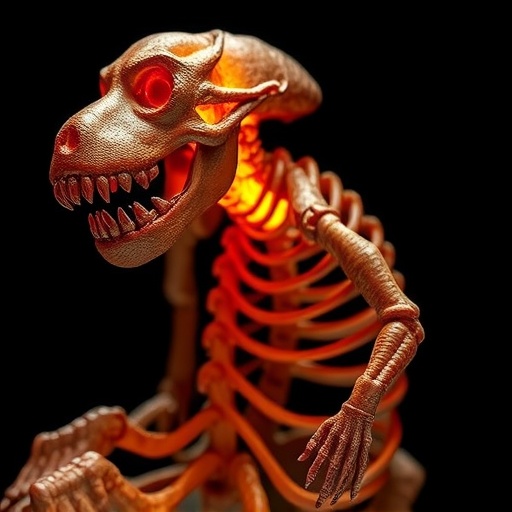
The ancient rhythms of life echo through the fossil record in astonishing ways. Recently, a groundbreaking discovery has brought to light the oldest known evidence of a sophisticated breathing mechanism among amniotes, a group comprising reptiles, birds, mammals, and all their terrestrial ancestors. Unearthed in an Oklahoma cave system, a 289-million-year-old mummified specimen of the reptile Captorhinus aguti provides unparalleled insight into the evolutionary development of costal (rib) breathing — a mechanism fundamental to the rise and diversification of terrestrial vertebrates.
The fossil, impeccably preserved in three dimensions, contains not only the skeleton but also remnants of skin, calcified cartilage, and remarkably, original protein molecules. Such preservation is exceptionally rare for fossils dating back to the early Permian period, making this find a veritable time capsule capturing the biology and soft tissues of an ancient creature. This research, recently published in Nature, delineates the morphology of Captorhinus’ breathing apparatus and underscores its significance as the earliest known example of rib-driven respiration in amniotes, predating previous records by nearly 100 million years.
The evolutionary innovation encapsulated by Captorhinus marks a pivot from the fundamentally distinct respiratory strategy of contemporary amphibians. Unlike amphibians, which rely heavily on cutaneous respiration and buccal pumping to ventilate their lungs, early amniotes developed a musculoskeletal system that allowed them to actively aspirate air into their lungs via expansion and contraction of the ribcage. This costal aspiration breathing supported more vigorous metabolic demands associated with a fully terrestrial life, facilitating expanded activity levels and ecological diversification.
This breakthrough was made possible in part by the unique depositional environment of the Richards Spur cave system in Oklahoma. Rich in late Paleozoic fauna, this locality is renowned for its dark, oxygen-poor mud deposits saturated with hydrocarbons from natural oil seeps. These conditions effectively arrested decomposition, enabling delicate tissues such as skin and cartilage to fossilize in three dimensions, preserving their fine texture and minute anatomical detail—a rarity seldom observed in fossils beyond the Mesozoic.
Employing cutting-edge neutron computed tomography (nCT) at an advanced Australian facility, the researchers non-invasively visualized the fossil’s internal structures in exquisite detail. Such imaging revealed a previously invisible network of segmented cartilaginous sternum components, sternal ribs, and intermediate ribs interconnected with the pectoral girdle, forming an articulated apparatus directly implicated in costal breathing. This represents the earliest anatomical reconstruction of the amniote respiratory system with this level of completeness and fidelity.
Detailed study of the mummified skin uncovered an intricate patterning of scales, exhibiting accordion-like folds with concentric banding around the torso and neck. This integumentary configuration shares striking similarities with extant worm lizards (amphisbaenians), indicating convergent evolutionary adaptations to burrowing or low-oxygen microhabitats. The three-dimensional preservation of skin texture and calcified cartilage not only illuminates the external morphology of early reptiles but provides crucial clues about their lifestyles and physiological capacities.
The breathing mechanism preserved in Captorhinus signifies a critical point in vertebrate evolution. Early amphibians’ reliance on cutaneous respiration and buccal pumping placed limitations on their metabolic rates and active capacities. In contrast, the costal aspiration system seen in Captorhinus allowed for more efficient ventilation of the lungs, thereby enabling greater oxygen intake and carbon dioxide expulsion. This evolutionary leap is a cornerstone that paved the way for the vast radiation of reptiles into diverse ecological niches during the Permian and beyond.
Moreover, this discovery has profound implications for our understanding of the ancestral condition of amniote respiration. According to co-author Professor Robert Reisz, the rib-involved breathing system apparent in Captorhinus likely represents the primitive configuration from which modern reptiles, birds, and mammals derive their respiratory strategies. The evolutionary establishment of thoracic musculature dedicated to breathing unlocked new potential for locomotion, endurance, and metabolic diversification critical to terrestrial dominance.
One of the most stunning revelations from this research lies in the preservation of molecular remnants within the fossil. Using synchrotron infrared spectroscopy, the team detected residual proteins in the bone, cartilage, and skin matrices. These organic molecules, remarkably intact after nearly 290 million years, shatter previous assumptions about the upper limits of soft tissue fossilization. Prior to this, the oldest confirmed protein remains were linked to dinosaur fossils some 190 million years old. This finding not only transforms the boundaries of molecular paleontology but also opens novel avenues for probing early life biochemistry.
The significance of these molecular remnants extends beyond mere preservation. They offer an opportunity to delve into the molecular architecture and evolutionary modifications of early amniote tissues. Such data, combined with anatomical insights, can inform models of physiological function, developmental biology, and evolutionary pressures shaping vertebrate respiratory systems across deep time.
Following their excavation and study, the Captorhinus fossils have been curated by the Royal Ontario Museum in Toronto, ensuring their availability for ongoing and future scientific inquiry. Lead researcher Ethan Mooney, now pursuing doctoral studies at Harvard University, continues to unravel the complexities of early reptilian evolution. His work exemplifies the integration of paleontological fieldwork, advanced imaging techniques, and molecular analysis crucial for illuminating the deep history of vertebrate life on Earth.
The ramifications of this discovery resonate not only within the field of paleontology but also across evolutionary biology, functional anatomy, and earth history. It illuminates a transformative evolutionary moment when vertebrates mastered more efficient respiratory mechanics, setting the stage for their proliferation and adaptive radiation on land. This narrative underscores how the fossil record, when coupled with modern technological tools, continues to rewrite our understanding of ancient life in vivid and unexpected ways.
The mummified Captorhinus specimen, frozen in its death pose with its arm tucked beneath its body, invites us to reconsider the physiological sophistication of early amniotes and appreciate the evolutionary innovations that underpin the biological vitality we observe today. From the texture of its scaly skin to the delicate architecture of its ribcage, this ancient reptile stands as a testament to nature’s ingenuity and resilience through deep time.
News Publication Date: 8-Apr-2026
Web References:
- Nature Article: https://www.nature.com/articles/s41586-026-10307-y
- DOI: http://dx.doi.org/10.1038/s41586-026-10307-y
Cite Scienmag News
Gavin Prescott. (April 8, 2026). Ancient Breath Unveiled: 300-Million-Year-Old Mummy Sheds Light on the Origins of Amniote Respiration. Scienmag. https://scienmag.com/ancient-breath-unveiled-300-million-year-old-mummy-sheds-light-on-the-origins-of-amniote-respiration/
Gavin Prescott. "Ancient Breath Unveiled: 300-Million-Year-Old Mummy Sheds Light on the Origins of Amniote Respiration." Scienmag, 8 April 2026, https://scienmag.com/ancient-breath-unveiled-300-million-year-old-mummy-sheds-light-on-the-origins-of-amniote-respiration/. Accessed 4 September 2026.
Gavin Prescott. "Ancient Breath Unveiled: 300-Million-Year-Old Mummy Sheds Light on the Origins of Amniote Respiration." Scienmag. April 8, 2026. https://scienmag.com/ancient-breath-unveiled-300-million-year-old-mummy-sheds-light-on-the-origins-of-amniote-respiration/


