


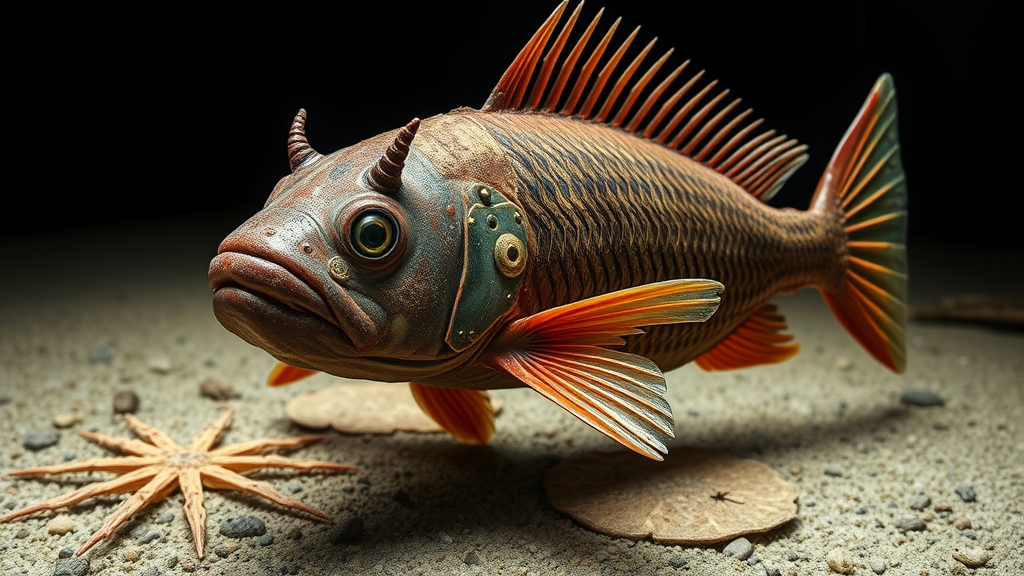
More than 400 million years before the first dinosaurs stalked the Earth, the oceans of ancient Australia were ruled by a group of heavily armoured fish that would change the course of vertebrate history forever. These creatures, known as placoderms, were the first vertebrates to evolve jaws and teeth, and a new study has revealed just how experimentally diverse those pioneering jaws really were. Researchers at Flinders University have used a powerful new combination of computer modelling and three-dimensional analysis to reconstruct how eight different placoderm species caught and processed their prey on a tropical reef that once covered what is now northern Western Australia. Their findings, published in Scientific Reports, show that these early jawed fish did not follow a single evolutionary blueprint when it came to eating hard-shelled food. Instead, they arrived at two remarkably different solutions to the same biological problem, and the difference appears to hinge on one crucial factor: the size of the prey relative to the predator.
The placoderms in question lived around 385 million years ago during the Devonian Period, often called the Age of Fishes, in the rich marine ecosystems of the famous Gogo Formation in Western Australia. This world-renowned fossil site has been the focus of decades of research, including long-running collaborations with the local Gooniyandi and Gogo community, and has yielded some of the most exquisitely preserved three-dimensional fish fossils ever discovered. It was here that these armoured predators hunted other armoured creatures on an exotic ancient reef, and it is here that the fossil evidence for their feeding strategies has been locked away in stone, waiting for modern technology to unlock it.
Dr Alice Clement, an ARC Future Fellow at the Flinders Palaeontology Lab and a co-author of the study, explains that placoderms present an extraordinary natural experiment in the early evolution of biting. Placoderms experimented with an extraordinary range of jaw shapes and biting parts during the early evolution of vertebrates, she notes, providing a rare opportunity to understand how some of the first jaws became specialised for different diets. Unlike most animals alive today, including humans, placoderms did not possess a single lower jaw bone. Instead, their jaws were built from paired bony plates supported by cartilage, with biting surfaces that ranged from broad, flat crushing plates to sharp slicing edges armed with tooth-like structures. This anatomical diversity makes them ideal subjects for investigating how jaws first became adapted to different kinds of food.
To probe that diversity, the research team employed a technique borrowed from engineering known as finite element analysis. First author Dr Rex Mitchell, of the College of Science and Engineering at Flinders University, together with colleagues, created digital three-dimensional models of the fossil jaw bones and then performed computer-based bite simulations on them. These simulations measure how well each jaw structure could withstand and support the forces generated during biting, effectively stress-testing extinct animals in silico. The team then compared the mechanical performance of each jaw with the anatomical complexity of its biting surface, looking for patterns that might connect jaw shape to diet and feeding behaviour across the eight species they examined.
Conventional wisdom in biomechanics holds that animals feeding on hard foods, such as shells and bone, generally evolve stronger jaws with broader, flatter crushing surfaces, much like the nutcracker jaws of modern hyenas or the durophagous dentitions of many rays and wrasses. That is not exactly what the analysis revealed. Rather than finding a simple, predictable relationship between jaw strength and surface shape, the researchers discovered something unexpected: both the largest and the smallest placoderms in the study possessed the strongest jaws for handling hard bites, despite using completely different biting tools. The smallest species had broad, almost featureless crushing plates, while the largest species carried highly complex, elevated dental surfaces that bore little resemblance to their diminutive relatives.
It was an interesting surprise, says PhD student and co-author Austin Fitzpatrick. Both the smallest and largest animals had evolved strong jaws, he explains, but they had solved the problem of processing harder foods in completely different ways. The key to this paradox, the researchers suggest, lies in the relationship between predator and prey body size when the prey in question is wrapped in tough exterior armour. A small placoderm confronting a small armoured prey item did not need to break it apart at all. The prey could simply be engulfed whole and then pulverised between broad, flat biting plates, much as some modern fish swallow and crush small shelled invertebrates. Strength was essential, but anatomical complexity was not.
Larger prey presented an entirely different challenge. An armoured animal too big to fit inside a predator’s mouth first had to be broken into manageable pieces before it could be eaten. That requirement demanded more elaborate dental architecture, capable of first piercing through shell or armour before crushing the remains. The largest species in the study possessed teeth arranged along a raised bony crest, forming a structure that the researchers describe as strikingly similar to the heads of medieval armour-piercing weapons such as war hammers and poleaxes. This fearsome configuration suggests the fish used its jaws to puncture the protective coverings of its prey before breaking them apart, functioning less like a nutcracker and more like a can opener followed by a hammer.
The broader significance of the finding is that hard-object feeding among Earth’s earliest jawed vertebrates was not achieved through a single evolutionary solution. Evolution, in other words, produced a diversity of jaw designs that allowed different placoderm species to exploit different prey within the same ancient reef ecosystem, a pattern ecologists call niche separation. Two species could both be powerful biters specialised for hard-shelled food, yet occupy genuinely different ecological roles depending on what they could fit in their mouths and how they had to dismantle it. This paints a picture of the Devonian reef as a complex, ecologically structured environment in which early vertebrates were already carving out specialised feeding niches hundreds of millions of years before the first tetrapods crawled onto land.
The study also reinforces the central place of placoderms in the story of human evolution. Flinders Emeritus Professor John Long, a co-author who has worked at the Western Australian fossil site for 40 years and found some of the specimens used in this study, emphasises that since 2013 placoderms have been directly linked to our own lineage as the starting point of the line leading from fishes to humans. Understanding placoderms, he argues, is now vital to revealing the origins of the human body plan. Their jaws, in particular, represent the evolutionary foundation upon which all later vertebrate mouths, from shark snouts to human faces, were ultimately built, making every new insight into how these structures functioned a contribution to a deeply personal chapter of natural history.
Technically, the study demonstrates the growing power of combining finite element analysis with comparative three-dimensional morphology to answer ecological questions that fossils alone cannot resolve. By measuring jaw strength numerically and then mapping it against surface complexity, the team could infer not only what these extinct fish ate but also how large their prey must have been relative to their own bodies, turning bite mechanics into a proxy for ancient food webs. The work, supported by the Australian Research Council through Discovery Projects funding, contributes to a growing picture of niche separation and ecological specialisation in the ancient Devonian reef. It shows that within a few tens of millions of years of jaws first appearing, vertebrates had already diversified into an impressive array of feeding specialists, from whole-swallowing crushers to armour-piercing giants, foreshadowing the extraordinary ecological breadth of jawed vertebrates that continues to this day.
Subject of Research: Feeding mechanics and jaw evolution in Devonian placoderms from the Gogo Formation, Western Australia
Article Title: Jaws tell tales: How ancient armoured fish munched prey whole
Article References: Jaws tell tales: How ancient armoured fish munched prey whole. (n.d.). Original publication
Image Credits: AI Generated
DOI: Not provided
Keywords: placoderms, Devonian, Gogo Formation, jaw evolution, finite element analysis, hard-object feeding, palaeontology, Flinders University, vertebrate evolution, fossil fish, predator-prey relationships, ancient reefs
Cite Scienmag News
Gavin Prescott. (September 12, 2026). Ancient Armoured Fish Evolved Two Surprising Ways to Crush Their Prey. Scienmag. https://scienmag.com/ancient-armoured-fish-evolved-two-surprising-ways-to-crush-their-prey/
Gavin Prescott. "Ancient Armoured Fish Evolved Two Surprising Ways to Crush Their Prey." Scienmag, 12 September 2026, https://scienmag.com/ancient-armoured-fish-evolved-two-surprising-ways-to-crush-their-prey/. Accessed 4 October 2026.
Gavin Prescott. "Ancient Armoured Fish Evolved Two Surprising Ways to Crush Their Prey." Scienmag. September 12, 2026. https://scienmag.com/ancient-armoured-fish-evolved-two-surprising-ways-to-crush-their-prey/


